Botticelli
Henry Bryan Binns
THE CLASSIC COLLECTION · 1905
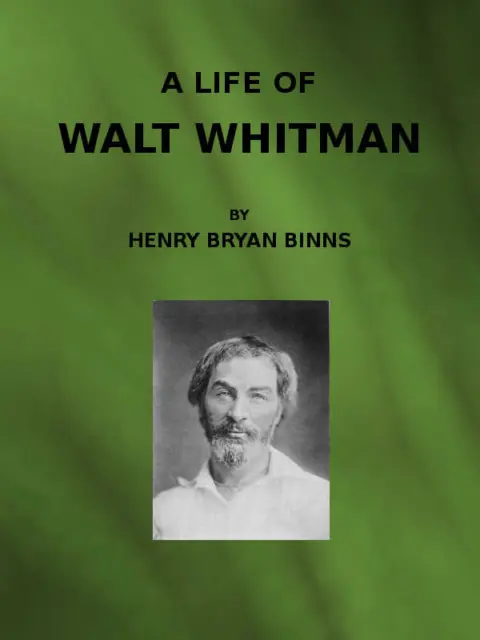
"A Life of Walt Whitman" by Henry Bryan Binns is a biographical study written in the early 20th century. This work delves into the life of the iconic American poet Walt Whitman, exploring his upbringing, his influences, and the context of his literary contributions. It seeks to provide insights into Whitman's character and the philosophy that shaped his poetry without claiming to be a definitive biography. The opening of the narrative introduces Binns's intent to create a personal interpretation of Whitman's life from an English perspective, setting the stage for a comprehensive examination of the poet's complexities. The preface outlines his consideration of Whitman's American roots and hints at the various influences—both personal and historical—on Whitman throughout his life. He acknowledges the challenge of accurately capturing Whitman's essence, arguing that a full understanding requires a grasp of the poet's relationship with his time and his country. Near the beginning, Binns expresses gratitude toward those who aided in the creation of this book and gives an overview of the sources he's drawn from, suggesting a thoughtful and well-researched approach to Whitman's life story.
Introduction adapted from the source catalogue; source summaries may be automatically generated.
Free to read · English · 149,520 words · No account needed
MAKE TIME FOR A GOOD BOOK
On by default. Untick to stop anonymous reading totals. Each page counts after 10 seconds in view. How this works.
Anonymous counting is on unless you have switched it off.
Instead, he turned once more to add new poems to his collection. A hint in explanation is to be found in a poem written about this time,[237] in which he tells how, having first sought knowledge, he then determined to live for America and become her orator; he was afterwards possessed by the desire for a heroic life of action, but was given the commission of song. Finally, another change came over his spirit; the claims of his own life seized him; he could not escape from the passion of comradeship which overwhelmed him and wholly absorbed his thought.[238] We shall consider this phase in the next chapter, but before doing so, it will be well to recall the political events of the hour and the circumstances surrounding the advent of a new power and personality into American life.
[202] M. D. Conway, Autobiography.
[203] Fort. Rev., vi., 538; Kennedy, 51.
[204] In re, 36.
[205] See Familiar Letters of H. D. Thoreau, 339-349.
[206] F. B. Sanborn's Thoreau, 307; cf. H. S. Salt's Thoreau, 293.
[207] Fam. Letters, 347.
[208] Camden, lxxii.; cf. Life of A. Tennyson, ii., 424.
[209] A new translation of the great Indian classic had just appeared.
[210] Kennedy, 78.
[211] L. of G., 112, 120.
[212] L. of G., 176.
[213] L. of G. (1860), 329; cf. An American Primer, by W. W.
(1904).
[214] L. of G., 179.
[215] L. of G., 177.
[216] Ib., 120.
[217] L. of G., 129.
[218] Ib., 207; ('60), 229-31.
[219] See also p. 166.
[220] L. of G., 285.
[221] Ib., 148.
[222] L. of G., 264.
[223] Ib. (1860), 121.
[224] L. of G. (1860), 166.
[225] Ib., 171-74; cf. L. of G., 213.
[226] L. of G. (1860), 172.
[227] See esp. the Life of Susan B. Anthony.
[228] L. of G., 88.
[229] L. of G., 90.
[230] Ib. (1856).
[231] Bucke, 139.
[232] Burroughs, 19.
[233] Camden, vii.; viii., 244-260; ix., 200; x., 32.
[234] In re, 35.
[235] Camden, ix., 7, 8.
[236] Ib., viii., 245.
[237] L. of G. (1860), 354.
[238] As the poem is not given in the complete L. of G. I reprint it
here:--
Long I thought that knowledge alone would suffice me--O if I could but obtain knowledge! Then my lands engrossed me--Lands of the prairies, Ohio's land, the southern savannas, engrossed me--For them I would live--I would be their orator; Then I met the examples of old and new heroes--I heard of warriors, sailors, and all dauntless persons--And it seemed to me that I too had it in me to be as dauntless as any--and would be so; And then, to enclose all, it came to me to strike up the songs of the New World--And then I believed my life must be spent in singing; But now take notice, land of the prairies, land of the south savannas, Ohio's land, Take notice, you Kanuck woods--and you Lake Huron--and all that with you roll toward Niagara--and you Niagara also, And you, Californian mountains--That you each and all find somebody else to be your singer of songs, For I can be your singer of songs no longer--One who loves me is jealous of me, and withdraws me from all but love, With the rest I dispense--I sever from what I thought would suffice me, for it does not--it is now empty and tasteless to me, I heed knowledge, and the grandeur of The States, and the example of heroes, no more, I am indifferent to my own songs--I will go with him I love, It is to be enough for us that we are together--We never separate again.
Your reading position is saved on this browser. Take it to another device with a library code. Reading pages adapt to text, rather than matching a printed edition.
Henry Bryan Binns
BEHIND THE BOOK
This eBook is for the use of anyone anywhere in the United States and most other parts of the world at no cost and with almost no restrictions whatsoever. You may copy it, give it away or re-use it under the terms of the Project Gutenberg License included with this eBook or online at www.gutenberg.org. If you are not located in the United States, you will have to check the laws of the country where you are located before using this eBook. Read the source licence.
The original source file, including credits and licence, is retained by this library. Request an original-format copy at no charge. Please include the book title and Project Gutenberg identifier #56536.
KEEP YOUR CURIOSITY GOING
John L. Ransom

Herman W. Mudgett

Harriet Monroe
Daniel Dulany Addison
Charles Lanman

Harold Rosher