
Last letters from the living dead man
David Patterson (Spirit) Hatch
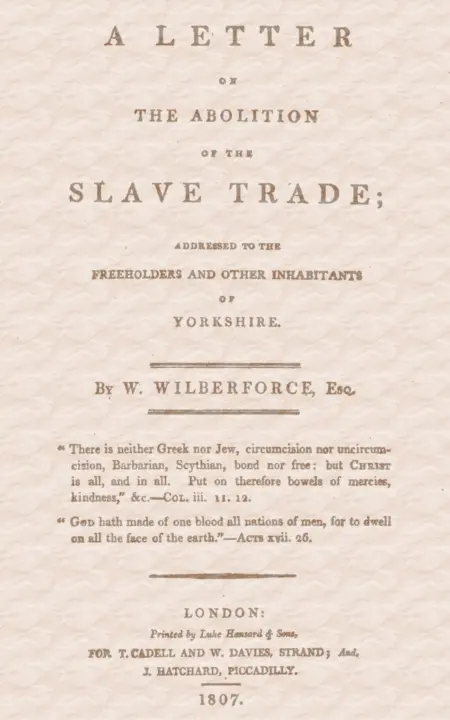
THE CLASSIC COLLECTION · 1807
"A Letter on the Abolition of the Slave Trade" by William Wilberforce is a historical account written in the early 19th century. The work serves as a passionate appeal to the freeholders and inhabitants of Yorkshire, urging them to acknowledge the moral imperative to abolish the slave trade. It predominantly discusses the atrocities and injustices of the slave trade system, aiming to incite action against this brutal practice. The opening portion of the text introduces Wilberforce's enduring quest to advocate for the abolition of the slave trade, a cause he has championed for over fourteen years in Parliament. He reflects on both the moral obligation of his constituents and the historical context of the ongoing discussions surrounding slavery. By expressing his concerns about the fading public awareness of the issue and the recent revival of misconceptions and arguments against abolition, Wilberforce lays the groundwork for a detailed examination of the brutal realities of the slave trade—especially its impacts on Africa—promising to present the facts and arguments that underpin the abolitionist cause. He emphasizes the deep moral responsibility shared by the British public, and the urgent need for collective action to eradicate this "foulest blot" on humanity.
Introduction adapted from the source catalogue; source summaries may be automatically generated.
Free to read · English · 89,339 words · No account needed
MAKE TIME FOR A GOOD BOOK
On by default. Untick to stop anonymous reading totals. Each page counts after 10 seconds in view. How this works.
Anonymous counting is on unless you have switched it off.
To the honour of the Legislature of Jamaica, the consolidated Slave Act, which passed in 1788, contained a proviso, which Mr. Edwards himself subsequently endeavored to carry into more complete effect, that, as far as possible, there should be no separation of the different branches of the same family. I might remark that such a law, from the very nature of the case, would be very imperfectly executed. But even where no such humane condition has been prescribed, let me observe, that it is not so much to my present purpose to notice the violence done to the domestic and social feelings of the Slaves, as to point out the tendency which the whole scene must have, to degrade and vilify the wretched beings in the eyes of the spectators.
[Sidenote: Sales of Negroes for Owners’ debts.]
It is another particular in the situation of these poor creatures, which should here be noticed; that they are personal estate, or moveable property, and that hence they are liable to be seized and sold for their Owner’s debts. This operates the more unfavourably towards them, because, in the West Indies, there is always a more rapid change of property than in any other country; and never has there been more speculation, never more general difficulty and distress, consequently never more seizures and sales, than during the last twenty or thirty years.
These continual sales, often commonly by auction, not only of recently imported, but of homeborn and long-settled Negroes, are productive of the most acute sufferings to the Slaves, by tearing open, in the Africans, the old wounds, which might after many years have closed, and by forcing them once more from their homes, their families, and connections, when they had perhaps taken root in their West Indian soil, and multiplied their domestic and social holdings. These transplantations, besides, greatly tend to lessen the little disposition which the Slaves, circumstanced as they are, naturally feel, to endeavour to gain a good character, and obtain a master’s confidence, in the hope that they and their families may possess a place in his esteem. There is an object which it is obvious will operate most severely in the case of the most industrious and best-conditioned Slaves. In proportion as they are of this character, they are likely to have multiplied their domestic and friendly relations, and in and about their dwelling-places to have collected such little comforts as have been within their reach, and as have tended to cause home to present, even to them, an idea of consolation and refreshment. But all of them have some home, all have some relatives and acquaintances. From all these they are hurried away, often necessarily separated from the closest of all connections. They are sent, probably, to form new settlements, when, perhaps, past the prime of life, and to encounter hardships, and endure labours, to which their bodily strength is scarcely equal.[29] At least they have to form a new home, new connections, new attachments; and, when the best of their days have now been spent in vain, how must the spirits, even of the well disposed, sink within them, under the consciousness that they have to recommend themselves to a new master, when, from the mere decay of their bodily powers, they cannot hope, by the alacrity and vigour of their services, to obtain any considerable share of notice or esteem; or when, if at an earlier period of life, they are discouraged from attempting it, by the probability, that ere long they may again be transferred to a new owner.
Your reading position is saved on this browser. Take it to another device with a library code. Reading pages adapt to text, rather than matching a printed edition.
BEHIND THE BOOK
This eBook is for the use of anyone anywhere in the United States and most other parts of the world at no cost and with almost no restrictions whatsoever. You may copy it, give it away or re-use it under the terms of the Project Gutenberg License included with this eBook or online at www.gutenberg.org. If you are not located in the United States, you will have to check the laws of the country where you are located before using this eBook. Read the source licence.
The original source file, including credits and licence, is retained by this library. Request an original-format copy at no charge. Please include the book title and Project Gutenberg identifier #63974.
KEEP YOUR CURIOSITY GOING
David Patterson (Spirit) Hatch

David Patterson (Spirit) Hatch

David Patterson (Spirit) Hatch
Cécile Tormay

Moritz Busch
John L. Ransom