
Last letters from the living dead man
David Patterson (Spirit) Hatch
THE CLASSIC COLLECTION · 1807
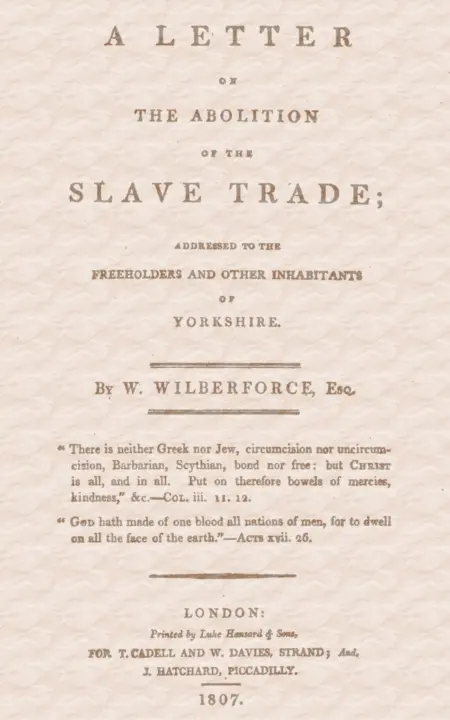
"A Letter on the Abolition of the Slave Trade" by William Wilberforce is a historical account written in the early 19th century. The work serves as a passionate appeal to the freeholders and inhabitants of Yorkshire, urging them to acknowledge the moral imperative to abolish the slave trade. It predominantly discusses the atrocities and injustices of the slave trade system, aiming to incite action against this brutal practice. The opening portion of the text introduces Wilberforce's enduring quest to advocate for the abolition of the slave trade, a cause he has championed for over fourteen years in Parliament. He reflects on both the moral obligation of his constituents and the historical context of the ongoing discussions surrounding slavery. By expressing his concerns about the fading public awareness of the issue and the recent revival of misconceptions and arguments against abolition, Wilberforce lays the groundwork for a detailed examination of the brutal realities of the slave trade—especially its impacts on Africa—promising to present the facts and arguments that underpin the abolitionist cause. He emphasizes the deep moral responsibility shared by the British public, and the urgent need for collective action to eradicate this "foulest blot" on humanity.
Introduction adapted from the source catalogue; source summaries may be automatically generated.
Free to read · English · 89,339 words · No account needed
MAKE TIME FOR A GOOD BOOK
On by default. Untick to stop anonymous reading totals. Each page counts after 10 seconds in view. How this works.
Anonymous counting is on unless you have switched it off.
But an argument for the continuance of the Slave Trade has been grounded on the massacre, which would otherwise take place, of the Slaves which had been brought down to the coast for sale. This slaughter, however, even granting it to be well founded, ought, in all fairness, to be charged to the account of the Slave Trade, which had created the demand for these wretched victims. At any rate it would only happen once; for the Slave hunters would cease to catch and bring down for sale this species of game, when it was known there could no longer be any demand for it. But in truth, as the supposition is utterly contrary to common sense, so it is abundantly contradicted by experience; [Sidenote: The assertion positively contradicted by opponents partisans.] for it clearly appears from Mr. Parke, as well as from the testimony of other witnesses, that Slaves, when brought down to the coast for sale, are set to work for their own maintenance, or for their master’s emolument, either when there is no demand for them, or when the price offered for them is deemed inadequate to their value. It further appears that, even at this time, “It sometimes happens, when no ships are on the coast, that a humane and considerate master incorporates his purchased Slaves among his domestics; and their offspring, at least, if not the parents, become entitled to all the privileges of the native class.”[13]
[Sidenote: Middle passage.]
On the middle passage but little shall be said; but we must not pass from Africa to the West Indies, without some few observations.
When the public attention was first called to this branch of the subject, it was alleged, and with considerable plausibility, that self-interest alone would be a sufficient security against abuses; for not only was the owner of the Slave ship interested in having the Slaves brought to the port of sale in the best possible condition; but the master, officers, and surgeons of the ships had all a similar interest, their profits being made to depend, in a considerable degree, on the average value of the cargo. To this argument from self-interest, it must be confessed, that more weight was justly due in this part of the case, than in any other; because the interest was nearer, and more direct, and was not counteracted by any interest of an opposite nature; yet even here it was proved but too decisively, that, as in other cases, nature was too hard for reason, the passions too powerful for interest. The habit of viewing, and treating these wretched beings as mere articles of merchandize, had so blinded the judgment, and hardened the heart, as to produce a course of treatment highly injurious to the interest of the owners and officers of Slave ships, and at the same time abounding in almost every circumstance that could aggravate the miseries of the Slaves. When the condition therefore and treatment of the Negroes on shipboard were first laid open, the indignation of the House of Commons was excited so strongly, that though the Session of Parliament had nearly closed, a Bill was immediately brought in and passed, with a view to mitigate their sufferings, during even the short period for which, it was then conceived, the existence of the Slave Trade could be tolerated. Human ingenuity had almost been exhausted in contriving expedients for crowding the greatest possible number of bodies into a given space; and when the smallpox, the flux, or any other epidemic, broke out among them, the scene was horrible beyond description. Even where there was no such peculiar aggravation, the sufferings of the poor wretches were such as exhausted all powers of description. Accordingly, the average mortality on board the Slave ships was very considerable. Often, during a voyage of a few weeks, so many perished, that if in any country the same rate of mortality should prevail, the whole population would be swept away in a single year. The survivors also were landed in such a diseased state, that four and a half per cent. of the whole number imported were estimated to die in the short interval between the arrival of the ship and the sale of the cargo, probably not more than a fortnight; and, after the Slaves had passed into the hands of the planters, the numbers which perished from the effects of the voyage were allowed to be very considerable[14].
Your reading position is saved on this browser. Take it to another device with a library code. Reading pages adapt to text, rather than matching a printed edition.
BEHIND THE BOOK
This eBook is for the use of anyone anywhere in the United States and most other parts of the world at no cost and with almost no restrictions whatsoever. You may copy it, give it away or re-use it under the terms of the Project Gutenberg License included with this eBook or online at www.gutenberg.org. If you are not located in the United States, you will have to check the laws of the country where you are located before using this eBook. Read the source licence.
The original source file, including credits and licence, is retained by this library. Request an original-format copy at no charge. Please include the book title and Project Gutenberg identifier #63974.
KEEP YOUR CURIOSITY GOING
David Patterson (Spirit) Hatch

David Patterson (Spirit) Hatch

David Patterson (Spirit) Hatch
Cécile Tormay

Moritz Busch
John L. Ransom