
Last letters from the living dead man
David Patterson (Spirit) Hatch
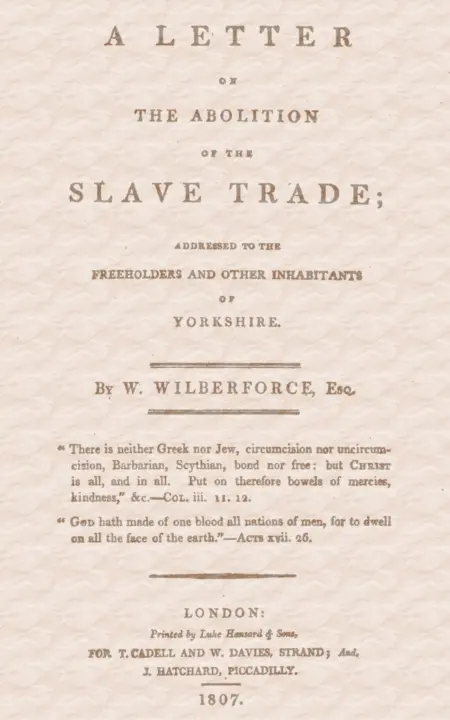
THE CLASSIC COLLECTION · 1807
"A Letter on the Abolition of the Slave Trade" by William Wilberforce is a historical account written in the early 19th century. The work serves as a passionate appeal to the freeholders and inhabitants of Yorkshire, urging them to acknowledge the moral imperative to abolish the slave trade. It predominantly discusses the atrocities and injustices of the slave trade system, aiming to incite action against this brutal practice. The opening portion of the text introduces Wilberforce's enduring quest to advocate for the abolition of the slave trade, a cause he has championed for over fourteen years in Parliament. He reflects on both the moral obligation of his constituents and the historical context of the ongoing discussions surrounding slavery. By expressing his concerns about the fading public awareness of the issue and the recent revival of misconceptions and arguments against abolition, Wilberforce lays the groundwork for a detailed examination of the brutal realities of the slave trade—especially its impacts on Africa—promising to present the facts and arguments that underpin the abolitionist cause. He emphasizes the deep moral responsibility shared by the British public, and the urgent need for collective action to eradicate this "foulest blot" on humanity.
Introduction adapted from the source catalogue; source summaries may be automatically generated.
Free to read · English · 89,339 words · No account needed
MAKE TIME FOR A GOOD BOOK
On by default. Untick to stop anonymous reading totals. Each page counts after 10 seconds in view. How this works.
Anonymous counting is on unless you have switched it off.
I cannot vouch for the following fact, but it was related at the time with every appearance of authenticity. A few years ago the male convicts suffered very severely during their passage to New South Wales, and if I mistake not, for I speak from memory, several of them at length died from the hardships which they endured. On inquiring into the cause, it was stated to be, that the person whose province it was to provide necessaries for the voyage, had, by mistake, purchased such fetters as were used on board Slave ships, instead of the common fetters for convicts.
Footnote 17:
Vide evidence taken before the House of Commons.
Footnote 18:
Vide the late Publication of a professional Planter.
Footnote 19:
Vide Practical Rules for the Management of Negro Slaves, by a professional Planter. “New Negroes says he, court the warmest situations they can find, nothing less intense than actual fire being too hot for them. Hence we see that when they turn out in the morning, even in the low lands in the West Indies, they embrace their bodies closely with their wrappers to defend them from the cold.”
Footnote 20:
Vide the evidence of —— Botham, Esq. in the Minutes of Evidence taken before the Privy Council.
Footnote 21:
Vide Hume’s Essays, vol. i. page 407. Edinb. 1777. Cadell.
Footnote 22:
The professional Planter’s own words well deserve to be inserted: “For I aver it boldly, melancholy experience having given me occasion to make the remark, that a great number of Negroes have perished annually by diseases produced by inanition. To be convinced of this truth, let us trace the effect of that system, which assigned, for a Negro’s weekly allowance, six or seven pints of flour, or grain, with as many salt herrings; and it is in vain to conceal what we all know to be true, that in many of the islands they did not give more. With so scanty a pittance, It is indeed possible for the soul and body to be held together a considerable portion of time, provided a man’s only business be to live, and his spirits be husbanded with a frugal hand; but if motion short of labour, much more labour itself, and that too intense, be exacted from him, how is the body to support itself.”—“Their attempts to wield the hoe prove abortive, they shrink from their toil, and, being urged to perseverance by stripes, you are soon obliged to receive them into the hospital, whence, unless your plan be speedily corrected, they depart but to the grave. It may possibly be urged in palliation of this practice, that in cases of such short allowance as I have mentioned above, Negroes do not depend upon that solely for their subsistence, but that they derive considerable aid from little vacant spots on the estate, which they are allowed to cultivate on their own account. Though frequently otherwise, this may sometimes be the case; yet even there it is to be observed, that such spots, in the low-land plantations, are capable of producing only for a part of the year, either through the drought of the season or the sterility of the soil, and when that happens, the Negro is again at his short allowance; and having no honest means of eking it out, to make it square with the demands of nature, he is compelled to pilfer.”—The writer goes on to state, that the delinquent, extending his thefts, is detected and apprehended, is severely whipped and chained, and confined; but as neither chains nor stripes, nor confinement, can extinguish hunger, he returns, when released, to the same practices, till, partly from the discipline, partly from scanty nourishment, and colds from exposure during his desertion, he, ten to one, falls into a distempered habit, which soon hurries him out of the world. The close is very remarkable, “Now this was set down as a vicious incorrigible subject, and his death is deemed a beneficial release to the estate.”
Your reading position is saved on this browser. Take it to another device with a library code. Reading pages adapt to text, rather than matching a printed edition.
BEHIND THE BOOK
This eBook is for the use of anyone anywhere in the United States and most other parts of the world at no cost and with almost no restrictions whatsoever. You may copy it, give it away or re-use it under the terms of the Project Gutenberg License included with this eBook or online at www.gutenberg.org. If you are not located in the United States, you will have to check the laws of the country where you are located before using this eBook. Read the source licence.
The original source file, including credits and licence, is retained by this library. Request an original-format copy at no charge. Please include the book title and Project Gutenberg identifier #63974.
KEEP YOUR CURIOSITY GOING
David Patterson (Spirit) Hatch

David Patterson (Spirit) Hatch

David Patterson (Spirit) Hatch
Cécile Tormay

Moritz Busch
John L. Ransom