
Last letters from the living dead man
David Patterson (Spirit) Hatch
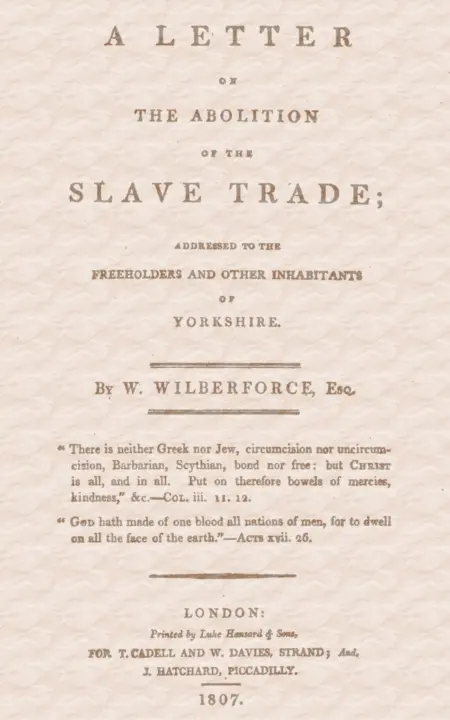
THE CLASSIC COLLECTION · 1807
"A Letter on the Abolition of the Slave Trade" by William Wilberforce is a historical account written in the early 19th century. The work serves as a passionate appeal to the freeholders and inhabitants of Yorkshire, urging them to acknowledge the moral imperative to abolish the slave trade. It predominantly discusses the atrocities and injustices of the slave trade system, aiming to incite action against this brutal practice. The opening portion of the text introduces Wilberforce's enduring quest to advocate for the abolition of the slave trade, a cause he has championed for over fourteen years in Parliament. He reflects on both the moral obligation of his constituents and the historical context of the ongoing discussions surrounding slavery. By expressing his concerns about the fading public awareness of the issue and the recent revival of misconceptions and arguments against abolition, Wilberforce lays the groundwork for a detailed examination of the brutal realities of the slave trade—especially its impacts on Africa—promising to present the facts and arguments that underpin the abolitionist cause. He emphasizes the deep moral responsibility shared by the British public, and the urgent need for collective action to eradicate this "foulest blot" on humanity.
Introduction adapted from the source catalogue; source summaries may be automatically generated.
Free to read · English · 89,339 words · No account needed
MAKE TIME FOR A GOOD BOOK
On by default. Untick to stop anonymous reading totals. Each page counts after 10 seconds in view. How this works.
Anonymous counting is on unless you have switched it off.
As soon as a stranger is observed, all the inhabitants quit their occupations, and hasten to shake him by the hand, repeating several times the word “Senno,” welcome. Even the children who can barely lisp a welcome, when a little custom has diminished the dread attending a white face, are eager to discharge this duty of hospitality, and with a smile hold out their little hands, and seem delighted if he deigns to notice them.—(p. 214.)
Smith’s Guinea, about 1730.—These Negroes seem to be very industrious, for they all go clad with their own manufactures.—(p. 104.)
The natives of Axim industriously employ themselves either in trade, fishing, or agriculture. (p. 115.)
Whydah.—Before the king of Dahomey conquered this place, the natives were so industrious, that no place which was thought fertile could escape being planted.—(p. 199.)
The discerning natives account it their greatest unhappiness that they were ever visited by Europeans. They say that we Christians introduced the traffic of Slaves, and that before our coming, they lived in peace. But say they, it is observable, that wherever Christianity comes there come, with it a sword, a gun, powder and ball. (p. 266.)
Africans natural Qualities, and Capacity for Civilization—Commercial Intercourse practicable.—Astley’s Voyages, vol. iii.
Bosman.—Whidah.—All who have seen it allow it to be one of the most delightful countries of the world.
The number and variety of tall, beautiful, shady trees; the verdant fields, every where cultivated, and only divided by those groves, or in some places by a small footpath; together with the innumerable little agreeable villages.
The farther you go from it (the ocean) the more beautiful and populous you find the country; so that it resembles the Elysian fields.
There is also a weekly market in the province of Aplogua, which is so resorted to, that there are usually five or six thousand merchants.—(p. 11.)
Ogilby.—Kingdom of Loango.—There are many handicrafts among them, as weavers, smiths, cap-makers, bead-makers, potters, carpenters, vintners, fishermen, canoe-makers, besides merchants and other traders, (p. 221.)
There are whole mountains of porphyry, jasper, and marble, of divers colours, which in Rome are called marbles of Numidia, Africa, and Ethiopia; certain pillars whereof may be seen in the palace of Pope Gregory. (p. 299.)
Natural Qualities and Disposition of Africans.
Capt. Wilson, of the Royal Navy (in Africa about 1783–4) fully believes Africans to be equal to Europeans in capacity. They have various manufactures, chiefly for home consumption. They make cotton cloths beautifully fine, under every want of machinery: also very curious ornaments of gold, and weapons and tools of iron, which their experience makes them prefer to those sent from hence, which are made for them.
Your reading position is saved on this browser. Take it to another device with a library code. Reading pages adapt to text, rather than matching a printed edition.
BEHIND THE BOOK
This eBook is for the use of anyone anywhere in the United States and most other parts of the world at no cost and with almost no restrictions whatsoever. You may copy it, give it away or re-use it under the terms of the Project Gutenberg License included with this eBook or online at www.gutenberg.org. If you are not located in the United States, you will have to check the laws of the country where you are located before using this eBook. Read the source licence.
The original source file, including credits and licence, is retained by this library. Request an original-format copy at no charge. Please include the book title and Project Gutenberg identifier #63974.
KEEP YOUR CURIOSITY GOING
David Patterson (Spirit) Hatch

David Patterson (Spirit) Hatch

David Patterson (Spirit) Hatch
Cécile Tormay

Moritz Busch
John L. Ransom