
Last letters from the living dead man
David Patterson (Spirit) Hatch
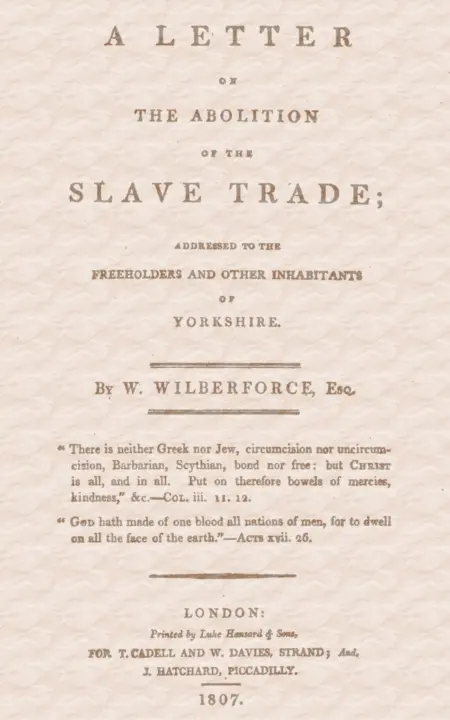
THE CLASSIC COLLECTION · 1807
"A Letter on the Abolition of the Slave Trade" by William Wilberforce is a historical account written in the early 19th century. The work serves as a passionate appeal to the freeholders and inhabitants of Yorkshire, urging them to acknowledge the moral imperative to abolish the slave trade. It predominantly discusses the atrocities and injustices of the slave trade system, aiming to incite action against this brutal practice. The opening portion of the text introduces Wilberforce's enduring quest to advocate for the abolition of the slave trade, a cause he has championed for over fourteen years in Parliament. He reflects on both the moral obligation of his constituents and the historical context of the ongoing discussions surrounding slavery. By expressing his concerns about the fading public awareness of the issue and the recent revival of misconceptions and arguments against abolition, Wilberforce lays the groundwork for a detailed examination of the brutal realities of the slave trade—especially its impacts on Africa—promising to present the facts and arguments that underpin the abolitionist cause. He emphasizes the deep moral responsibility shared by the British public, and the urgent need for collective action to eradicate this "foulest blot" on humanity.
Introduction adapted from the source catalogue; source summaries may be automatically generated.
Free to read · English · 89,339 words · No account needed
MAKE TIME FOR A GOOD BOOK
On by default. Untick to stop anonymous reading totals. Each page counts after 10 seconds in view. How this works.
Anonymous counting is on unless you have switched it off.
Conceive, if you can, the agony with which, as he is hurried away by his unfeeling captors, he looks back upon the native village which contains his wife and children who are left behind; or, supposing them to have been carried off also, with which he sees their sufferings, and looks forward to the dreadful future; while his own anguish is augmented by witnessing theirs. Accompany him through his long and painful march to the coast; behold him, when the powers of nature are almost exhausted by fatigue and affliction, urged forward like a brute by the lash, or, with still more bitterness of suffering, seeing the fainting powers of his wretched wife or daughter roused into fresh exertions by the same savage discipline.[56] Behold him next brought on shipboard and delivered over to men, whose colour, appearance, language, are all strange to him, while every object around must excite terror. If his wretched family have not been brought away with him, he is tormented by the consciousness that they are left destitute and unprotected, and that his eyes will see them no more. If his wife and daughter have been carried off with him, he sees them dragged away to another part of the ship, while he is debarred from their society, and often even from the sight of them; what must be his anguish, from being conscious not only that they are suffering many of the same evils as himself, but still more, from knowing that they are exposed to all those brutalities, the idea of which must be most cutting to a husband or a father; while his misery becomes more intense, from the consciousness that they are close to him, though he cannot alleviate their misery, or protect their weakness.
See our wretched family or individual arriving at the destined port, and then call to mind the abominations of the sale of a negro cargo. See the wretched individual or family exposed naked like brutes, and the same methods taken as with their fellow brutes, to ascertain whether or not their limbs and members are perfect. See them forced to jump or dance, to prove their agility; or, still more affecting, see them afraid, each lest the other only should be bought by some particular purchaser, and therefore displaying their agility, while their hearts are wrung with anguish, in order to induce the buyer to take them both. Perhaps the different branches of the family may be bought by different owners; they may probably be taken to different islands, and the poor hope of wearing away together the wretched remainder of their lives is disappointed; or, if they are purchased together, see them taken home to the estate, and entering upon their course of laborious and bitter degradation; while, looking forward to the future, not a single ray of hope breaks in to cheer the prospect, no hope of any alleviation of drudgery or degradation for them or for their children, for ever! Suppose our wretched Slave at length reduced to the level of his condition, and, either with his own family or with a new one, suppose him to have his hard lot in some little measure mitigated by a very slight taste of domestic and social comforts. It might well be thought, that, except for the hardships and sufferings inseparable from such a state of slavery, where even the necessaries of life must depend on an owner’s affluence, in a country where we know that an immense majority are extremely embarrassed in their affairs—the bitterness of death would be now past; but a negro Slave does not die so easily; again probably, possibly again and again, he is to be subjected to the brutalities of a sale, and to the pains of separation from all that are most dear to him.[57] He is taken perhaps to form a new settlement, and forced to the severe labour of clearing land, in a pestilential soil and climate, without any of those little accommodations which ingenious and industrious poverty might in a course of years have collected around him, in his old habitation. This, however, if a severe is still a short suffering, from which death soon releases him, and is far preferable to the sad fate of those, who linger out the tedious remainder of life, separated from all who have known them in their better days, and without any of those kindly props to lean upon, which the merciful ordainer of all things has provided, for sustaining the weakness, and mitigating the sorrows of age. To look around, and to see not a single face of friendship or relationship, no eye to cheer, no staff to lean upon; surely the comfortless close of such a Negro’s comfortless life, though not of equal intensity of suffering with many of the evils of the former scenes through which he has passed, is yet, from the deep tinge and uniform melancholy of its colouring, as affecting a state, to the humane mind, as any whatever in a life abounding in all the varieties of human wretchedness.
Your reading position is saved on this browser. Take it to another device with a library code. Reading pages adapt to text, rather than matching a printed edition.
BEHIND THE BOOK
This eBook is for the use of anyone anywhere in the United States and most other parts of the world at no cost and with almost no restrictions whatsoever. You may copy it, give it away or re-use it under the terms of the Project Gutenberg License included with this eBook or online at www.gutenberg.org. If you are not located in the United States, you will have to check the laws of the country where you are located before using this eBook. Read the source licence.
The original source file, including credits and licence, is retained by this library. Request an original-format copy at no charge. Please include the book title and Project Gutenberg identifier #63974.
KEEP YOUR CURIOSITY GOING
David Patterson (Spirit) Hatch

David Patterson (Spirit) Hatch

David Patterson (Spirit) Hatch
Cécile Tormay

Moritz Busch
John L. Ransom