
Last letters from the living dead man
David Patterson (Spirit) Hatch
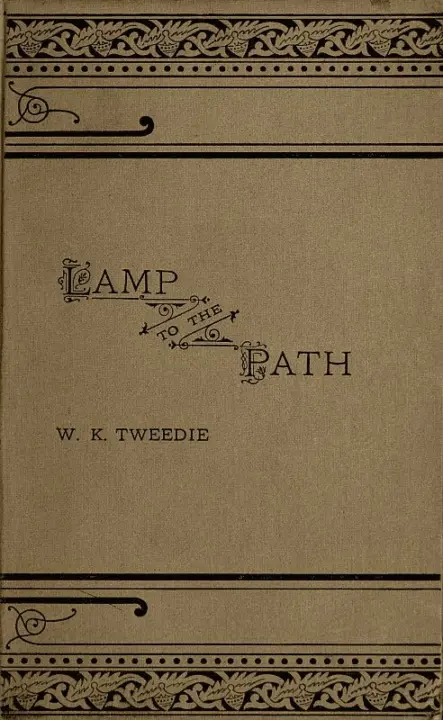
THE CLASSIC COLLECTION · 1884
"A Lamp to the Path" by W. K. Tweedie is a religious work written in the late 19th century. The book delves into the significance of God's Word in guiding individuals through various aspects of life including the heart, family, workplace, and marketplace. Tweedie seeks to illustrate how spirituality must permeate all facets of human existence to ensure moral integrity and a fulfilling life. The opening of the work sets a reflective tone by discussing the enduring relevance of scripture in a world that is often perceived as increasingly corrupt. The author introduces the theme of illumination provided by faith and the necessity of divine guidance for personal growth and societal wellbeing. Through touching narratives and profound insights, the text contrasts individuals who embrace the light of God's truth with those who remain in darkness, emphasizing the transformative power of living according to one's faith. It is clear that the book aims to serve as a practical guide for integrating Christian principles into everyday life, marking the beginning of a series of discussions on religion's role in personal and communal contexts.
Introduction adapted from the source catalogue; source summaries may be automatically generated.
Free to read · English · 63,243 words · No account needed
MAKE TIME FOR A GOOD BOOK
On by default. Untick to stop anonymous reading totals. Each page counts after 10 seconds in view. How this works.
Anonymous counting is on unless you have switched it off.
But this also came to an end; and disasters followed which rent society like an earthquake. The leaders in the scheme were consigned to prison, or compelled to seek refuge in exile; while their deluded victims were left amid poverty, and its attendant woe, to gather the native fruit of the thorns and the thistles, from which they had expected grapes and figs. It was miserable comfort to reflect, that their own baseless expectations had abetted the delusion, and made the ruin complete.
And such is another illustration of the effects which follow the infatuation of putting Mammon in the place of God, or delivering up the whole soul to the pursuit of what the Holy One declares to be unsatisfying as a dream. It is thus that he warns men, in his providence, against that lust of speculation, which is often as ruinous as the lust of power, or any passion which drives men headlong upon misery.
The very titles of some of the schemes which were projected at the period now referred to, stamp them with infatuation. The nation had become an aggregate of gamblers, and the following are some of the stakes:--
A Company for Increasing Children's Fortunes.
A Company for Furnishing Funerals in any part of Great
Britain.
A Company, already mentioned, for carrying on an Undertaking of Great Advantage; but nobody to know what it is.
A Company for Making Looking-Glasses. Capital, £2,000,000.
A Company for Improving Malt Liquors. Capital, £4,000,000.
A Company for Insuring all Masters and Mistresses against Losses by Servants. Capital, £3,000,000.
A Company for Importing Walnut Trees. Capital, £2,000,000.
A Company for Erecting Hospitals for Illegitimate Children.
Capital, £2,000,000.
A Company for Erecting Loan-Offices. Capital, £2,000,000.
--But we need not enumerate more. In that scramble for riches, reason appears to have been befooled. Departing from the law of God, men were left to starvation: "They that did feed delicately, are desolate in the streets: they that were brought up in scarlet, embrace dunghills." What though one, or two, or a few realized wealth, and withdrew in time from the ingulfing vortex? The wide wail--the desolating explosions which followed, were poorly compensated for by these exceptions. What though some might be charioted to-day, who yesterday lived by the sweat of their brows? To-morrow will see them more wretched than before. What though artificial standards have elevated a nominal wealth to the value of Potosi or Golconda? Broken fortunes, broken characters, broken hearts, are the sad realities which close the vista. And thus, would men learn, they might; it is written in light above us, according to the words already quoted: "He that loveth silver shall not be satisfied with silver; nor he that loveth abundance with increase." If covetousness be idolatry, and Mammon the idol, his devotees are taught that disaster and woe are their lot.
Your reading position is saved on this browser. Take it to another device with a library code. Reading pages adapt to text, rather than matching a printed edition.
BEHIND THE BOOK
This eBook is for the use of anyone anywhere in the United States and most other parts of the world at no cost and with almost no restrictions whatsoever. You may copy it, give it away or re-use it under the terms of the Project Gutenberg License included with this eBook or online at www.gutenberg.org. If you are not located in the United States, you will have to check the laws of the country where you are located before using this eBook. Read the source licence.
The original source file, including credits and licence, is retained by this library. Request an original-format copy at no charge. Please include the book title and Project Gutenberg identifier #47538.
KEEP YOUR CURIOSITY GOING
David Patterson (Spirit) Hatch

David Patterson (Spirit) Hatch

David Patterson (Spirit) Hatch

Edwin Abbott Abbott

Richard Watson
T. G. (Theophilus Gould) Steward