
Last letters from the living dead man
David Patterson (Spirit) Hatch
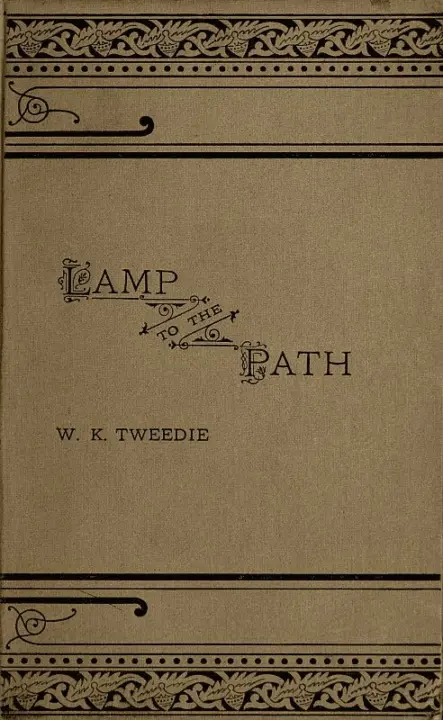
THE CLASSIC COLLECTION · 1884
"A Lamp to the Path" by W. K. Tweedie is a religious work written in the late 19th century. The book delves into the significance of God's Word in guiding individuals through various aspects of life including the heart, family, workplace, and marketplace. Tweedie seeks to illustrate how spirituality must permeate all facets of human existence to ensure moral integrity and a fulfilling life. The opening of the work sets a reflective tone by discussing the enduring relevance of scripture in a world that is often perceived as increasingly corrupt. The author introduces the theme of illumination provided by faith and the necessity of divine guidance for personal growth and societal wellbeing. Through touching narratives and profound insights, the text contrasts individuals who embrace the light of God's truth with those who remain in darkness, emphasizing the transformative power of living according to one's faith. It is clear that the book aims to serve as a practical guide for integrating Christian principles into everyday life, marking the beginning of a series of discussions on religion's role in personal and communal contexts.
Introduction adapted from the source catalogue; source summaries may be automatically generated.
Free to read · English · 63,243 words · No account needed
MAKE TIME FOR A GOOD BOOK
On by default. Untick to stop anonymous reading totals. Each page counts after 10 seconds in view. How this works.
Anonymous counting is on unless you have switched it off.
15 "He lives in a cottage, and yet he is a king and a priest unto God. He is fixed for life to the ignoble drudgery of a workman, and yet he is on the full march to a blissful immortality. He is a child in the mysteries of science, but familiar with greater mysteries. That preaching of the cross which is foolishness to others, he feels to be the power of God and the wisdom of God."--Dr. CHALMERS.
16 Job v. 3.
17 "Pulchra Laverna, Da mihi fallere, da justo sanctoque videri."--HOR.
18 "We state it as our opinion, that though the whole business of the world were in the hands of men thoroughly Christianized, and who, rating wealth according to its real dimensions on the high scale of eternity, were chastened out of all their idolatrous regards to it; yet would trade, in these circumstances, be carried to the extreme limit of its being really productive or desirable. An affection for riches beyond what Christianity prescribes, is not essential to any extension of commerce that is at all valuable or legitimate; and in opposition to the maxim that the spirit of enterprise is the soul of commercial prosperity, do we hold that it is the excess of this spirit beyond the moderation of the New Testament, which, pressing on the natural boundaries of trade, is sure at length to visit every country where it operates with the record of all those calamities which, in the shape of beggared capitalists and unemployed operatives, and dreary intervals of bankruptcy and alarm, are observed to follow a season of overdone speculation."--Dr. CHALMERS.
19 2 Cor. viii. 2.
20 Mr. Hardcastle died in his sixty-seventh year.
21 See Mercantile Morals by Rev. W. H. Van Doren,
chap. iv.
22 See Mercantile Morality, chap. iv.
23 The Dutch florin is worth about two shillings.
24 A span of horses means a team or pair of /matches/
for a carriage.
25 A livre is equal to about 10½d. English.
26 See Mercantile Morals, chap. iv.
27 See Dr. Boardman's "Bible in the Counting-House,"
p. 132.
28 /Hunt's Merchant's Magazine/, quoted in Boardman's
"Bible in the Counting-House."
29 Psalm ii. 9-11.
30 "Ubi tres Medici, duo Athei."
31 Lectures on Medical Missions, Lect. V., by
Dr. G. Wilson.
32 Gouge, in his "Surest and Safest Way of Thriving," tells of an eminent physician of his day, Dr. Bathurst, that "all his Lord's-day fees were kept as a bank for the poor."
33 See this quotation from the "The Licence of Counsel," in Whately's Rhetoric. Part II., chap. iii.
34 See Archbishop Whately's Rhetoric. Part II.,
chap. iii.
35 See Campbell's Lives of the Chancellors, vol. ii.
pp. 429, 430.
36 Campbell, vol. ii. p. 307.
37 Memoirs of the Lives of Robert Haldane, and James A.
Haldane, p. 132.
Your reading position is saved on this browser. Take it to another device with a library code. Reading pages adapt to text, rather than matching a printed edition.
BEHIND THE BOOK
This eBook is for the use of anyone anywhere in the United States and most other parts of the world at no cost and with almost no restrictions whatsoever. You may copy it, give it away or re-use it under the terms of the Project Gutenberg License included with this eBook or online at www.gutenberg.org. If you are not located in the United States, you will have to check the laws of the country where you are located before using this eBook. Read the source licence.
The original source file, including credits and licence, is retained by this library. Request an original-format copy at no charge. Please include the book title and Project Gutenberg identifier #47538.
KEEP YOUR CURIOSITY GOING
David Patterson (Spirit) Hatch

David Patterson (Spirit) Hatch

David Patterson (Spirit) Hatch

Edwin Abbott Abbott

Richard Watson
T. G. (Theophilus Gould) Steward