THE CLASSIC COLLECTION✦Salve Venetia, gleanings from Venetian history; vol. IICLASSIC FREE BOOKS
Salve Venetia, gleanings from Venetian history; vol. II
F. Marion (Francis Marion) Crawford
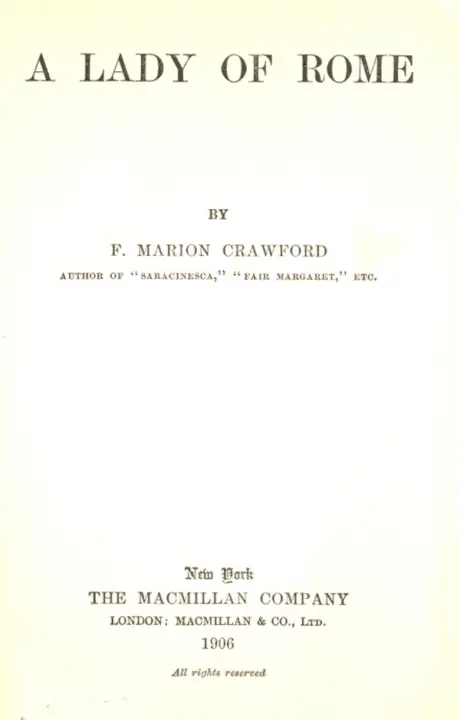
THE CLASSIC COLLECTION · 1906
"A Lady of Rome" by F. Marion Crawford is a novel written in the early 20th century. The story revolves around Maria Montalto, a beautiful woman selling lemonade at a Roman fair, who is burdened by her past and the memories of a failed marriage. As the narrative unfolds, themes of love, loss, and societal expectations come to the forefront, particularly as Maria is unexpectedly confronted by her former love, Baldassare del Castiglione, after years of separation. At the start of the novel, Maria, dressed in a colorful traditional costume, captures the attention of fairgoers while grappling with her complex emotions regarding her estranged husband and her past love. The opening introduces the reader to her conflicting feelings of nostalgia and pain linked to her turbulent history with Castiglione. As she serves refreshments, her interactions reveal that while society views her with admiration and pity, there is a deeper, haunting story of love, loss, and moral dilemmas beneath her composed exterior. The reunion with Castiglione sets the stage for a journey of emotional reckoning, leaving readers intrigued by the potential unraveling of her life’s narrative.
Introduction adapted from the source catalogue; source summaries may be automatically generated.
Free to read · English · 99,811 words · No account needed
MAKE TIME FOR A GOOD BOOK
On by default. Untick to stop anonymous reading totals. Each page counts after 10 seconds in view. How this works.
Anonymous counting is on unless you have switched it off.
Montalto looked at her in surprise, and paused in the act of reconstructing one of his Havana cigarettes.
‘Why, my dear?’ he asked. ‘You yourself urged me to act, before I had time to form an opinion, and you seemed distressed because I took a day or two to think it over; and now you suddenly advise me not to act at all. This is very strange. I do not understand you.’
He waited for her to answer him, and he saw that she hesitated.
‘You must have some very good reason for changing your mind so unexpectedly,’ he said, in a discontented tone, and resumed the rolling of his cigarette.
Maria felt the difficulty of the situation, for which she was not in the least prepared; she had been very sure that he would not do anything in the matter, because she hoped that he would not.
‘Also,’ he continued, ‘why do you speak of more than one person?’
‘More than one?’
‘You said: until “they” write a second time. What reason have you to suppose that any one is concerned in this but Schmidt?’
She had been thinking of the wording of the paper, of Blosse and
his ‘accomplices.’
‘The letter mentioned two other names,’ she said.
‘I have no doubt that Schmidt goes by twenty,’ returned her husband testily. ‘You know very well that Pozzi and Pizzuti both stand for Schmidt!’
He lighted his cigarette, and smoked in silence for some moments.
‘I cannot understand why you have changed your mind,’ he repeated at last. ‘You must have some reason.’
Maria attempted a little diplomacy.
‘Don’t you think a second letter, if it should come, might give a better clue for the police to work on, or might--what do they call it?--strengthen the evidence against Schmidt?’
‘There is evidence enough already to send him to penal servitude, if we can catch him,’ answered Montalto. ‘I really cannot see what more is needed!’
‘Except that--to catch him,’ suggested Maria. ‘I really think that
another letter----’
‘Absurd!’ Montalto was seriously annoyed with her by this time. ‘Something has happened to make you change your mind. Am I right or not?’
Maria turned a little pale and bit her lip. But she would not tell
an untruth.
‘Yes, something has happened,’ she answered.
‘What?’ The single word was pronounced with a good deal of
sharpness.
Maria turned to him.
‘I would rather not tell you,’ she said gently. ‘It is quite useless for you to go to the police, for the letters will not be published.’
She spoke in a tone of perfect certainty that surprised him.
‘You seem very sure,’ he said.
‘I am quite sure.’
Your reading position is saved on this browser. Take it to another device with a library code. Reading pages adapt to text, rather than matching a printed edition.
F. Marion (Francis Marion) Crawford
F. Marion (Francis Marion) Crawford

F. Marion (Francis Marion) Crawford

F. Marion (Francis Marion) Crawford
BEHIND THE BOOK
This eBook is for the use of anyone anywhere in the United States and most other parts of the world at no cost and with almost no restrictions whatsoever. You may copy it, give it away or re-use it under the terms of the Project Gutenberg License included with this eBook or online at www.gutenberg.org. If you are not located in the United States, you will have to check the laws of the country where you are located before using this eBook. Read the source licence.
The original source file, including credits and licence, is retained by this library. Request an original-format copy at no charge. Please include the book title and Project Gutenberg identifier #47624.
KEEP YOUR CURIOSITY GOING
Coulson Kernahan

Maurice Baring
Frances Wright
Cécile Tormay

Frederic Jesup Stimson

W. H. P. (William Henry Pope) Jarvis