THE CLASSIC COLLECTION✦Salve Venetia, gleanings from Venetian history; vol. IICLASSIC FREE BOOKS
Salve Venetia, gleanings from Venetian history; vol. II
F. Marion (Francis Marion) Crawford
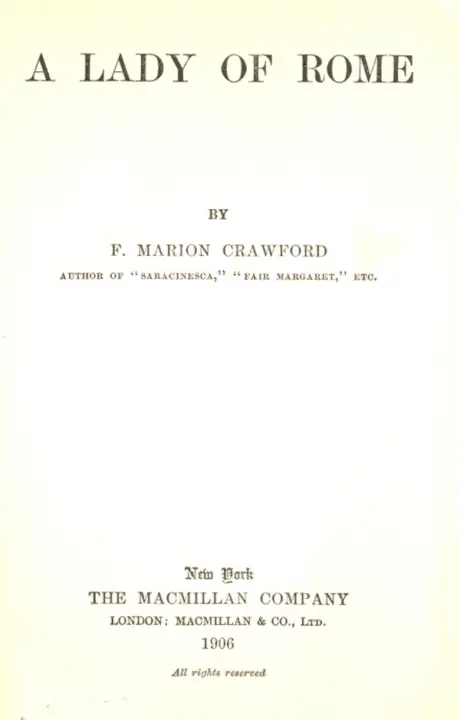
THE CLASSIC COLLECTION · 1906
"A Lady of Rome" by F. Marion Crawford is a novel written in the early 20th century. The story revolves around Maria Montalto, a beautiful woman selling lemonade at a Roman fair, who is burdened by her past and the memories of a failed marriage. As the narrative unfolds, themes of love, loss, and societal expectations come to the forefront, particularly as Maria is unexpectedly confronted by her former love, Baldassare del Castiglione, after years of separation. At the start of the novel, Maria, dressed in a colorful traditional costume, captures the attention of fairgoers while grappling with her complex emotions regarding her estranged husband and her past love. The opening introduces the reader to her conflicting feelings of nostalgia and pain linked to her turbulent history with Castiglione. As she serves refreshments, her interactions reveal that while society views her with admiration and pity, there is a deeper, haunting story of love, loss, and moral dilemmas beneath her composed exterior. The reunion with Castiglione sets the stage for a journey of emotional reckoning, leaving readers intrigued by the potential unraveling of her life’s narrative.
Introduction adapted from the source catalogue; source summaries may be automatically generated.
Free to read · English · 99,811 words · No account needed
MAKE TIME FOR A GOOD BOOK
On by default. Untick to stop anonymous reading totals. Each page counts after 10 seconds in view. How this works.
Anonymous counting is on unless you have switched it off.
‘Yes,’ Montalto said after a long time, when he had got a light and was leaning back in his chair. ‘Yes,’ he repeated, in a tone of profound meditation. ‘Yes, by all means, if it amuses you, my dear.’
‘Then you think Schmidt is right about the old things?’ said Maria with a renewed interrogation in her tone.
Another pause, and several small puffs of smoke.
‘Maria,’ Montalto began, as if he had reached a conclusion, ‘you are not what people call a highly accomplished woman, but you have a great deal of sense.’
The Countess wondered what was coming, and answered by a preliminary and deprecating smile. Montalto often told her that in his opinion she was the most beautiful creature in the world; after such nonsense it was a relief to be called a sensible woman. She might not be even that, but at all events the statement was not likely to lead to one of those outbreaks of his passion for her which she dreaded.
‘Maria,’ he said, as if he were beginning over again, ‘I have great confidence in your judgment.’
‘But I know nothing about gardening or mediæval wells,’ she
protested.
‘Possibly not, though you know vastly more about both than I do. I was brought up under the influence of the Spanish taste of the eighteenth century, and I like it. Ippolito Saracinesca says it is atrocious, and of course he knows. But I like it, nevertheless.’
‘At least, you have the courage of your opinion,’ said Maria, still completely in the dark, but feeling that she must say something.
‘That does not matter, for it is not the question,’ returned her husband. ‘We neither of us know anything about architecture, I am sure. But I shall be glad if you will go into this question with Schmidt, and then give me an opinion.’
‘It will be worthless.’
‘Not your opinion of the garden, my dear, but your opinion of
Schmidt.’
‘Oh!’ Maria was very much surprised. ‘But why? I told you in Rome that I thought him an excellent person and very intelligent!’
‘Did it ever occur to you that he might be too intelligent?’
‘No. But perhaps I don’t understand just what you mean. Do you think he is educated above his station? Too good for his place?’
‘Not at all. But sometimes, in money dealings and positions of trust, a man may be too clever. That is what I mean.’
‘You mean that you don’t quite trust him,’ said Maria, ‘and you wish me to form a judgment of him.’
Your reading position is saved on this browser. Take it to another device with a library code. Reading pages adapt to text, rather than matching a printed edition.
F. Marion (Francis Marion) Crawford
F. Marion (Francis Marion) Crawford

F. Marion (Francis Marion) Crawford

F. Marion (Francis Marion) Crawford
BEHIND THE BOOK
This eBook is for the use of anyone anywhere in the United States and most other parts of the world at no cost and with almost no restrictions whatsoever. You may copy it, give it away or re-use it under the terms of the Project Gutenberg License included with this eBook or online at www.gutenberg.org. If you are not located in the United States, you will have to check the laws of the country where you are located before using this eBook. Read the source licence.
The original source file, including credits and licence, is retained by this library. Request an original-format copy at no charge. Please include the book title and Project Gutenberg identifier #47624.
KEEP YOUR CURIOSITY GOING
Coulson Kernahan

Maurice Baring
Frances Wright
Cécile Tormay

Frederic Jesup Stimson

W. H. P. (William Henry Pope) Jarvis