THE CLASSIC COLLECTION✦Girls togetherCLASSIC FREE BOOKS
Girls together
Amy Ella Blanchard
THE CLASSIC COLLECTION · 1908
"A Journey of Joy" by Amy Ella Blanchard is a novel written in the early 20th century. The book centers on the adventures of three women—Miss Cavendish and her two goddaughters, Gabriella and Sidney—who embark on an extended and economical European tour, with a particular focus on Italy. Through lively dialogue and richly descriptive narrative, the story explores their deepening bonds, personal growth, and the delights and challenges they encounter as travelers abroad. The novel’s tone is spirited and witty, making it appealing to readers who enjoy character-driven travel narratives. The opening of "A Journey of Joy" introduces readers to the close and playful relationship between Gabriella, her godmother Miss Cavendish (affectionately called ‘Gem’), and her fellow goddaughter Sidney. Their journey is born from Gem’s desire for meaningful companionship and a longing to experience Europe independently and on a budget. The story quickly transitions from their initial excitement in America to their travels across Italy, where the trio marvels at the scenery, navigates small mishaps (such as a minor ship collision and confusion over train stations), and experiences the vibrant life of Naples, Capri, Sorrento, Amalfi, and Rome. The narrative is marked by Gabriella’s exuberant personality, Sidney’s gentle enthusiasm, and Miss Cavendish’s thoughtful leadership, all of which combine to depict both the joys and realities of foreign travel at the turn of the century.
Introduction adapted from the source catalogue; source summaries may be automatically generated.
Free to read · English · 68,603 words · No account needed
MAKE TIME FOR A GOOD BOOK
On by default. Untick to stop anonymous reading totals. Each page counts after 10 seconds in view. How this works.
Anonymous counting is on unless you have switched it off.
“I believe you Americans charge us with a lack of humor,” Mr. Morgan
ventured to say.
“I don’t think I am capable of judging, having never been in England. You are the first Englishman I have ever known.”
“And my sense of humor is weak?”
“How shall I test it? Let me see, you have rather a pretty wit at times, as they used to say. Do you enjoy Alice in Wonderland?”
“I certainly do.”
“Then you stand outside the ban. I simply adore Alice.”
“I am delighted that you agree with me on that one point.”
“Don’t I always agree with you?”
“Seldom. Except at San Miniato I can recall but few instances.”
“And I suppose in your lordly Briton way you like girls to agree with you; to be very sweet and say ‘Quite so,’ or, ‘Fancy,’ or ‘Ow,’ and allow you to do most of the talking. Have you the English opinion which insists that Americans talk too much?”
Mr. Morgan considered the question with gravity. “I think some of them talk more than is necessary,” he answered guardedly. “At times I have met those who would be more charming if they added a little repose to their manner.”
“And a little more softness to their quality of voice.”
“Quite so.”
“And no doubt you like a floppy, flowing style of dress.” Gabriella
began to wax indignant.
“No, I like the way American girls dress. I can always tell them from
English girls.”
“How do you distinguish us, pray?”
“By your belts,” said Mr. Morgan, confidentially. “American girls always wear their belts so they go up in the back and down in front, and English girls wear theirs in just the opposite way.”
Gabriella laughed gleefully.
“And you have a way of putting on your veils which no other girls can imitate,” continued Mr. Morgan, “and you wear less jewelry, trinkets and chains and things, you know.”
“I have noticed that,” returned Gabriella, “though I don’t think that can be said of all Americans; some women are overloaded even when they are not in the drawing-room.”
“But surely jewels are very feminine. You wouldn’t have women discard
them, would you?”
“No, but I would have them wear such ornaments only upon appropriate
occasions.”
“Ow!” Mr. Morgan was pondering over this as Gabriella fell back that she might join Miss Cavendish.
“We are discussing the differences between the English and the Americans,” Gabriella informed her friend.
Your reading position is saved on this browser. Take it to another device with a library code. Reading pages adapt to text, rather than matching a printed edition.
Amy Ella Blanchard
Amy Ella Blanchard
Amy Ella Blanchard
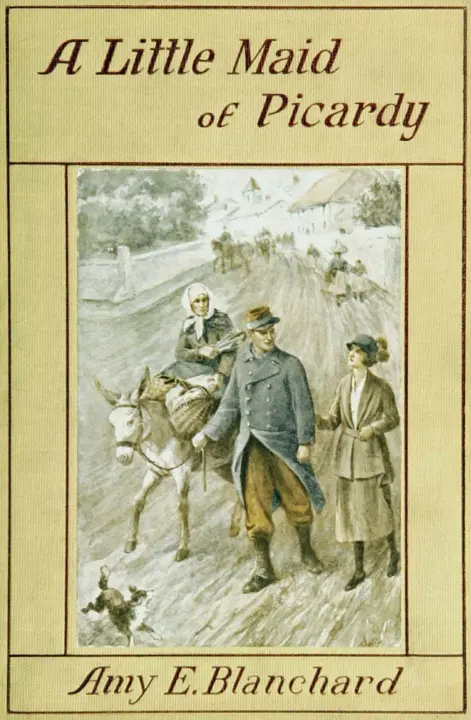
Amy Ella Blanchard
BEHIND THE BOOK
This eBook is for the use of anyone anywhere in the United States and most other parts of the world at no cost and with almost no restrictions whatsoever. You may copy it, give it away or re-use it under the terms of the Project Gutenberg License included with this eBook or online at www.gutenberg.org. If you are not located in the United States, you will have to check the laws of the country where you are located before using this eBook. Read the source licence.
The original source file, including credits and licence, is retained by this library. Request an original-format copy at no charge. Please include the book title and Project Gutenberg identifier #75999.
KEEP YOUR CURIOSITY GOING
Wilfrid Scawen Blunt
Wilfrid Scawen Blunt

E. W. (Edgar Watson) Howe
Coulson Kernahan

Maurice Baring
Frances Wright