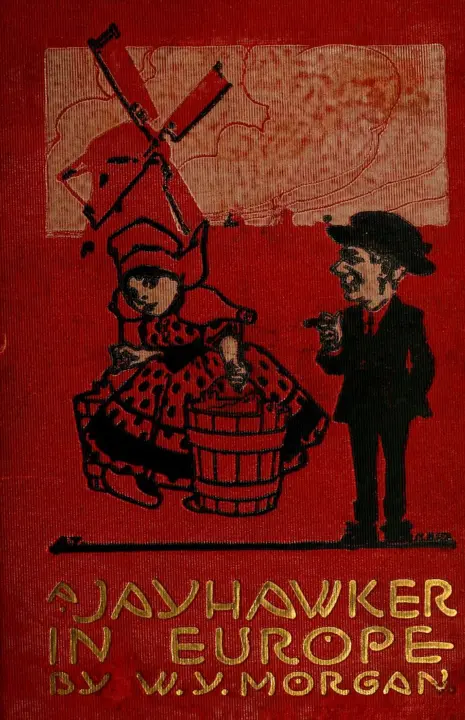
A Jayhawker in Europe
W. Y. (William Yoast) Morgan
THE CLASSIC COLLECTION · 1905
"A Journey of a Jayhawker" by W. Y. Morgan is a travel memoir written in the early 20th century. The narrative chronicles the author's adventurous journey through Europe, beginning with his departure from Kansas, his excitement about traversing the Atlantic, and his experiences in various countries, including Ireland, France, and Italy. This work reflects on the author's observations, cultural experiences, and contemplations about the places he visits and the people he encounters, often injecting humor and personal insights. The opening of the memoir sets the stage for the author's journey as he prepares to embark on his European adventure. He expresses both the exhilaration and anxiety that come with traveling abroad, detailing his preparation and the conflicting advice he receives from friends and fellow travelers. He humorously describes his thoughts on packing, the challenges of managing clothing for various climates, and the emotional complexity of departing from his homeland. As he boards the steamship Arabic, he begins to explore his feelings of homesickness and curiosity about the unknown world ahead, all while grappling with the comedic reality of modern ocean travel compared to the romanticism often portrayed in literature.
Introduction adapted from the source catalogue; source summaries may be automatically generated.
Free to read · English · 66,288 words · No account needed
MAKE TIME FOR A GOOD BOOK
On by default. Untick to stop anonymous reading totals. Each page counts after 10 seconds in view. How this works.
Anonymous counting is on unless you have switched it off.
As soon as I disclosed my European intentions, I began to get advice from friends and old travelers. This is a trying experience. Everybody has ideas as to what should be done, and no two will agree. One of the first questions to be settled is that of clothing. The importance of this is impressed upon the prospective tourist. In the first place I am told to take no baggage except the very simplest that can be carried in the hand. In the second place I am advised that when traveling in Europe, even more than in this country, one should be prepared for all kinds of climate and be ready with the proper clothes to meet every emergency. Every bit of information is absolutely as true as common law or the gospel, for the informant has either made the trip, or his wife’s cousin has, or he knows a man who knows another man who did,—and you are told what happened with all the harrowing details. Clothes do not make the man or the woman, but they help out a lot. So that our friends will realize the difficulties we may meet. I will admit that we are going to the “simple” extreme, taking only light baggage, very little more than a clean collar and a pleasant smile. If royalty wants to call upon us, royalty will not find us prepared with the clothes required by the books of etiquette, unless I can hire a dress suit or borrow one from the head waiter.
I have also discovered that it is going to be difficult to please everybody with our route. Nearly every person has something that just must be seen, and not to do so would make a trip to Europe a flat failure. Most of these important places are dug up by inspiration from the memory of some novel or play. There is the scientific man who urges German universities, the musically inclined who would make Wagnerian objects the great points, the historical student who prescribes battlefields, the sportive gent who urges Monte Carlo, the classical enthusiast who can think of nothing less than a thousand years old, the art-lover who has a list of seventy-seven different styles of Madonnas, the novel-reader who would wander over the country of Scott, the social oracle who would spend the time in London and “Paree,” the enthusiast in civics who is interested in government railroads, the initiative and referendum of Switzerland, and the man whose ideas of a trip abroad are condensed in the parting injunction, “Take one for me at Munich or Heidelberg.” It is shocking to see the disappointed look of the friendly adviser if you do not agree with him that his recommendation is the great thing in Europe. A friend of mine who is an archæologist said: “Of course you are going to Greece?” Now I had not thought of Greece, and ventured to say so. “What, not going to Greece!” was the withering answer in a tone which plainly meant that you were undoubtedly going to throw your opportunity away like an empty sack when the peanuts are gone. Another type of adviser is the man who says: “You must see the Coliseum,” when you know the man would not know the Coliseum if he were to meet it in the road. He has simply heard some one say something about the Coliseum, and takes that word in order to show off his superior knowledge of the sights of Europe. During the weeks of preparation we have made “itineraries” to suit the suggestions of our friends. It is easy to make an itinerary, and no trouble at all to change it the next day when a more profitable route is offered. On a rough estimate I should say that in the last few weeks we have made European itineraries enough to take about seventeen years’ time, and we are intending to be away only about three months. The fact is that while Europe is only a little continent, not near as big as the United States, it has been fought over, scrapped over, built over, written about and has been doing business for so many hundreds of years that there is hardly a pin-point on the map which for some good reason you do not want to visit. It is like taking a newspaper article about seven columns long and condensing it to a small paragraph. You feel you are cutting out all the really good places, and about the extent of your trip is to the points to which you have ordered your mail sent and where you have to go to change trains.
Your reading position is saved on this browser. Take it to another device with a library code. Reading pages adapt to text, rather than matching a printed edition.
W. Y. (William Yoast) Morgan
BEHIND THE BOOK
This eBook is for the use of anyone anywhere in the United States and most other parts of the world at no cost and with almost no restrictions whatsoever. You may copy it, give it away or re-use it under the terms of the Project Gutenberg License included with this eBook or online at www.gutenberg.org. If you are not located in the United States, you will have to check the laws of the country where you are located before using this eBook. Read the source licence.
The original source file, including credits and licence, is retained by this library. Request an original-format copy at no charge. Please include the book title and Project Gutenberg identifier #65125.
KEEP YOUR CURIOSITY GOING
Wilfrid Scawen Blunt
Wilfrid Scawen Blunt

E. W. (Edgar Watson) Howe
Francis Greenleaf Allinson & Anne C. E. (Anne Crosby Emery) Allinson
Cyrenus Cole

John Martineau