Pomona’s Travels A Series of Letters to the Mistress of Rudder Grange from her Former Handmaiden
Frank R. Stockton

THE CLASSIC COLLECTION · 1880
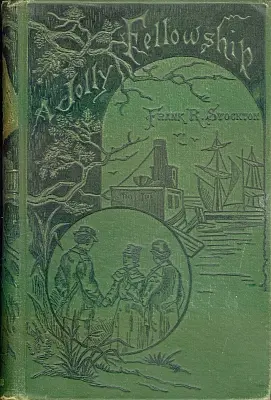
"A Jolly Fellowship" by Frank R. Stockton is a novel written in the late 19th century. The story follows a 16-year-old named Will Gordon, who embarks on a journey with his companion Rectus, a boy two years younger than him, as they travel from New York to the Southern States and the West Indies. Throughout their adventure, the narrative captures their youthful naivety and the various challenges they face, illustrating themes of friendship and exploration. At the start of the novel, Will waits on a steamship dock in New York for Rectus, who arrives with his parents bidding him farewell. This moment prompts Will to reminisce about how they first met during a swimming incident that nearly cost him his life. As the boys set off on this journey, Will is tasked with looking after Rectus, whose well-being is heavily emphasized by his parents. The initial chapters establish the boys' contrasting personalities and set the stage for their impending adventures filled with youthful excitement and unforeseen circumstances as they navigate life while away from home.
Introduction adapted from the source catalogue; source summaries may be automatically generated.
Free to read · English · 76,697 words · No account needed
MAKE TIME FOR A GOOD BOOK
On by default. Untick to stop anonymous reading totals. Each page counts after 10 seconds in view. How this works.
Anonymous counting is on unless you have switched it off.
"He's just taken the last room but one in the boat that leaves Pilatka
to-morrow morning."
"And when do you leave here to catch that boat?" said Mr. Chipperton.
"This afternoon,--and stay all night at Pilatka."
"Oh, father! father!" cried Corny, who had been standing with her eyes and ears wide open, all this time, "let's go! let's go!"
"I believe I will," said Mr. Chipperton,--"I believe I will. You say you have one more room. All right. I'll take it. This will be very pleasant, indeed," said he, turning to me. "It will be quite a party. It's ever so much better to go to such places in a party. We've been thinking of going for some time, and I'm so glad I happened in here now. Good-bye. We'll see you this afternoon at the depot."
I didn't say anything about being particularly glad, but just as I left the door Corny ran out after me.
"Do you think it would be any good to take a fishing-line?" she cried.
"Guess you'd better," I shouted back, and then I ran home, laughing.
"Here are the tickets!" I cried out to Rectus, "and we've got to be at the station by four o'clock this afternoon. There's no backing out now."
"Who wants to back out?" said Rectus, looking up from his trunk, into
which he had been diving.
"Can't say," I answered. "But I know one person who wont back out."
"Who's that?"
"Corny," said I.
Rectus stood up.
"Cor----!" he exclaimed.
"Ny," said I, "and father and mother. They took the only room left,--engaged it while I was there."
"Can't we sell our tickets?" asked Rectus.
"Don't know," said I. "But what's the good? Who's going to be afraid of a girl,--or a whole family, for that matter? We're in for it now."
Rectus didn't say anything, but his expression saddened.
We had studied out this trip the night before, and knew just what we had to do. We first went from St. Augustine, on the sea-coast, to Tocoi, on the St. John's River, by a railroad fifteen miles long. Then we took a steam-boat up the St. John's to Pilatka, and the next morning left for the Oclawaha, which runs into the St. John's about twenty-five miles above, on the other side of the river.
We found the Corny family at the station, all right, and Corny immediately informed me that she had a fishing-line, but didn't bring a pole, because her father said he could cut her one, if it was needed. He didn't know whether it was "throw-out" fishing or not, on that river.
Your reading position is saved on this browser. Take it to another device with a library code. Reading pages adapt to text, rather than matching a printed edition.
Frank R. Stockton

Frank R. Stockton

Frank R. Stockton
Frank R. Stockton
BEHIND THE BOOK
This eBook is for the use of anyone anywhere in the United States and most other parts of the world at no cost and with almost no restrictions whatsoever. You may copy it, give it away or re-use it under the terms of the Project Gutenberg License included with this eBook or online at www.gutenberg.org. If you are not located in the United States, you will have to check the laws of the country where you are located before using this eBook. Read the source licence.
The original source file, including credits and licence, is retained by this library. Request an original-format copy at no charge. Please include the book title and Project Gutenberg identifier #20651.
KEEP YOUR CURIOSITY GOING
Wilfrid Scawen Blunt

E. W. (Edgar Watson) Howe
Coulson Kernahan

Maurice Baring
Frances Wright