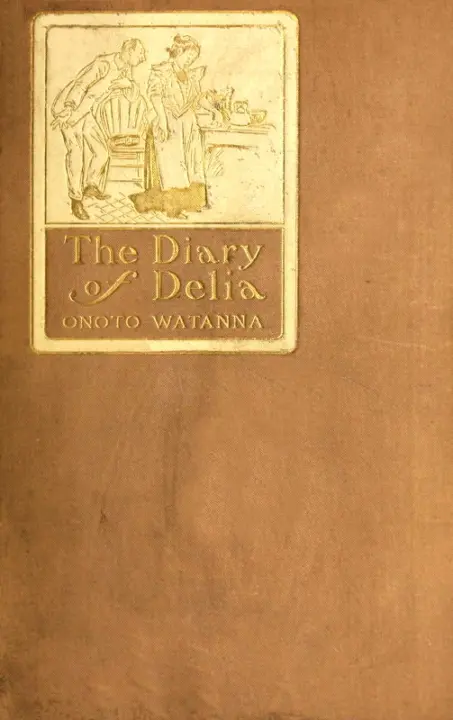
The diary of Delia : Being a veracious chronicle of the kitchen, with some side-lights on the parlour
Onoto Watanna
THE CLASSIC COLLECTION · 1901
"A Japanese Nightingale" by Onoto Watanna is a novel written in the late 19th century. The story centers around Yuki, a talented and captivating Japanese dancer who captures the attention of Jack Bigelow, an American man in Japan. As the plot unfolds, it explores themes of cultural exchange, identity, and the complexities of love as Eastern and Western customs collide. At the start of the novel, we are introduced to a magical scene set during a moonlit banquet on a small island in Japan. Yuki performs a mesmerizing storm dance that leaves the audience, including Jack and an American theatrical manager, enchanted and eager to know her identity. The narrative sets the stage for Jack's growing fascination with Yuki, highlighting his initial encounter with her and the stark contrast between their worlds. As Jack expresses interest in Yuki and her unique talents, the thematic elements of fate and destiny begin to reveal themselves, allowing readers to sense the impending connection and challenges that will arise from their relationship. The opening chapters artfully blend beauty and cultural richness, drawing readers into a world where love, ambition, and the desire for belonging take center stage.
Introduction adapted from the source catalogue; source summaries may be automatically generated.
Free to read · English · 32,651 words · No account needed
MAKE TIME FOR A GOOD BOOK
On by default. Untick to stop anonymous reading totals. Each page counts after 10 seconds in view. How this works.
Anonymous counting is on unless you have switched it off.
Send for her! Ah, Madam Omatsu begged her noble son's pardon ten million times, but she had made a great mistake. His sister had, of course, retired, but it was not within their augustly miserable and honorably unworthy domicile. She had gone out on a visit to some friends.
Taro undid the clinging hands and pushed her from him, his brooding eyes
glaring.
"Where?"
Where? Why, it was only a short distance--perhaps two rice-fields'
lengths from their house.
"The house?--the people's name?"
Madam Omatsu whitened a trifle. Her eyes narrowed, her lips quivered. She tried once more frantically to prevaricate.
The people's name? She could not quite recall, but the next day--the
next day surely--
"Ah-h," said her son, with delirious brutality, "you are deceiving me, lying to me. I demand to know where she is. I am her rightful guardian. I must see her at once."
Madam Omatsu protested with faint vehemence, but she did not weep. She even essayed a little laugh, that reminded Jack eerily of Yuki. In the dimly lighted room she looked strangely like her daughter, save that she was much smaller and quite thin and frail, whereas Yuki was rosy and healthy.
Taro was speaking to her in Japanese, in a sharp, cruel voice, and she was answering gently, meekly, humbly, consolingly. Jack felt sorry for her. Suddenly Taro threw her hands from him, with a gesture of sheer despair and exhausted patience.
"I can learn nothing from her, nothing," he said in English. Then he turned on her again. "Listen," he said: "You are my mother, and as such I honor you, but you must not deceive me. I know all; know that my sister was married to an American; know how she was married, if you call such marriage. They do not consider it so, as you must know. What do you know of this, my mother? It could not have happened without your knowledge?"
The mother broke down at last. All was indeed lost if he knew that much. She sank in a heap at his feet, and again the other man was reminded of her daughter.
Taro raised her, not ungently, curbing his emotions.
"Pray speak to me the truth," he implored.
"It was for you," she said, faintly, in Japanese. "I desired it, I, your mother; and, afterwards, she also, she, your sister. It was a small sacrifice, my son."
"Sacrifice! What do you mean?" he cried.
"Alas, we had not the money to keep you at the American school, and later, when you desired to return, it was still harder."
"Oh, my God!"
Your reading position is saved on this browser. Take it to another device with a library code. Reading pages adapt to text, rather than matching a printed edition.
Onoto Watanna
Onoto Watanna
Onoto Watanna
Onoto Watanna
BEHIND THE BOOK
This eBook is for the use of anyone anywhere in the United States and most other parts of the world at no cost and with almost no restrictions whatsoever. You may copy it, give it away or re-use it under the terms of the Project Gutenberg License included with this eBook or online at www.gutenberg.org. If you are not located in the United States, you will have to check the laws of the country where you are located before using this eBook. Read the source licence.
The original source file, including credits and licence, is retained by this library. Request an original-format copy at no charge. Please include the book title and Project Gutenberg identifier #63181.
KEEP YOUR CURIOSITY GOING
Coulson Kernahan

Maurice Baring
Frances Wright
Cécile Tormay

Frederic Jesup Stimson

W. H. P. (William Henry Pope) Jarvis