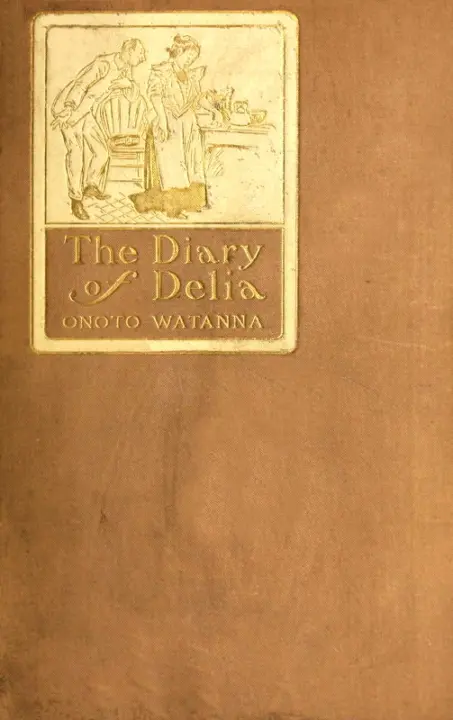
The diary of Delia : Being a veracious chronicle of the kitchen, with some side-lights on the parlour
Onoto Watanna
THE CLASSIC COLLECTION · 1901
"A Japanese Nightingale" by Onoto Watanna is a novel written in the late 19th century. The story centers around Yuki, a talented and captivating Japanese dancer who captures the attention of Jack Bigelow, an American man in Japan. As the plot unfolds, it explores themes of cultural exchange, identity, and the complexities of love as Eastern and Western customs collide. At the start of the novel, we are introduced to a magical scene set during a moonlit banquet on a small island in Japan. Yuki performs a mesmerizing storm dance that leaves the audience, including Jack and an American theatrical manager, enchanted and eager to know her identity. The narrative sets the stage for Jack's growing fascination with Yuki, highlighting his initial encounter with her and the stark contrast between their worlds. As Jack expresses interest in Yuki and her unique talents, the thematic elements of fate and destiny begin to reveal themselves, allowing readers to sense the impending connection and challenges that will arise from their relationship. The opening chapters artfully blend beauty and cultural richness, drawing readers into a world where love, ambition, and the desire for belonging take center stage.
Introduction adapted from the source catalogue; source summaries may be automatically generated.
Free to read · English · 32,651 words · No account needed
MAKE TIME FOR A GOOD BOOK
On by default. Untick to stop anonymous reading totals. Each page counts after 10 seconds in view. How this works.
Anonymous counting is on unless you have switched it off.
Her docility and gentleness strengthened his confidence in her. He was sure she would never leave him again. He even told her of this belief, and she did not deny it. But her eyes were tearful. With boyish insistence he teased her.
"Tell me so--that you will never leave me again."
"Never?" she said, but the word slipped her lips as a question.
"Repeat it after me," he demanded.
"Say: 'I--shall--never--never--leave you again.'"
"Ah, you makin' fun ad me," she protested, begging the question.
But he still persisted, and made her repeat slowly after him, word by word, that she would remain with him till death should part them.
One day he found her laboriously occupied at her small writing-desk. Her little hand flew down the page, rapidly drawing the strange characters of her country's letters.
"What are you doing? You look as wise and solemn as a female Buddha."
Yuki carefully blotted and covered her letter. She did not answer him. Instead she held up her little stained fingers, to show him the ink on them. He sat down beside her, kissing the tips of her fingers.
"To whom were you writing, fairy-sage?" he said.
"To whom? My brudder."
"Your brother! Ah, you have a brother, have you? And where is he?"
She still hesitated, and he watched her keenly.
"He live ad Japan," she said, after a long moment.
"Japan is quite a big place," remarked her husband, suggestively. "He has rather large quarters for one fellow, don't you think?"
"Japan liddle bit country," she argued, trying to change the subject. "America, perhaps, grade big place, big as half the whole worl'--"
"Not quite," interposed her husband, smiling.
"Well, big's one-quarter of the worl', anyhow," she declared. "Bud Japan! Mos' liddle bit insignificant spot on all the beautiful maps."
"What part of Japan does your family live in?"
"Liddle bit town two hundled miles north of Tokyo."
"Indeed."
She had spoken the truth, he knew.
"Why doesn't your brother come to see you?"
Now that he had commenced it, he stuck to his catechism doggedly.
"He don't know where I live," she said.
"Don't know! That's strange. Why doesn't he?"
"I 'fraid tellin'."
"Afraid of what?"
"Afraid he disowning me forever."
"Why should he do that?"
He was getting interested. He disliked wringing her secrets from her in this wise. He wanted her confidence unsolicited; but his curiosity had the better of him. "Why should he disown you?" he repeated.
"Because I marrying--" she paused, somewhat piteously, holding one of his hands closely between her own small ones, and entreatingly pressing it as though begging him not to pursue his questions.
"Well?" he said--"because you married--"
Your reading position is saved on this browser. Take it to another device with a library code. Reading pages adapt to text, rather than matching a printed edition.
Onoto Watanna
Onoto Watanna
Onoto Watanna
Onoto Watanna
BEHIND THE BOOK
This eBook is for the use of anyone anywhere in the United States and most other parts of the world at no cost and with almost no restrictions whatsoever. You may copy it, give it away or re-use it under the terms of the Project Gutenberg License included with this eBook or online at www.gutenberg.org. If you are not located in the United States, you will have to check the laws of the country where you are located before using this eBook. Read the source licence.
The original source file, including credits and licence, is retained by this library. Request an original-format copy at no charge. Please include the book title and Project Gutenberg identifier #63181.
KEEP YOUR CURIOSITY GOING
Coulson Kernahan

Maurice Baring
Frances Wright
Cécile Tormay

Frederic Jesup Stimson

W. H. P. (William Henry Pope) Jarvis