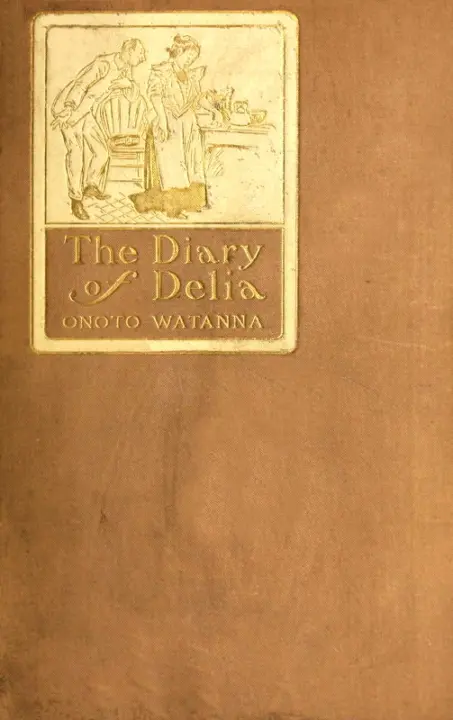
The diary of Delia : Being a veracious chronicle of the kitchen, with some side-lights on the parlour
Onoto Watanna
THE CLASSIC COLLECTION · 1901
"A Japanese Nightingale" by Onoto Watanna is a novel written in the late 19th century. The story centers around Yuki, a talented and captivating Japanese dancer who captures the attention of Jack Bigelow, an American man in Japan. As the plot unfolds, it explores themes of cultural exchange, identity, and the complexities of love as Eastern and Western customs collide. At the start of the novel, we are introduced to a magical scene set during a moonlit banquet on a small island in Japan. Yuki performs a mesmerizing storm dance that leaves the audience, including Jack and an American theatrical manager, enchanted and eager to know her identity. The narrative sets the stage for Jack's growing fascination with Yuki, highlighting his initial encounter with her and the stark contrast between their worlds. As Jack expresses interest in Yuki and her unique talents, the thematic elements of fate and destiny begin to reveal themselves, allowing readers to sense the impending connection and challenges that will arise from their relationship. The opening chapters artfully blend beauty and cultural richness, drawing readers into a world where love, ambition, and the desire for belonging take center stage.
Introduction adapted from the source catalogue; source summaries may be automatically generated.
Free to read · English · 32,651 words · No account needed
MAKE TIME FOR A GOOD BOOK
On by default. Untick to stop anonymous reading totals. Each page counts after 10 seconds in view. How this works.
Anonymous counting is on unless you have switched it off.
"Why," he said, hotly, "if we're to be married, she can have all she
wants and needs."
That wouldn't do at all, the nakoda told him, warily. There would have to be a marriage settlement and a stated allowance agreed upon. He would have to pay more, also, as she was a maid and not a widow.
When the ugly terms of the agreement were completed, the nakoda bowed himself out, and Jack went back to Yuki. He found her changed; her simplicity had left her, and her coquetry had returned. She stood off from him, and he felt constrained and awkward. After a time she demanded of him, with a shrewd inflection in her voice:
"You goin' to lige me, excellency?"
"No question of that," he answered promptly, smiling.
"No," she repeated, "tha's sure thing," and then she laughed at her own assurance, and she was so pretty he wanted to kiss her, but she backed from him in mock alarm.
"Tha's nod ride," she declared, "till we marry."
"God speed the day!" he said, with devout joyousness. Still approaching her, as she backed from him, he questioned her boyishly:
"And you? Will you like me?"
She surveyed him critically. Then she nodded emphatically. They laughed together this time, but when he approached her she grew fearful. He did not want to frighten her.
"You god nod anudder wife?" she asked.
"No! Good heavens!"
"I god nod anudder hosban'," she informed him, complacently.
"I should hope not."
"Perhaps," she said, "you marrying with girl in Japan thad god marry
before. Me? I never."
"No, of course not." He didn't quite understand what she was driving at.
Then she said: "You pay more money ad liddle girl lige me whad nod been
marry before?"
He recoiled and frowned heavily at her.
"I settled that matter with the nakoda," he said, coldly.
Seeing he was displeased, she tried to conciliate him. She smiled at
him, engagingly, coaxingly.
"You don' lige me any more whicheven."
But his face did not clear up. She had hurt him deeply by her reference
to money.
"Perhaps you don' want me even," she suggested, tentatively. "I bedder go 'way. Leave you all 'lone."
She turned and was making her way slowly out of the room, when he sprang
impetuously after her.
"Don't, Yuki!" he cried, and caught her eagerly in his arms. She yielded herself to his embrace, though she was trembling like a little frightened child. For the first time he kissed her.
Your reading position is saved on this browser. Take it to another device with a library code. Reading pages adapt to text, rather than matching a printed edition.
Onoto Watanna
Onoto Watanna
Onoto Watanna
Onoto Watanna
BEHIND THE BOOK
This eBook is for the use of anyone anywhere in the United States and most other parts of the world at no cost and with almost no restrictions whatsoever. You may copy it, give it away or re-use it under the terms of the Project Gutenberg License included with this eBook or online at www.gutenberg.org. If you are not located in the United States, you will have to check the laws of the country where you are located before using this eBook. Read the source licence.
The original source file, including credits and licence, is retained by this library. Request an original-format copy at no charge. Please include the book title and Project Gutenberg identifier #63181.
KEEP YOUR CURIOSITY GOING
Coulson Kernahan

Maurice Baring
Frances Wright
Cécile Tormay

Frederic Jesup Stimson

W. H. P. (William Henry Pope) Jarvis