THE CLASSIC COLLECTION✦An American tragedy, v. 2CLASSIC FREE BOOKS
An American tragedy, v. 2
Theodore Dreiser
THE CLASSIC COLLECTION · 1916
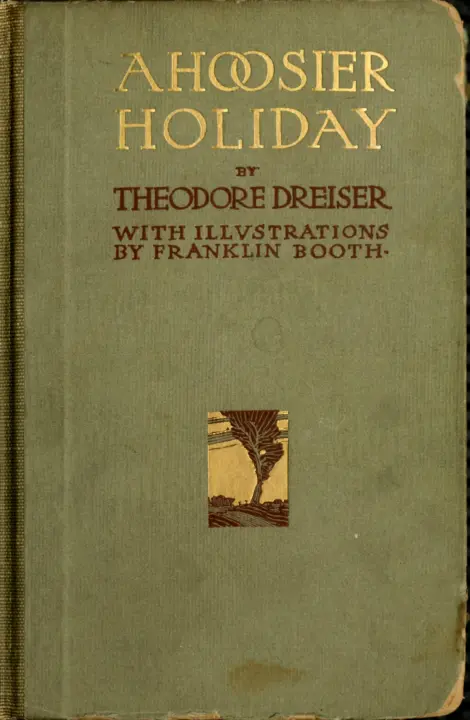
"A Hoosier Holiday" by Theodore Dreiser is a travel narrative written in the early 20th century. The book chronicles the author's journey back to his native Indiana, accompanied by an illustrator named Franklin. In this work, Dreiser reflects on his memories, childhood experiences, and the landscape of Indiana, expressing a deep nostalgia for his roots and the simple American life. At the start of the book, Dreiser shares the catalyst for his journey — a chance encounter with Franklin, who suggests a road trip to Indiana. The narrative unfolds with Dreiser reminiscing about his early years in various towns across Indiana, including Terre Haute and Warsaw, while detailing their modest circumstances and rich experiences. The opening chapters set the tone for a reflective journey filled with personal anecdotes, insights on rural life, and observations about the changing American landscape, hinting at the broader themes of nostalgia and the complexity of revisiting one’s past.
Introduction adapted from the source catalogue; source summaries may be automatically generated.
Free to read · English · 170,854 words · No account needed
MAKE TIME FOR A GOOD BOOK
On by default. Untick to stop anonymous reading totals. Each page counts after 10 seconds in view. How this works.
Anonymous counting is on unless you have switched it off.
My field of clover!
It was an unkempt weed patch, small, disreputable, disillusionizing—a thing that had never been large at all or had shrunk to insignificant proportions. My tree—the column of the brooding hawk—it was gone. There was no fine fecund truck patch alongside our house, where once we had raised corn, potatoes, peas, onions, beans—almost our total summer and winter fare. Three other small shabby houses and their grounds occupied the field we had cultivated. I realized now in looking at this what an earnest, industrious woman my mother must have been.
A band of ragamuffin children were playing out in front, children with bare legs, bare arms, in most cases half bare bodies, and so dirty! When they saw our car they gathered in a group and surveyed us. One of the littlest of them had a sore-eyed puppy elevated to his loving breast. It was a “poor white trash” neighborhood.
“My brother’s got tabuckalosis of the bones,” one little girl said to me, nodding at a skimpy, distrait looking youth who stood to one side, rather pleased than not that his ailment should attract so much attention.
“Oh, no,” I said, “surely not. He doesn’t look as though he had anything but a good appetite, does he, Franklin?”
“Certainly not,” replied the latter cheerfully.
The youth gazed at me solemnly.
“Oh, yes, he has,” continued his sister, “the doctor said so.”
“But don’t you know that doctors don’t know everything?” put in Franklin. “Doctors just imagine things, the same as other people. Why, look at him—he’s nice and healthy.”
“No, he ain’t either,” replied this protector argumentatively. “If he don’t get better he’ll haff to go to the 'ospital. Our doctor says so. My mother ain’t got the money or he’d go now.”
“Dear! Dear!” I exclaimed, looking at the youth sympathetically. “But there, he looks so well. You feel all right, don’t you?” I asked of the contemplative victim, who was staring at me with big eyes.
“Yes, sir.”
“You’re never sick in bed?”
“No, sir.”
“Well, now here’s a nickel. And don’t you get sick. You’ll be well so long as you think so.”
“Ooh, let’s see it,” commanded the advertising sister, drawing near and trying to take the hand with the coin.
“No.”
“Well, let’s see how it looks.”
“No.”
“Well, then, keep it, smarty! You’ll have to give it to maw, anyhow.”
I began to wonder whether “tabuckalosis” of the bones was not something developed for trade purposes or whether it was really true.
Your reading position is saved on this browser. Take it to another device with a library code. Reading pages adapt to text, rather than matching a printed edition.
Theodore Dreiser
Theodore Dreiser
Theodore Dreiser
Theodore Dreiser
BEHIND THE BOOK
This eBook is for the use of anyone anywhere in the United States and most other parts of the world at no cost and with almost no restrictions whatsoever. You may copy it, give it away or re-use it under the terms of the Project Gutenberg License included with this eBook or online at www.gutenberg.org. If you are not located in the United States, you will have to check the laws of the country where you are located before using this eBook. Read the source licence.
The original source file, including credits and licence, is retained by this library. Request an original-format copy at no charge. Please include the book title and Project Gutenberg identifier #70269.
KEEP YOUR CURIOSITY GOING
Wilfrid Scawen Blunt
Wilfrid Scawen Blunt

E. W. (Edgar Watson) Howe
Francis Greenleaf Allinson & Anne C. E. (Anne Crosby Emery) Allinson
Cyrenus Cole

John Martineau