North Africa and the desert
George Edward Woodberry
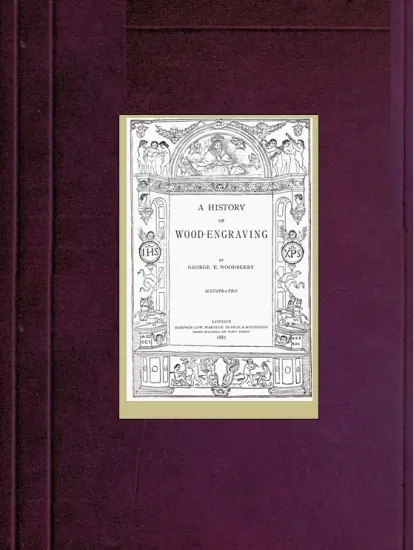
THE CLASSIC COLLECTION · 1883
"A History of Wood-Engraving" by George Edward Woodberry is a historical account written in the late 19th century. The book provides insight into the art of wood-engraving, tracing its origins and developments throughout history, reflecting on its significance in terms of culture and civilization. It serves as a comprehensive exploration for those interested in artistic techniques, artistic history, and the evolution of printing. The beginning of the text discusses the obscured origins of wood-engraving in Europe, illustrating its early practices and the potential influence of goldsmiths skilled in engraving. Woodberry outlines the challenges in pinpointing the initial inventor of the art, mentioning the place of wood-engraving within a broader context of artistic and cultural expression. Additionally, he references early prints, including the role of woodcuts in religious instruction, emphasizing their importance as a form of visual literacy in a time when access to books was limited.
Introduction adapted from the source catalogue; source summaries may be automatically generated.
Free to read · English · 44,012 words · No account needed
MAKE TIME FOR A GOOD BOOK
On by default. Untick to stop anonymous reading totals. Each page counts after 10 seconds in view. How this works.
Anonymous counting is on unless you have switched it off.
With the second half of the century began that expansion of the press, that increase in the volume and improvement in the quality of the reading provided for the public through newspapers and magazines, which has been one of the most striking and important results of democratic institutions. The Harpers’ Monthly Magazine was established in 1850, and it was followed within a decade by several illustrated periodicals; during the civil war there was naturally a slackening in this development, but, upon its close, numerous new illustrated weekly or monthly publications began their longer or shorter career, among them those issued by the Scribners, which were to have so important a bearing on the history of wood-engraving. The art naturally received a great impetus from this demand upon its resources; it rapidly advanced; and being encouraged farther by the popularity of the new and beautifully illustrated gift-books of the Boston and New York publishers, it has taken the leading place in the artistic interests of the country.
The scope of this volume does not allow any detailed account of the works of American engravers individually; but while the increased productiveness and improved technique of the art during the third quarter of the century are being noticed, it would be unjust to make no mention of the quiet, careful, and refined woodcuts of Mr. Anthony, or of the long and unflinching fidelity of Mr. Linton, with its reward in admirable work, or of the exquisite skill of Mr. Henry Marsh, the best of American engravers of that period. The latter’s marvellous rendering of insect life in the illustrations to Harris’s Insects Injurious to Vegetation, published in 1862, can never be forgotten by any who have been fortunate enough to see the artist-proofs. His work is in the manner of copperplate-engraving, and affords one of the few instances in which wood-engraving has equalled the rival art in fineness, delicacy, softness, and gradation of tone. Whatever the critic’s theory may be, he must remember that genius has a higher validity than reason, and must acknowledge such work as this to be its own justification. Unfortunately, the cuts in the published volume were not--perhaps at that time could not be--printed with the success they deserved. The work of these three engravers illustrates what advance had already been made in skilful line-arrangement and in technique before 1870, about which time the indications of an approaching change in the art became plainly evident. Since then progress has been uninterrupted, swift, marked by bold experiments and startling surprises. Now American engravers excel all others in knowledge of the resources of their art, and in control of its materials, as well as in the interest of their work. They have not, it is true, produced, as yet, anything to rank in artistic value with the designs of the older masters; but, in their hands, the art has gained a width and utility of influence among our people hitherto unequalled in any nation at any period. From the beginning of its history wood-engraving has been distinctively a democratic art; at present the ease and cheapness of its processes and the variety of its applications make it one of the most accessible sources of inexpensive information and pleasure; for this reason it has acquired in our country, where a reading middle class forms the larger portion of the nation, a popular influence of such far-reaching and penetrative power as to make it a living art in a sense which none other of the fine arts can claim. It now enters into the intellectual life and enjoyment of our people to a degree and with a constancy impossible to other arts. In this respect, too, it is only at the beginning of its career; for, as popular education spreads, the place that the art holds in the national life will continually become more important. These social conditions, the technical skill of the engravers, and the appearance among the people of a critical spirit concerning their work--not perhaps to be called intelligent as yet, but forming, nascent, feeling its way into conscious and active life--make up a group of most favorable circumstances for a real artistic development. Whether such a development will take place depends in large measure on the clearness with which engravers understand the laws of their art, as presented by their materials, and on the degree in which such knowledge controls them. The experiments of recent years are to be judged finally by the results; but, in spite of the novel effects obtained, and of the new character that has been given to the art, there is at present no such unanimity, either among the engravers or the public, as to be decisive of the worth of the new work as a whole. While the issue is still doubtful, and the stake is the future of the only art by which those who care for the growth of civilization can develop in the people a sense of art, bring them to an appreciation of its value, open their understandings to its teachings, and fill their lives with its delights, something may be gained by recurring to fundamental principles, as illustrated by the practice of the older masters, not with an end to limit the future by the past, but to foresee it. Such a brief review and summary of past thought respecting the aims and methods of wood-engraving, with such corrections as modern improvements in processes justify, will afford the surest ground for criticism of the work still to be considered.
Your reading position is saved on this browser. Take it to another device with a library code. Reading pages adapt to text, rather than matching a printed edition.
George Edward Woodberry
George Edward Woodberry
George Edward Woodberry
BEHIND THE BOOK
This eBook is for the use of anyone anywhere in the United States and most other parts of the world at no cost and with almost no restrictions whatsoever. You may copy it, give it away or re-use it under the terms of the Project Gutenberg License included with this eBook or online at www.gutenberg.org. If you are not located in the United States, you will have to check the laws of the country where you are located before using this eBook. Read the source licence.
The original source file, including credits and licence, is retained by this library. Request an original-format copy at no charge. Please include the book title and Project Gutenberg identifier #40638.
KEEP YOUR CURIOSITY GOING
Cécile Tormay

Moritz Busch
John L. Ransom
Frances Wright
Cécile Tormay

Mabel Potter Daggett