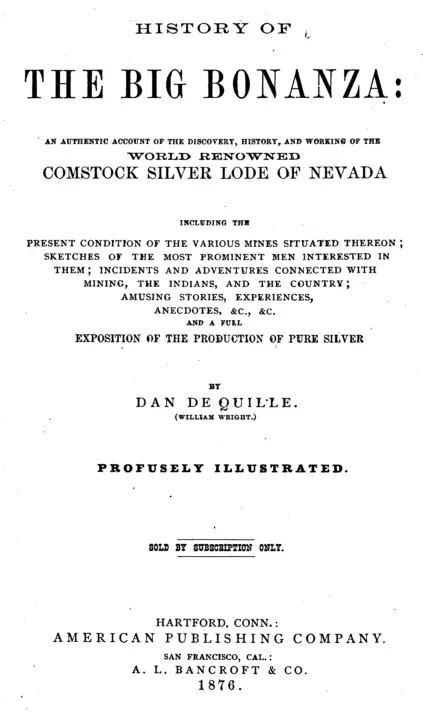
History of the big bonanza
Dan De Quille
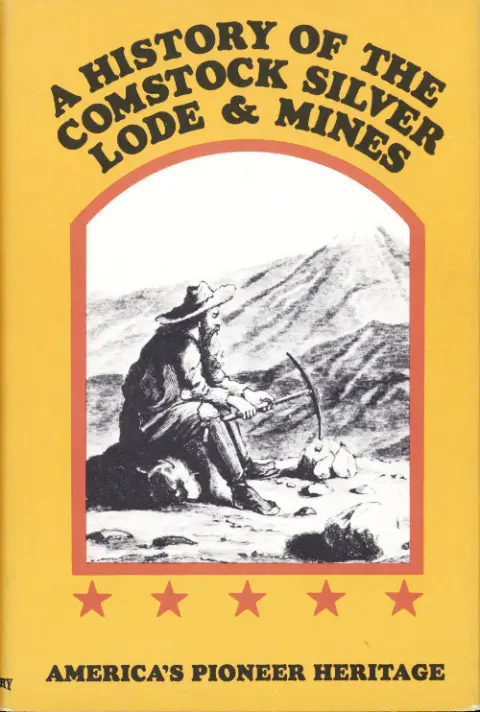
THE CLASSIC COLLECTION · 1889
"A History of the Comstock Silver Lode & Mines" by Dan De Quille is a historical account written in the late 19th century. The book provides a comprehensive exploration of the silver mining history of the Comstock Lode in Nevada and the surrounding Great Basin region, detailing the mineral and agricultural resources, towns, and industries of the area. The opening of the text lays the groundwork for understanding the geographic and historical context of Nevada, describing its boundaries, physical features, and the initial conditions that set the stage for silver mining. The author emphasizes the significance of the Comstock Lode's discovery, outlining early mining efforts, the challenges faced, and the remarkable developments in mining technology and infrastructure that followed. De Quille intends to cater to both tourists and those interested in the region's mining heritage, hinting at the upcoming detailed accounts of the mines, towns, and the lives of the miners who populated the area.
Introduction adapted from the source catalogue; source summaries may be automatically generated.
Free to read · English · 38,291 words · No account needed
MAKE TIME FOR A GOOD BOOK
On by default. Untick to stop anonymous reading totals. Each page counts after 10 seconds in view. How this works.
Anonymous counting is on unless you have switched it off.
To show the rate at which some of the mines have been paying during the past year, though handicapped by an unusually dry season and a lack of milling facilities, I give a few statistics, as follows: During the quarter that ended March 31, 1888, the Chollar Company milled 1,415 tons of ore that yielded $21,795.70 in bullion; the Confidence 1,722 tons, yielding $42,541.72; Hale & Norcross, 7,958 tons, yielding $236,047.32; Kentuck, 1,027 tons, yielding $13,055.50; Potosi, 3,050 tons, yielding $56,461.16, and the Yellow Jacket, 16,780 tons, yielding $121,027.82.
For the quarter ending June 30, 1888, the Hale & Norcross yielded 18,075 tons of ore, that produced $451,740 in bullion; the Chollar, 4,750 tons, yielding $74,507; Confidence, 17,285 tons, yielding $401,293; Yellow Jacket, 7,080 tons, yielding $55,022.
For the quarter that ended September 30, the Hale & Norcross yielded 6,365 tons of ore, that produced $173,941.80 in bullion; Confidence, 9,207 tons, yielding $176,064.93; Yellow Jacket, 1,370 tons, yielding $9,932.
For the quarter that ended December 30, 1888, the Chollar milled 2,835 tons that yielded $38,130.81: Challenge, 1,875 tons, yielding $31,096.16; Confidence, 6,195 tons, yielding $105,970.59; Yellow Jacket, 3,388 tons, yielding $25,856; Savage, 5,292 tons, yielding $66,422.75; Hale & Norcross, 4,820 tons, yielding $90,015.59, and the Alta, 946 tons, yielding $23,330.
The Consolidated California and Virginia has steadily paid $108,000 monthly in dividends. The Confidence and Hale & Norcross also paid dividends during 1888 at the rate of from $49,000 to $50,000 a month. And during the year the pay rolls of the several companies have aggregated from $250,000 to over $300,000 a month.
During 1888, new bodies of ore were found in the Consolidated California and Virginia, Hale & Norcross, Confidence, Yellow Jacket, Crown Point, Gould & Curry, Savage, Chollar, Potosi, Best & Belcher, and some others. Crown Point and Belcher have made connection with the Sutro drain tunnel, and are again working below that level. Eventually the leading companies will get back into the deep workings now deserted.
Vicissitudes of Fortune in Mining.
The vicissitudes of fortune are probably more striking in mining for silver than in any other kind of mining. In all silver-producing countries we are told of mines being again and again abandoned because it was thought their rich “bonanzas” had been exhausted, but they have again and again been reopened and new and rich bodies of ore discovered. The Valenciana Mine, on the Veta Macbee (mother vein), of Guanaguato, Mexico, was reopened in 1760, on a part of the vein where work had been done in the sixteenth century, and which had afterwards lain as worthless for 200 years, and in 1768 a bonanza was struck at a depth of only 240 feet, from which $1,500,000 was extracted annually. And from 1788 to 1810 the annual average was still $1,383,195. At a depth of 1,200 feet the ore was considered too poor for extracting, and the mine was allowed to fill with water. Afterwards it was again opened and again paid immensely by working the almost inexhaustible quantities of low-grade ore.
Your reading position is saved on this browser. Take it to another device with a library code. Reading pages adapt to text, rather than matching a printed edition.
Dan De Quille
BEHIND THE BOOK
This eBook is for the use of anyone anywhere in the United States and most other parts of the world at no cost and with almost no restrictions whatsoever. You may copy it, give it away or re-use it under the terms of the Project Gutenberg License included with this eBook or online at www.gutenberg.org. If you are not located in the United States, you will have to check the laws of the country where you are located before using this eBook. Read the source licence.
The original source file, including credits and licence, is retained by this library. Request an original-format copy at no charge. Please include the book title and Project Gutenberg identifier #64699.
KEEP YOUR CURIOSITY GOING
Wilfrid Scawen Blunt
Wilfrid Scawen Blunt

E. W. (Edgar Watson) Howe
Cécile Tormay

Moritz Busch
John L. Ransom