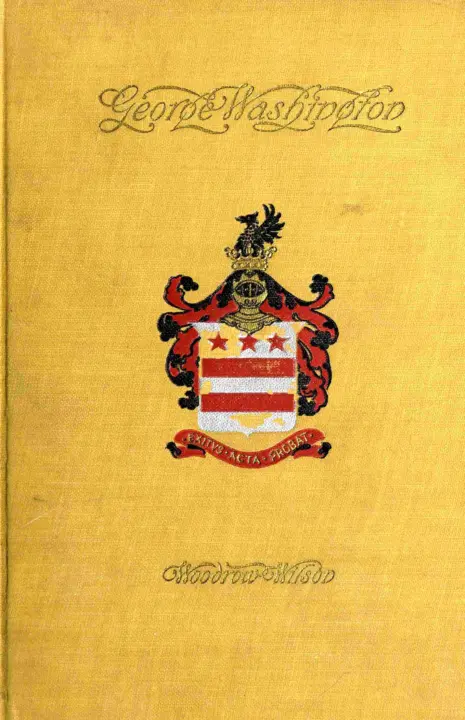
George Washington
Woodrow Wilson
THE CLASSIC COLLECTION · 1901
"A history of the American people, Vol. 2 [of 5]" by Woodrow Wilson is a historical account written in the early 20th century. Centered on the British mainland colonies’ growth from scattered settlements into an emerging nation, it follows imperial rivalry, frontier expansion, commerce, religion, and politics as they converge toward revolution and independence. This volume likely covers the late 17th century through the Revolutionary era, highlighting how colonial society, war, and governance forged a common American direction.
The opening of this volume surveys the colonies from the late 1600s into the 1730s, showing how repeated wars and shared pressures began to knit them together. It contrasts English settlement with French military expansion down the St. Lawrence, Great Lakes, and Mississippi, notes the Iroquois as a decisive barrier, and recounts King William’s War and Queen Anne’s War—raids, failed expeditions, Port Royal’s capture, and the Carolinas’ hard fighting against Spain and native confederacies. Alongside war, it traces trade under the Navigation Acts, the rise and suppression of piracy (including Kidd, Blackbeard, and Bonnet), William Penn’s conciliatory reforms, New Jersey’s shift to royal control, new colleges, and Alexander Spotswood’s forward-looking Virginia governance and Blue Ridge exploration. A long Walpole-era peace brings population growth and diversity (Scots-Irish, Germans, Huguenots), Charleston’s plantation elite, colonial assertiveness (the Zenger acquittal), slave unrest, and the tightening French cordon inland (Crown Point, Niagara, New Orleans). The section closes with James Oglethorpe’s founding of Georgia as a philanthropic, military buffer, deliberately settled by vetted Europeans such as Salzburgers and Highlanders.
Introduction adapted from the source catalogue; source summaries may be automatically generated.
Free to read · English · 73,663 words · No account needed
MAKE TIME FOR A GOOD BOOK
On by default. Untick to stop anonymous reading totals. Each page counts after 10 seconds in view. How this works.
Anonymous counting is on unless you have switched it off.
All controversies concerning the private right of soil claimed under different grants of two or more States, whose jurisdiction as they may respect such lands, and the States which passed such grants are adjusted, the said grants or either of them being at the same time claimed to have originated antecedent to such settlement of jurisdiction, shall on the petition of either party to the Congress of the United States, be finally determined as near as may be in the same manner as is before prescribed for deciding disputes respecting territorial jurisdiction between different States.
The United States in Congress assembled shall also have the sole and exclusive right and power of regulating the alloy and value of coin struck by their own authority, or by that of the respective States—fixing the standard of weights and measures throughout the United States—regulating the trade and managing all affairs with the Indians, not members of any of the States, provided that the legislative right of any State within its own limits be not infringed or violated—establishing and regulating post-offices from one State to another, throughout all the United States, and exacting such postage on the papers passing thro’ the same as may be requisite to defray the expenses of the said office—appointing all officers of the land forces, in the service of the United States, excepting regimental officers—appointing all the officers of the naval forces, and commissioning all officers whatever in the service of the United States—making rules for the government and regulation of the said land and naval forces, and directing their operations.
The United States in Congress assembled shall have authority to appoint a committee, to sit in the recess of Congress, to be denominated “a Committee of the States,” and to consist of one delegate from each State; and to appoint such other committees and civil officers as may be necessary for managing the general affairs of the United States under their direction—to appoint one of their number to preside, provided that no person be allowed to serve in the office of president more than one year in any term of three years; to ascertain the necessary sums of money to be raised for the service of the United States, and to appropriate and apply the same for defraying the public expenses—to borrow money, or emit bills on the credit of the United States, transmitting every half year to the respective States an account of the sums of money so borrowed or emitted,—to build and equip a navy—to agree upon the number of land forces, and to make requisitions from each State for its quota, in proportion to the number of white inhabitants in such State; which requisition shall be binding, and thereupon the Legislature of each State shall appoint the regimental officers, raise the men and cloath, arm and equip them in a soldier like manner, at the expense of the United States; and the officers and men so cloathed, armed and equipped shall march to the place appointed, and within the time agreed on by the United States in Congress assembled: but if the United States in Congress assembled shall, on consideration of circumstances judge proper that any State should not raise men, or should raise a smaller number than its quota, and that any other State should raise a greater number of men than the quota thereof, such extra number shall be raised, officered, cloathed, armed and equipped in the same manner as the quota of such State, unless the legislature of such State shall judge that such extra number cannot be safely spared out of the same, in which case they shall raise, officer, cloath, arm and equip as many of such extra number as they judge can be safely spared. And the officers and men so cloathed, armed and equipped, shall march to the place appointed, and within the time agreed on by the United States in Congress assembled.
Your reading position is saved on this browser. Take it to another device with a library code. Reading pages adapt to text, rather than matching a printed edition.
Woodrow Wilson
Woodrow Wilson
Woodrow Wilson
Woodrow Wilson
BEHIND THE BOOK
This eBook is for the use of anyone anywhere in the United States and most other parts of the world at no cost and with almost no restrictions whatsoever. You may copy it, give it away or re-use it under the terms of the Project Gutenberg License included with this eBook or online at www.gutenberg.org. If you are not located in the United States, you will have to check the laws of the country where you are located before using this eBook. Read the source licence.
The original source file, including credits and licence, is retained by this library. Request an original-format copy at no charge. Please include the book title and Project Gutenberg identifier #78469.
KEEP YOUR CURIOSITY GOING
Cécile Tormay

Moritz Busch
John L. Ransom
Frances Wright
Cécile Tormay

Mabel Potter Daggett