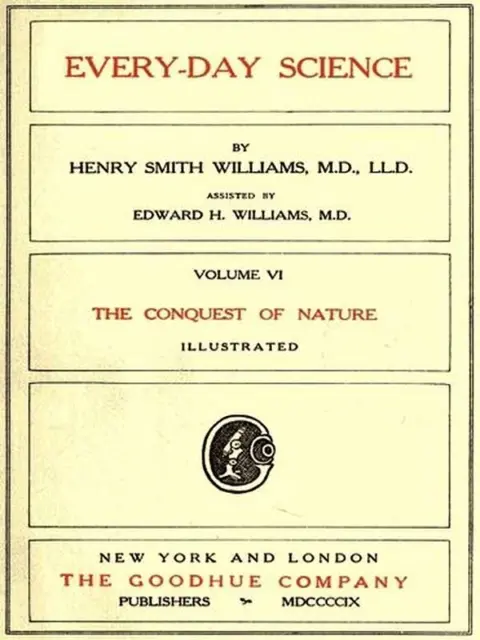
Every-day Science: Volume 6. The Conquest of Nature
Henry Smith Williams & Edward Huntington Williams
THE CLASSIC COLLECTION · 1904
"A History of Science — Volume 5" by Henry Smith Williams, assisted by Edward H. Williams, is a historical account written in the early 20th century. The volume focuses on the aspects of recent science, exploring key developments and institutions that have shaped the field, particularly in the context of the 18th and 19th centuries. It provides a narrative of how science transitioned into modernity through notable personalities and institutions such as the British Museum and the Royal Society. At the start of this volume, the author sets the stage for discussions on significant developments in the world of science, beginning with the founding of the British Museum. He elaborates on the circumstances that led to its establishment, including the lottery set up to fund its formation and the collections it amassed, notably those acquired from Sir Hans Sloane and Egyptian antiquities from Napoleon’s era. The narrative serves as an introduction to the evolution of institutions that play a pivotal role in scientific advancement, while also hinting at the cultural and social implications of scientific discovery that have persisted into modern times.
Introduction adapted from the source catalogue; source summaries may be automatically generated.
Free to read · English · 72,517 words · No account needed
MAKE TIME FOR A GOOD BOOK
On by default. Untick to stop anonymous reading totals. Each page counts after 10 seconds in view. How this works.
Anonymous counting is on unless you have switched it off.
An Inquiry into the Causes and Effects of the Variolo Vaccino, London,
1799.
Laénnec, René Théophile Hyacinthe. See vol. iv., p. 201.
Traité d'auscultation médiate, Paris, 1819. Lamarck, Jean Baptiste de.
See vol. iv., p. 152.
Philosophie zoologique, 8 vols., Paris, 1801. His famous statement of the supposed origin of species occurs on p. 235 of vol. i., as follows: "Everything which nature has caused individuals to acquire or lose by the influence of the circumstance to which their race is long exposed, and consequently by the influence of the predominant employment of such organ, or its constant disuse, she preserves by generation to the new individuals proceeding from them, provided that the changes are common to the two sexes, or to those which have produced these new individuals."
Libbig, Justin. See vol. iv., p. 131.
Animal Chemistry, London, 1843.
Libbig and Wôhler. See vol. iv., p. 56.
The important work of Liebig and Wôhler appeared until 183a mostly in Poggendorff's Armalen, but after 1832 most of Liebig's work appeared in his own Annalen. About the earliest as well as one of his most important separate works is Anleitung zur Analyse organischen, Korper, 1837.
Lotze, Hermann. See vol. iv., p. 263.
Medizinische Psychologie, oder Physiologie der Seele, Leipzig, 1852.
Mohl, Hugo von. See vol. iv., p. 125.
Uber der Saftbewegung im Innern d. Zelle, Bot. Zei-tung, 1846. Morgagni, Giovanni Battista. See vol. iv., p. 76.
De sedibus et causis ntorborum, 2 vols., Venice, 1761.
Oken, Lorenz. See vol. iv., p. 160.
Philosophie der Natur, Zurich, 1802.
Pasteur, Louis. See vol. iv., pp. 217, 233.
Studies on Fermentation, London, 1879. His famous paper on attenuation and inoculation was published in the Compte Rendu of the Academy of Science, Paris, 1881 (vol. xcii.).
Saint-Hilaire, Etienne Geoffroy. See vol. iv., p. 160.
Philosophie anatomique, vol. i., Paris, 1818. Schwann, Theodor. See vol.
iv., p. 119.
Mikroskopische Untersuchungen uber die Ubereinstim-mung in der Structur und dem Wachsthum der Thiere und Pflanzen, Berlin, 1839. Trans, by Sydenham Soc., 1847. Spencer, Herbert. See vol. iv., p. 268.
Principles of Psychology, London, 1855. 260
Treviranus, Gottfried Reinhold. See vol. iv.t p. 159. Biologie, oder Philosophie der lebenden Natur, 1802.
Weber, E. H. See vol. iv., p. 263.
The statement of "Weber's Law*' was first made in articles by Weber contributed to Wagner's Handwârter-buch der Physiologie, but is again stated and elaborated in Fechner's Psychophysik. (See Fechner.) Weismann, August. See vol. iv., p. 179.
Studies in the Theories of Descent. Trans, by Professor R. Meldola, London, 1882. The introduction to this work was written by Darwin. Wohler, Friedrich. ' (See Liebig and Wôhler.) Wundt, Wilhelm Max. See vol. iv., p. 268.
Grundzuge der physiologischen Psychologie, 1874. Many articles by Wundt have appeared in the Philosophische Studien, published at Leipzig.
Astronomische G es disc haft.
A quarterly journal of astronomy published in Leipzig.
Berry, Arthur.
Your reading position is saved on this browser. Take it to another device with a library code. Reading pages adapt to text, rather than matching a printed edition.
Henry Smith Williams & Edward Huntington Williams
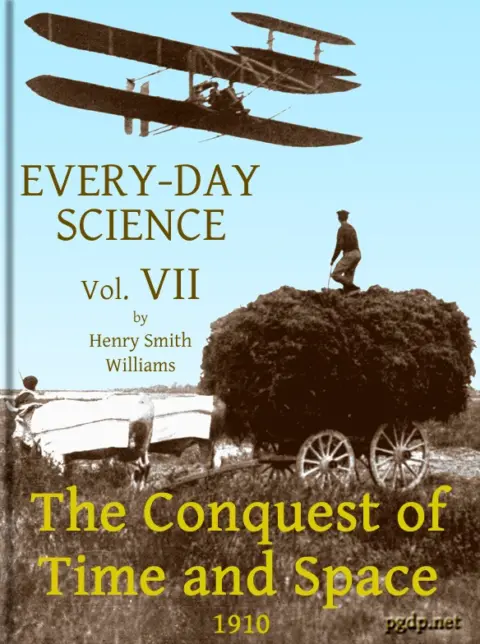
Henry Smith Williams & Edward Huntington Williams
BEHIND THE BOOK
This eBook is for the use of anyone anywhere in the United States and most other parts of the world at no cost and with almost no restrictions whatsoever. You may copy it, give it away or re-use it under the terms of the Project Gutenberg License included with this eBook or online at www.gutenberg.org. If you are not located in the United States, you will have to check the laws of the country where you are located before using this eBook. Read the source licence.
The original source file, including credits and licence, is retained by this library. Request an original-format copy at no charge. Please include the book title and Project Gutenberg identifier #30495.
KEEP YOUR CURIOSITY GOING
Cécile Tormay

Moritz Busch
John L. Ransom
Frances Wright
Cécile Tormay

Mabel Potter Daggett