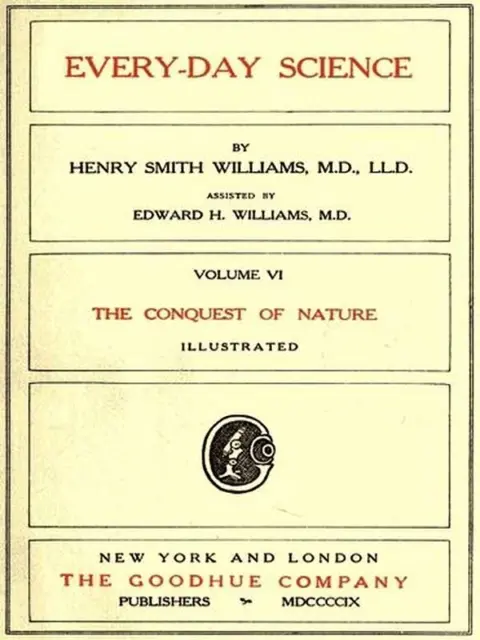
Every-day Science: Volume 6. The Conquest of Nature
Henry Smith Williams & Edward Huntington Williams
THE CLASSIC COLLECTION · 1904
"A History of Science — Volume 5" by Henry Smith Williams, assisted by Edward H. Williams, is a historical account written in the early 20th century. The volume focuses on the aspects of recent science, exploring key developments and institutions that have shaped the field, particularly in the context of the 18th and 19th centuries. It provides a narrative of how science transitioned into modernity through notable personalities and institutions such as the British Museum and the Royal Society. At the start of this volume, the author sets the stage for discussions on significant developments in the world of science, beginning with the founding of the British Museum. He elaborates on the circumstances that led to its establishment, including the lottery set up to fund its formation and the collections it amassed, notably those acquired from Sir Hans Sloane and Egyptian antiquities from Napoleon’s era. The narrative serves as an introduction to the evolution of institutions that play a pivotal role in scientific advancement, while also hinting at the cultural and social implications of scientific discovery that have persisted into modern times.
Introduction adapted from the source catalogue; source summaries may be automatically generated.
Free to read · English · 72,517 words · No account needed
MAKE TIME FOR A GOOD BOOK
On by default. Untick to stop anonymous reading totals. Each page counts after 10 seconds in view. How this works.
Anonymous counting is on unless you have switched it off.
De acido e cibis orlo, et de magnesia, reprinted at Edinburgh, 1854. In this he sketched his discovery of carbonic acid. Later this paper was incorporated in his Experiments on Magnesia, Quicklime, and Other Alkaltne Substances.
Bunsen, William. See vol. iv., p. 69.
Cavendish, Henry. See vol. iv., p. 15.
"Experiments on Air," in Phil. Trans., 1784, p. 119. This paper contains Cavendish's discovery of the composition of water and of nitric acid.
Daguerre, Louis J. M. See vol. iv., p. 70.
Historique et description des procédés du daguerréotype et du diorama, Paris, 1839. (This was translated into English.)
Dalton, John. See vol. iv., p. 40.
"On the Absorption of Gases by Water," read before the Literary and Philosophical Society of Manchester, October 21, 1803. This was published in 1805, and contains the atomic weight of twenty-one substances, some of which were probably added, or corrected, between the date of the first reading and the publication.
Davy, Sir Humphry. See vol. iv., pp. 48, 209.
"Some Chemical Agencies of Electricity," in Phil. Trans, for 1806, vol. viii. Researches, Chemical and Philosophical, chiefly concerning Nitrous Oxide or De-phlogisticated Nitrous Air and its Respiration, London, 1800.
Dewar, James. See vol. v., p. 39.
"Solid Hydrogen," in Proc. Roy. Inst, for 1900. "The Nadir of
Temperature and Allied Problems " (Bakerian Lecture), Proc. Roy. Soc,
1901.
Dufay, Cisternay. See vol. ii., p. 267.
Histoire de l'Académie Royale des Sciences, between 1733 and 1737, contains Dufay's principal papers.
Eulbr, Leonard (1707-1783). See vol. iii., p. 17.
Lettres a une Princesse d'Allemagne sur quelques sujets de physique et de philosophie, St. Petersburg, 1768.
Faraday, Michael. See vol. iii., p. 241.
On the Induction of Electric Currents, in Phil. Trans. of Royal Society for 1832, pp. 126-128. Explication of Arago's Magnetic Phenomena, by Michael Faraday, F.R.S., Phil. Trans, of Royal Society for 1832, pp. 146-149. Franklin, Benjamin. See vol. ii., p. 286.
New Experiments and Observations on Electricity, London, 1760.
Galvani, Luigi (1737-1798). See vol. iii., p. 229.
De viribus electricitatis in motu musculari commentatio, Bologna, 1791. This discovery of Galvani was first brought to notice by Volta's famous paper to the Royal Society, entitled "An Account of some Discoveries made by Mr. Galvani, of Bologna," published in the Phil. Trans, for 1793, pp. 10-44.
Gay-Lussac, Joseph Louis. See vol. iv., p. 41.
Mémoire sur la combinaison des substances gazeuses, Mem. Soc. d'Arcueil,
1809.
Halley, Edmund. See vol. iii., p. 7.
An Account of Several Extraordinary Meteors or Lights in the Sky, in Phil. Trans., vol. xxix., pp. 159-162, London, 1714. Helmholtz, H. L. F. See vol. iii., p. 280.
Handbuch der physiologische Optik, Leipzig, 1867.
Joule, J. P. See vol. iii., p. 269.
On the Calorific Effects of Magneto-Electricity and the Mechanical Value of Heat, in Report of the British Association for the Advancement of Science, 1843, vol. xii" p. 33-
Kirwan, R. See vol. iv., p. 3 ff.
Your reading position is saved on this browser. Take it to another device with a library code. Reading pages adapt to text, rather than matching a printed edition.
Henry Smith Williams & Edward Huntington Williams
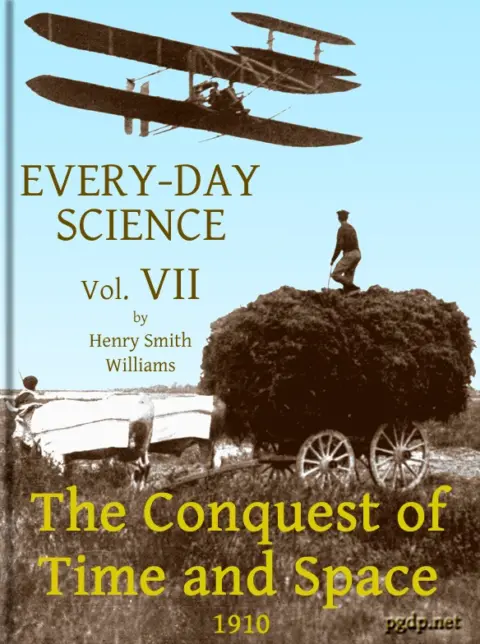
Henry Smith Williams & Edward Huntington Williams
BEHIND THE BOOK
This eBook is for the use of anyone anywhere in the United States and most other parts of the world at no cost and with almost no restrictions whatsoever. You may copy it, give it away or re-use it under the terms of the Project Gutenberg License included with this eBook or online at www.gutenberg.org. If you are not located in the United States, you will have to check the laws of the country where you are located before using this eBook. Read the source licence.
The original source file, including credits and licence, is retained by this library. Request an original-format copy at no charge. Please include the book title and Project Gutenberg identifier #30495.
KEEP YOUR CURIOSITY GOING
Cécile Tormay

Moritz Busch
John L. Ransom
Frances Wright
Cécile Tormay

Mabel Potter Daggett