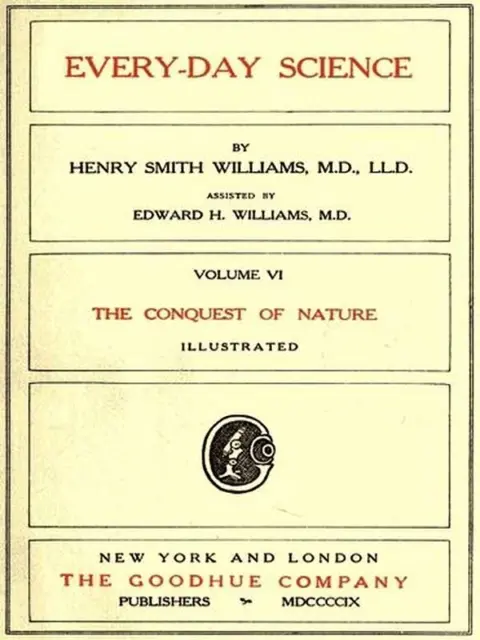
Every-day Science: Volume 6. The Conquest of Nature
Henry Smith Williams & Edward Huntington Williams
THE CLASSIC COLLECTION · 1904
"A History of Science — Volume 5" by Henry Smith Williams, assisted by Edward H. Williams, is a historical account written in the early 20th century. The volume focuses on the aspects of recent science, exploring key developments and institutions that have shaped the field, particularly in the context of the 18th and 19th centuries. It provides a narrative of how science transitioned into modernity through notable personalities and institutions such as the British Museum and the Royal Society. At the start of this volume, the author sets the stage for discussions on significant developments in the world of science, beginning with the founding of the British Museum. He elaborates on the circumstances that led to its establishment, including the lottery set up to fund its formation and the collections it amassed, notably those acquired from Sir Hans Sloane and Egyptian antiquities from Napoleon’s era. The narrative serves as an introduction to the evolution of institutions that play a pivotal role in scientific advancement, while also hinting at the cultural and social implications of scientific discovery that have persisted into modern times.
Introduction adapted from the source catalogue; source summaries may be automatically generated.
Free to read · English · 72,517 words · No account needed
MAKE TIME FOR A GOOD BOOK
On by default. Untick to stop anonymous reading totals. Each page counts after 10 seconds in view. How this works.
Anonymous counting is on unless you have switched it off.
With this all controversy ceased, for the most grasping geologist or biologist would content himself with a fraction of that time. But the case for the geologist was to receive yet another prop from the studies of radio-activity, which seem to prove that the atom of matter has in store a tremendous, supply of potential energy which may be drawn on in a way to vitiate utterly all the computations to which I have just referred. Thus a particle of radium is giving out heat incessantly in sufficient quantity to raise its own weight of water to the boiling-point in an hour. The demonstrated wide distribution of radio-active matter--making it at least an open question whether all matter does not possess this property in some degree--has led to the suggestion that the total heat of the sun may be due to radio-active matter in its substance. Obviously, then, all estimates of the sun's age based on the heat-supply must for the present be held quite in abeyance. What is more to the point, however, is the fact, which these varying estimates have made patent, that computations of the age of the earth based on any data at hand are little better than rough guesses. Long before the definite estimates were undertaken, geologists had proved that the earth is very, very old, and it can hardly be said that the attempted computations have added much of definiteness to that proposition. They have, indeed, proved that the period of time to be drawn upon is not infinite; but the nebular hypothesis, to say nothing of common-sense, carried us as far as that long ago.
If the computations in question have failed of their direct purpose, however, they have been by no means lacking in important collateral results. To mention but one of these, Lord Kelvin was led by this controversy over the earth's age to make his famous computation in which he proved that the telluric structure, as a whole, must have at least the rigidity of steel in order to resist the moon's tidal pull as it does. Hopkins had, indeed, made a somewhat similar estimate as early as 1839, proving that the earth's crust must be at least eight hundred or a thousand miles in thickness; but geologists had utterly ignored this computation, and the idea of a thin crust on a fluid interior had continued to be the orthodox geological doctrine. Since Lord Kelvin's estimate was made, his claim that the final crust of the earth could not have formed until the mass was solid throughout, or at least until a honeycomb of solid matter had been bridged up from centre to circumference, has gained pretty general acceptance. It still remains an open question, however, as to what proportion the lacunas of molten matter bear at the present day to the solidified portions, and therefore to what extent the earth will be subject to further shrinkage and attendant surface contortions. That some such lacunae do exist is demonstrated daily by the phenomena of volcanoes. So, after all, the crust theory has been supplanted by a compromise theory rather than completely overthrown, and our knowledge of the condition of the telluric depths is still far from definite. If so much uncertainty attends these fundamental questions as to the earth's past and present, it is not strange that open problems as to her future are still more numerous. We have seen how, according to Professor Darwin's computations, the moon threatens to come back to earth with destructive force some day. Yet Professor Darwin himself urges that there are elements of fallibility in the data involved that rob the computation of all certainty. Much the same thing is true of perhaps all the estimates that have been made as to the earth's ultimate fate. Thus it has been suggested that, even should the sun's heat not forsake us, our day will become month-long, and then year-long; that all the water of the globe must ultimately filter into its depths, and all the air fly off into space, leaving our earth as dry and as devoid of atmosphere as the moon; and, finally, that ether-friction, if it exist, or, in default of that, meteoric friction, must ultimately bring the earth back to the sun. But in all these prognostications there are possible compensating factors that vitiate the estimates and leave the exact results in doubt. The last word of the cosmic science of our generation is a prophecy of evil--if annihilation be an evil. But it is left for the science of another generation to point out more clearly the exact terms in which the prophecy is most likely to be fulfilled.
Your reading position is saved on this browser. Take it to another device with a library code. Reading pages adapt to text, rather than matching a printed edition.
Henry Smith Williams & Edward Huntington Williams
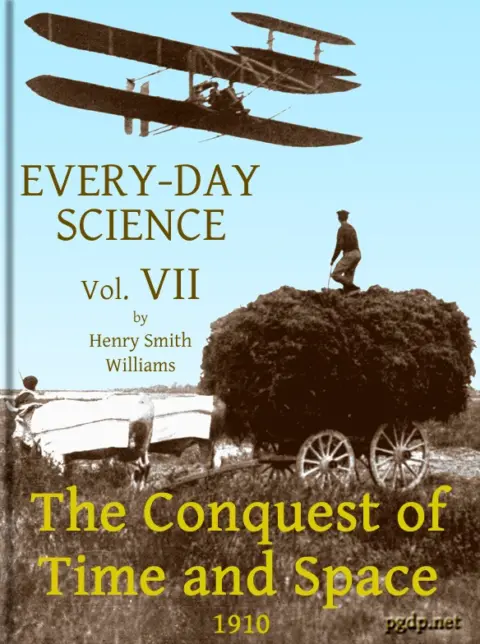
Henry Smith Williams & Edward Huntington Williams
BEHIND THE BOOK
This eBook is for the use of anyone anywhere in the United States and most other parts of the world at no cost and with almost no restrictions whatsoever. You may copy it, give it away or re-use it under the terms of the Project Gutenberg License included with this eBook or online at www.gutenberg.org. If you are not located in the United States, you will have to check the laws of the country where you are located before using this eBook. Read the source licence.
The original source file, including credits and licence, is retained by this library. Request an original-format copy at no charge. Please include the book title and Project Gutenberg identifier #30495.
KEEP YOUR CURIOSITY GOING
Cécile Tormay

Moritz Busch
John L. Ransom
Frances Wright
Cécile Tormay

Mabel Potter Daggett