THE CLASSIC COLLECTION✦An outlaw’s diary: the CommuneCLASSIC FREE BOOKS
An outlaw’s diary: the Commune
Cécile Tormay
THE CLASSIC COLLECTION · 1903
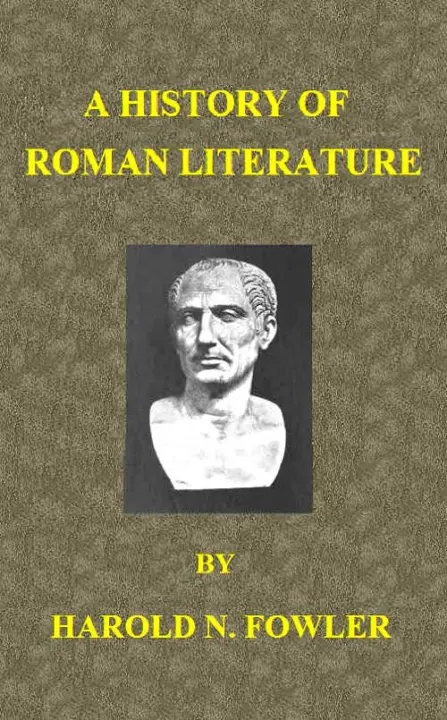
"A History of Roman Literature" by Harold North Fowler is a historical account written in the early 20th century. The book explores the development of Roman literature from its origins during the Republican period through various subsequent eras, detailing key authors and their contributions. It serves as both an educational text for schools and colleges and a reference work about the literary accomplishments of Rome. At the start of the book, the author outlines the significance of Roman literature, noting its roots in Greek literary traditions and its overarching political influence. Fowler discusses the practical character of Roman society, which shaped its literature to reflect political and military concerns rather than pure artistic expression. He introduces key figures, such as Livius Andronicus and Ennius, while also indicating the evolution of literary forms like tragedy and comedy in the context of Roman culture. Through these early chapters, Fowler sets the stage for a comprehensive exploration of the rich tapestry of Roman literary history.
Introduction adapted from the source catalogue; source summaries may be automatically generated.
Free to read · English · 97,375 words · No account needed
MAKE TIME FOR A GOOD BOOK
On by default. Untick to stop anonymous reading totals. Each page counts after 10 seconds in view. How this works.
Anonymous counting is on unless you have switched it off.
Ausonius was a Christian, but his poems have no specifically Christian contents. [Sidenote: Ausonius.] The most important specifically Christian poet of the fourth century is Aurelius Prudentius Clemens, who was born in Spain, at or near Saragossa, in 348 A. D., studied and practised oratory, and held important offices. His life was apparently passed for the most part in Spain, but at one time he held a position at the imperial court of Theodosius. The date of his death is probably about 410 A. D. Prudentius, like Ausonius, employs hexameters and various other classic metres, in which he departs occasionally, but not often, from the rules of quantitative verse. His poems, both epic and lyric, are religious and inspired by earnest faith and genuine enthusiasm. He excels in narrative and description, in wealth and brilliancy of language, but lacks the virtue of simplicity. His poetry was intended to appeal to educated readers, not to the people, and the cultured classes of the time were only too thoroughly accustomed to an artificial style. Yet, in spite of his faults of style, Prudentius is the most important Christian poet of the fourth century, and among the other poets of the time none equal him except Ausonius and Claudian.
[Sidenote: Claudian.] Claudius Claudianus, the last important Roman poet, was, like Livius Andronicus, with whom Roman poetry began, a Greek by birth. He was born in Asia Minor, but lived so long at Alexandria that he called that centre of learning his fatherland (patria). In 395 A. D. he went to Rome, where he was attached to the court of Honorius, from whom he received the rank of patrician and the honor of a statue in the Forum of Trajan. He remained at Rome, or rather at Milan, until 404 A. D., but about that time returned to Alexandria, and married a noble woman of the place, being aided in his suit by Serena, niece and adopted daughter of the Emperor Theodosius and wife of Stilicho. Claudian’s poems all appear to have been written from 395 to 404 A. D., and throughout this period he is the faithful follower and enthusiastic admirer of Stilicho, Whether Stilicho’s death in 408 A. D. relegated Claudian to obscurity, or the poet himself died at about the same time as his patron, can not now be determined. Claudian’s works comprise epic poems on the important events of his times, such as the Gothic war and the war against Gildo, mythological epics, and shorter miscellaneous poems. Among the historical epics are included poems in praise of Honorius and other patrons of the poet, as well as metrical attacks upon Rufinus and Eutropius. The only remains of his mythological epics are three books of a poem, on the Rape of Proserpine, and somewhat more than one hundred lines of a Gigantomachia. In these poems Claudian shows the mythological and antiquarian learning which had for centuries been characteristic of the Alexandrian school of poetry. That school was already old when it was imitated by Catullus and his contemporaries in the early days of Roman poetry, and now, when Roman literature was dying, Alexandria continued to train learned poets. Had Claudian not gone to Italy, he would doubtless have continued to write in his native Greek, and might, as a Greek poet, have rivalled his contemporary Nonnus. In his historical and miscellaneous poems also Claudian exhibits much Alexandrian learning, and at the same time shows an intimate acquaintance with the earlier Roman poets, which is somewhat surprising in one who was educated in the Greek-speaking provinces of the east. It is equally surprising that Claudian uses the Latin language with an ease and grace not attained by any of his contemporaries. His verse is correct, dignified, and harmonious, his diction pure and classical. In these respects, as well as in wealth of imagery, brilliancy of narrative, and skill in composition, he is unequalled by any Roman poet after Statius. His historical poems must be used with caution by historians, for, although facts are not invented, they are presented in a strong light, or left in obscurity, according to the effect they might have upon the reputation of the poet’s friends or enemies. In the exuberance of his praise, Claudian equals the contemporary prose panegyrists, and surpasses the early Alexandrian and most of the later Roman poets. Among his miscellaneous poems none is so well known in modern times, or so modern in tone, as the brief elegy of only twenty-two lines, on an old man of Verona, who never left his suburb, who pressed his staff upon the same sand in which he had crept, counted his years by the changes of crops, not by consuls, and saw the trees grow old which he had seen as little sprouts. The advantages of a quiet, humble life have seldom been more charmingly set forth than in this poem.
Your reading position is saved on this browser. Take it to another device with a library code. Reading pages adapt to text, rather than matching a printed edition.
BEHIND THE BOOK
This eBook is for the use of anyone anywhere in the United States and most other parts of the world at no cost and with almost no restrictions whatsoever. You may copy it, give it away or re-use it under the terms of the Project Gutenberg License included with this eBook or online at www.gutenberg.org. If you are not located in the United States, you will have to check the laws of the country where you are located before using this eBook. Read the source licence.
The original source file, including credits and licence, is retained by this library. Request an original-format copy at no charge. Please include the book title and Project Gutenberg identifier #44975.
KEEP YOUR CURIOSITY GOING
Cécile Tormay

Moritz Busch
John L. Ransom
Frances Wright
Cécile Tormay

Mabel Potter Daggett