THE CLASSIC COLLECTION✦An outlaw’s diary: the CommuneCLASSIC FREE BOOKS
An outlaw’s diary: the Commune
Cécile Tormay
THE CLASSIC COLLECTION · 1903
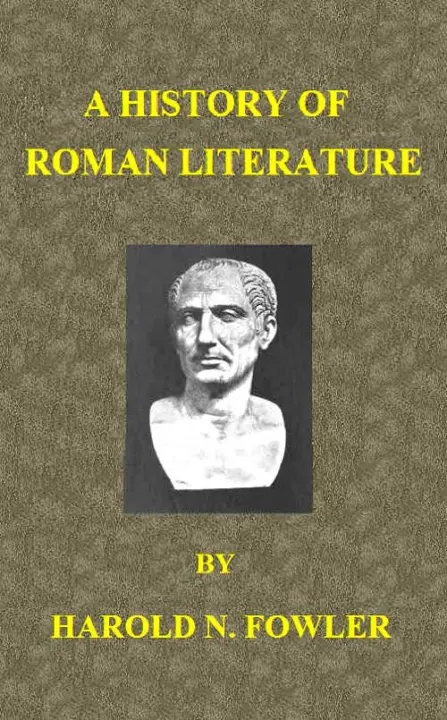
"A History of Roman Literature" by Harold North Fowler is a historical account written in the early 20th century. The book explores the development of Roman literature from its origins during the Republican period through various subsequent eras, detailing key authors and their contributions. It serves as both an educational text for schools and colleges and a reference work about the literary accomplishments of Rome. At the start of the book, the author outlines the significance of Roman literature, noting its roots in Greek literary traditions and its overarching political influence. Fowler discusses the practical character of Roman society, which shaped its literature to reflect political and military concerns rather than pure artistic expression. He introduces key figures, such as Livius Andronicus and Ennius, while also indicating the evolution of literary forms like tragedy and comedy in the context of Roman culture. Through these early chapters, Fowler sets the stage for a comprehensive exploration of the rich tapestry of Roman literary history.
Introduction adapted from the source catalogue; source summaries may be automatically generated.
Free to read · English · 97,375 words · No account needed
MAKE TIME FOR A GOOD BOOK
On by default. Untick to stop anonymous reading totals. Each page counts after 10 seconds in view. How this works.
Anonymous counting is on unless you have switched it off.
Livy’s work was even in his lifetime regarded as the most perfect example of historical writing. The younger Pliny tells us that a citizen of Cadiz travelled all the way to Rome merely to see Livy, and when he had seen him returned at once to Cadiz, feeling that the other sights of Rome were of no further interest. Livy’s influence upon later Roman writers was of the utmost importance, and his work has served as a model for more than one historian in more recent times. His enthusiasm for what is good and noble, his admiration for the great men of Rome, and his worship of Rome itself, give to his work something of the exalted character that belongs to a hymn of praise or a panegyric. His great history served, like Virgil’s Æneid, to give permanent literary expression to the greatness of the past days of the Roman commonwealth.
It would occupy too much space to try to give specimens of all the varieties of Livy’s style and composition. His descriptions of battles, among which that of the defeat of Antiochus at Magnesia[88] deserves special mention, are masterpieces of painting in words, even when they betray his lack of military knowledge, and his summaries of the characters of important persons are admirable. The introduction to the history of the war with Hannibal, with the description of the siege of Saguntum, the hesitation at Rome, and the scene in the Carthaginian senate, is unsurpassed. [Sidenote: Speech of Hanno.] The speech of Hanno, who alone among the Carthaginian senators wished to preserve peace by relinquishing Saguntum and delivering Hannibal into the hands of the Romans, is one of the most remarkable of the many striking passages in this wonderful history:[89]
You have sent to the army, adding, as it were, fuel to the fire, a youth who burns with the desire of ruling, and who sees only one way to his end, if he lives girt with arms and legions, sowing from wars the seed of wars. You have therefore nourished this fire with which you are now burning. Your armies are now surrounding Saguntum, which the treaty forbids them to approach; presently the Roman legions will surround Carthage under the leadership of those same gods by whom in the last war the broken treaties were avenged. Do you not know the enemy, or yourselves, or the fortune of the two peoples? Your good general refused to admit to his camp envoys who came from allies in behalf of allies; they, nevertheless, though refused admittance where even the envoys of enemies are not forbidden to enter, have come to us; they demand restitution in accordance with the treaty; that there may be no deceit on the part of the state, they ask that the author of the wrong and the accused person be delivered up. The more gently they act, the more slowly they begin, the more persistently, I fear, they will rage when once they have begun. Place before your eyes the Ægates islands and Eryx and what you suffered by land and sea for twenty-four years. And that leader was no boy, but his father Hamilcar himself, a second Mars, as his partisans will have it. But we had not kept our hands off from Tarentum, that is from Italy, in obedience to the treaty, as now we are not keeping them off from Saguntum. Therefore the gods overcame men, and in the question at issue, which people had broken the treaty, the event of war, like a just judge, gave the victory to that side on which right stood. It is against Carthage that Hannibal is now moving up his screens and towers; he is shaking the walls of Carthage with his battering-ram. The ruins of Saguntum (may I prove a false prophet!) will fall upon our heads, and the war begun against the Saguntines must be carried on against the Romans. “Shall we then give up Hannibal?” some one will say. I know that in his case my influence has little weight on account of my enmity to his father; but I have been glad that Hamilcar is dead, because if he were living we should already be at war with the Romans, and I hate and detest this youth as the fury and fire-brand of this war, as one who ought not only to be given up as an expiation for the broken treaty, but if no one demanded him, should be carried away to the uttermost shores of sea and land, removed to such a distance that his name and fame could not reach to us nor he disturb the condition of our quiet state. I make this motion: That ambassadors be sent at once to Rome, to give satisfaction to the senate; other envoys to announce to Hannibal that he withdraw his army from Saguntum, and to hand Hannibal himself over to the Romans in pursuance of the treaty; I move a third embassy to restore their property to the Saguntines.
Your reading position is saved on this browser. Take it to another device with a library code. Reading pages adapt to text, rather than matching a printed edition.
BEHIND THE BOOK
This eBook is for the use of anyone anywhere in the United States and most other parts of the world at no cost and with almost no restrictions whatsoever. You may copy it, give it away or re-use it under the terms of the Project Gutenberg License included with this eBook or online at www.gutenberg.org. If you are not located in the United States, you will have to check the laws of the country where you are located before using this eBook. Read the source licence.
The original source file, including credits and licence, is retained by this library. Request an original-format copy at no charge. Please include the book title and Project Gutenberg identifier #44975.
KEEP YOUR CURIOSITY GOING
Cécile Tormay

Moritz Busch
John L. Ransom
Frances Wright
Cécile Tormay

Mabel Potter Daggett