THE CLASSIC COLLECTION✦An outlaw’s diary: the CommuneCLASSIC FREE BOOKS
An outlaw’s diary: the Commune
Cécile Tormay
THE CLASSIC COLLECTION · 1919
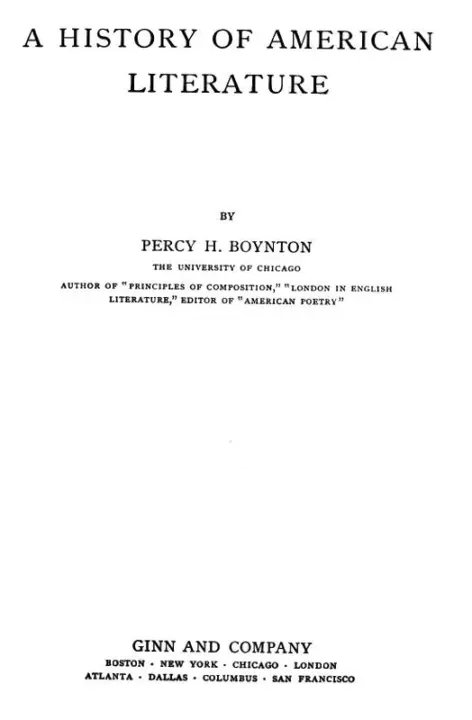
"A History of American Literature" by Percy Holmes Boynton is a comprehensive historical account written in the early 20th century. The book aims to explore the evolution of American literature by emphasizing significant writers and literary movements while providing insight into the development of American thought and culture throughout different historical periods. It is particularly focused on analyzing key works and authors, offering a lens through which readers can understand the complexities of American literary history. At the start of the book, the author establishes that American literature originates from diverse influences, particularly those carried over from England by early settlers. Boynton discusses the uniqueness of American literary beginnings, contrasting it with the literary traditions of established nations. The opening section highlights the formative influences of both the Puritans and Royalists in the context of 17th-century America, outlining how their differing motivations—religious freedom versus economic opportunity—shaped the emerging literary landscape. The text reflects on the character of early American literature as being a mix of religious piety, utilitarian prose, and the seeds of future literary developments, setting the stage for more in-depth examinations of individual authors and their contributions throughout the book.
Introduction adapted from the source catalogue; source summaries may be automatically generated.
Free to read · English · 167,546 words · No account needed
MAKE TIME FOR A GOOD BOOK
On by default. Untick to stop anonymous reading totals. Each page counts after 10 seconds in view. How this works.
Anonymous counting is on unless you have switched it off.
BRUCE, W. C. Benjamin Franklin Self-Revealed: A Biographical and Critical Study based mainly on his own Writings. 1918. 2 vols.
FORD, P. L. The Many-Sided Franklin. 1899.
HALE, E. E. and E. E., Jr. Franklin in France; from original documents most of which are now published for the first time. 1887-1888. 2 vols.
MCMASTER, J. B. Benjamin Franklin (A.M.L. Series). 1887.
MCMASTER, J. B. Franklin in France. Atlantic Monthly, Vol. LX.
September, 1887.
SHERMAN, STUART P. Cambridge History of American Literature,
Vol. I, chap. vi.
SWIFT, LINDSAY. Catalogue of works relating to Benjamin Franklin in the Boston Public Library. 1883.
KITTREDGE, G. L. The Old Farmer and his Almanack. 1904.
COOK, E. C. Cambridge History of American Literature, Vol. I,
chap. vii.
HUDSON, F. Journalism in the United States, 1690-1872. 1873.
THOMAS, I. History of Printing in America. 1871.
=Literary Treatment of the Period=
=Fiction=
COOPER, J. F. Satanstoe.
COOPER, J. F. The Chainbearer.
COOPER, J. F. The Deerslayer.
COOPER, J. F. The Redskins.
THACKERAY, W. M. The Virginians.
=Poetry=
Poems of American History (edited by B. E. Stevenson),
pp. 99-125
Few modern readers can regard the sermons of Jonathan Edwards as anything but documents of historical interest. It is quite worth study to read at first-hand one or two sermons about which so many careless generalizations have been made. The chief points of interest are the theology as it stands in his own living words, and his rhetorical method, which is an admirable exercise of forensic discourse.
Read Harriet Beecher Stowe's "The Minister's Wooing" and "Oldtown Folks" (especially chap. ) for a faithful portrait of one of Edwards's chief successors (see pp. 305-308).
Read Franklin's "Autobiography" for its revelation of personal characteristics: his continued emphasis on usefulness; his refusal to allow his emotions to carry him away (whether anger, love, religious fervor, or desire for revenge); his willingness to act unscrupulously for what he felt was a good end; his self-analysis (in other places than the passage on the virtues); his public spirit.
Read Franklin's "Autobiography" for its literary characteristics: his emulation of Addison's style (compare passages of this and the Spectator); his respect for Pope and his likeness in use of apothegms; his similarity to Chesterfield in point of view and use of homely detail. Contrast Franklin's style with Irving's or Cooper's.
Your reading position is saved on this browser. Take it to another device with a library code. Reading pages adapt to text, rather than matching a printed edition.
BEHIND THE BOOK
This eBook is for the use of anyone anywhere in the United States and most other parts of the world at no cost and with almost no restrictions whatsoever. You may copy it, give it away or re-use it under the terms of the Project Gutenberg License included with this eBook or online at www.gutenberg.org. If you are not located in the United States, you will have to check the laws of the country where you are located before using this eBook. Read the source licence.
The original source file, including credits and licence, is retained by this library. Request an original-format copy at no charge. Please include the book title and Project Gutenberg identifier #45353.
KEEP YOUR CURIOSITY GOING
Cécile Tormay

Moritz Busch
John L. Ransom
Frances Wright
Cécile Tormay

Mabel Potter Daggett