THE CLASSIC COLLECTION✦An outlaw’s diary: the CommuneCLASSIC FREE BOOKS
An outlaw’s diary: the Commune
Cécile Tormay
THE CLASSIC COLLECTION · 1919
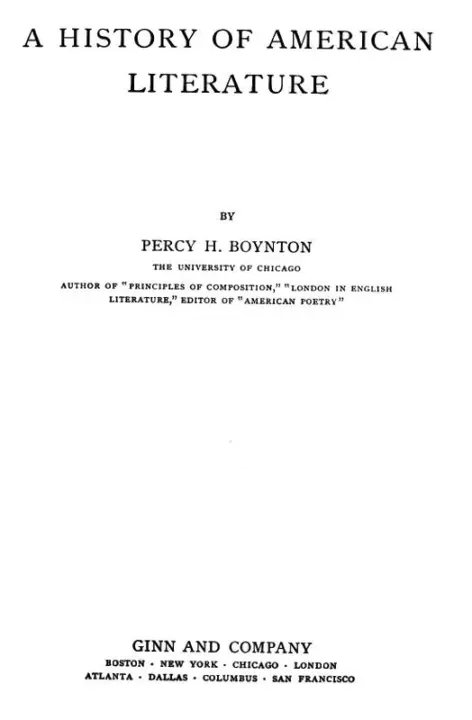
"A History of American Literature" by Percy Holmes Boynton is a comprehensive historical account written in the early 20th century. The book aims to explore the evolution of American literature by emphasizing significant writers and literary movements while providing insight into the development of American thought and culture throughout different historical periods. It is particularly focused on analyzing key works and authors, offering a lens through which readers can understand the complexities of American literary history. At the start of the book, the author establishes that American literature originates from diverse influences, particularly those carried over from England by early settlers. Boynton discusses the uniqueness of American literary beginnings, contrasting it with the literary traditions of established nations. The opening section highlights the formative influences of both the Puritans and Royalists in the context of 17th-century America, outlining how their differing motivations—religious freedom versus economic opportunity—shaped the emerging literary landscape. The text reflects on the character of early American literature as being a mix of religious piety, utilitarian prose, and the seeds of future literary developments, setting the stage for more in-depth examinations of individual authors and their contributions throughout the book.
Introduction adapted from the source catalogue; source summaries may be automatically generated.
Free to read · English · 167,546 words · No account needed
MAKE TIME FOR A GOOD BOOK
On by default. Untick to stop anonymous reading totals. Each page counts after 10 seconds in view. How this works.
Anonymous counting is on unless you have switched it off.
The English novel is nearing the end of its second century of influence. It is a constant in literature which will probably attract more readers than any other single form. Yet it will have its times of greater and lesser popularity, and it seems to have passed the height of a wave shortly after 1900. First the drama came forward with a new challenge to serious attention, and of late poetry has reëstablished itself as a living language.
=General References=
BESANT, SIR WALTER. The Art of Fiction. 1884.
BURTON, RICHARD. Forces in Fiction. 1902.
CRAWFORD, F. MARION. The Novel: what it is. 1903.
CROSS, W. L. The Development of the English Novel. 1899.
FISKE, H. S. Provincial Types in American Fiction. 1903.
GARLAND, HAMLIN. Crumbling Idols. 1894.
HOWELLS, W. D. Criticism and Fiction. 1895.
HOWELLS, W. D. Heroines of Fiction. 1901.
JAMES, HENRY. The Art of Fiction, in Partial Portraits.
JAMES, HENRY. The New Novel, in Notes on Novelists. 1914.
LANIER, SIDNEY. The English Novel. 1883.
MATTHEWS, BRANDER. Aspects of Fiction. 1896.
MATTHEWS, BRANDER. The Historical Novel and Other Essays. 1901.
NORRIS, FRANK. The Responsibilities of the Novelist. 1901.
PATTEE, F. L. American Literature since 1870, chaps. xi, xii, xvii.
1916.
PERRY, BLISS. A Study of Prose Fiction, chap. xiii. 1902.
PHELPS, W. L. Essays on Modern Novelists. (Howells, Mark Twain.) 1910.
=Individual Works=
The field is so extensive that no lists of works by the authors mentioned are included here. The novels selected for reading can be taken from the specific references in the text. All the works are in print and easily available.
=Magazine Articles=
The magazine articles on fiction are extremely numerous. From among those since 1900 the following are of special interest:
1900-1904. New Element in Modern Fiction. N. Boyce. Bookman, Vol. XIII, p. 149. April, 1901.
Novel and the Short Story. G. Atherton. Bookman, Vol. XVII, pp. 36-37. March, 1903.
Novel and the Theater. Nation, Vol. LXXII, pp. 210-211.
March 14, 1901.
1905-1909. Confessions of a Best-Seller. Atlantic, Vol. CIV, pp. 577-585. November, 1909.
Convention of Romance. Bookman, Vol. XXVI, pp. 266-267.
November, 1907.
Humor and the Heroine. Atlantic, Vol. XCV, pp. 852-854.
June, 1905.
Mob Spirit in Literature. H. D. Sedgwick. Atlantic, Vol. XCVI, pp. 9-15. July, 1905.
Purpose Novel. F. T. Cooper. Bookman, Vol. XXII, pp.
131-132. October, 1905.
1910-1914. American and English Novelists. Nation, Vol. XCVIII, pp. 422-423. April 16, 1914.
American backgrounds for fiction:
Georgia. W. N. Harben. Bookman, Vol. XXXVIII, pp.
186-192. October, 1913.
North Carolina. T. Dixon. Bookman, Vol. XXXVIII, pp.
511-514. January, 1914.
Tennessee. M. T. Daviess. Bookman, Vol. XXXVIII, pp.
394-399. December, 1913.
North Country of New York. I. Bacheller. Bookman, Vol. XXXVIII, pp. 624-628. February, 1914.
Pennsylvania Dutch. H. R. Martin. Bookman, Vol. XXXVIII, pp. 244-247. November, 1913.
American Novel in England. G. Atherton. Bookman, Vol. XXX, pp. 633-640. February, 1910.
Your reading position is saved on this browser. Take it to another device with a library code. Reading pages adapt to text, rather than matching a printed edition.
BEHIND THE BOOK
This eBook is for the use of anyone anywhere in the United States and most other parts of the world at no cost and with almost no restrictions whatsoever. You may copy it, give it away or re-use it under the terms of the Project Gutenberg License included with this eBook or online at www.gutenberg.org. If you are not located in the United States, you will have to check the laws of the country where you are located before using this eBook. Read the source licence.
The original source file, including credits and licence, is retained by this library. Request an original-format copy at no charge. Please include the book title and Project Gutenberg identifier #45353.
KEEP YOUR CURIOSITY GOING
Cécile Tormay

Moritz Busch
John L. Ransom
Frances Wright
Cécile Tormay

Mabel Potter Daggett