THE CLASSIC COLLECTION✦An outlaw’s diary: the CommuneCLASSIC FREE BOOKS
An outlaw’s diary: the Commune
Cécile Tormay
THE CLASSIC COLLECTION · 1919
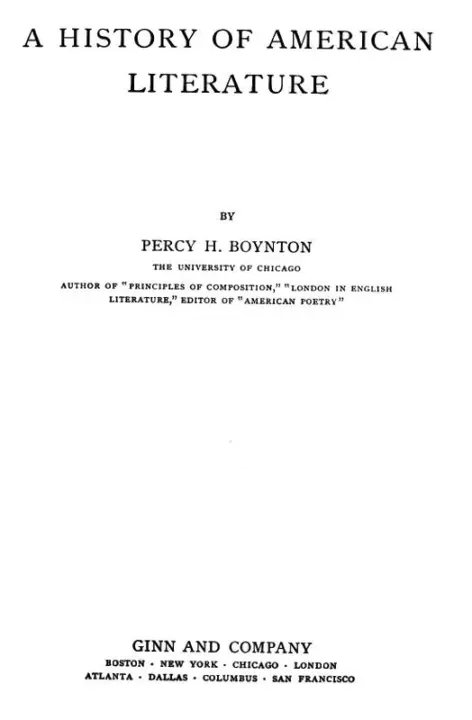
"A History of American Literature" by Percy Holmes Boynton is a comprehensive historical account written in the early 20th century. The book aims to explore the evolution of American literature by emphasizing significant writers and literary movements while providing insight into the development of American thought and culture throughout different historical periods. It is particularly focused on analyzing key works and authors, offering a lens through which readers can understand the complexities of American literary history. At the start of the book, the author establishes that American literature originates from diverse influences, particularly those carried over from England by early settlers. Boynton discusses the uniqueness of American literary beginnings, contrasting it with the literary traditions of established nations. The opening section highlights the formative influences of both the Puritans and Royalists in the context of 17th-century America, outlining how their differing motivations—religious freedom versus economic opportunity—shaped the emerging literary landscape. The text reflects on the character of early American literature as being a mix of religious piety, utilitarian prose, and the seeds of future literary developments, setting the stage for more in-depth examinations of individual authors and their contributions throughout the book.
Introduction adapted from the source catalogue; source summaries may be automatically generated.
Free to read · English · 167,546 words · No account needed
MAKE TIME FOR A GOOD BOOK
On by default. Untick to stop anonymous reading totals. Each page counts after 10 seconds in view. How this works.
Anonymous counting is on unless you have switched it off.
The number of more or less successful portrayers of provincial types in American fiction defies even enumeration. The most effective have, however, been unsatisfied with depicting the mere idiosyncrasies of a region heavily propped by dialect and have gone on to the interpretation of life as it might express itself anywhere under similar conditions. Thus the "Old Chester" of Mrs. Margaret Deland (1857- ) is a study of isolated conservatisms thrown into relief by the wise sanity of Dr. Lavendar. Old Chester, we are told, is in Pennsylvania. It might be in any state or country where narrow respectability could intrench itself. It is an American Cranford. In the "Old Chester Tales" (1898) "The Promises of Dorothea" involve her utterly respectable elopement with Mr. King, whose worst offense in the eyes of her guardian maiden aunts is that he has lived abroad for many years. The implied departure from Old Chester customs is sufficient condemnation. "Good for the Soul" culminates with the doctor's sensible advice to Elizabeth Day, who, at the end of twelve years of happy marriage, is oppressed by the memory of a Bohemian girlhood of which her husband is ignorant. "Suppose," said the doctor, "I hadn't found her a good woman, should I have told her to hold her tongue?" "The Child's Mother" is the story of an unregenerate whose baby Dr. Lavendar keeps away from her by a process we should call blackmail if it were not practiced by a saint. Wide and varied as her output is, Mrs. Deland has nowhere shown her artistry more finely than in the two Dr. Lavendar volumes.
The comments of Edith Wharton (1862- ) on American life are from the cosmopolitan point of view and present a series of pictures of the American woman which for harshness of uncharity are difficult to parallel. As a matter of fact America is so vast and varied that there is no national type of woman. Mrs. Wharton's women are representative of one stratum just as Christy's pictorial girls are. They are the product of indulgence which makes them hard, capricious, and completely selfish. Lily Bart of "The House of Mirth" (1905) begins high in the social scale, compromises reluctantly with moneyed ambition, and in one instance after another defeats herself by delay and equivocation in a declining series of "affairs." More approachable than irreproachable, she suffers from the social beclouding of her reputation and, in the end, as a consequence of her low standards but her lack of shamelessness she succumbs to the circumstances that created her and arrives at a miserable death. Undine Spragg, in "The Custom of the Country" (1913), first married and divorced in a Western town is then brought to New York, introduced into society and "made" by her good looks and her brazen ambition. She wrecks the life of her second husband, a refined gentleman, and then as a result of much foreign residence marries a Frenchman of family. From him she runs away, finally to remarry Moffatt, who, throughout the story, has been her familiar spirit, subtly revealing his intimacy of feeling, and increasing his hold upon her as he rises in the money world. The title gives the cue to the story as a whole and to its several parts. By nature Undine is coarse-grained, showy, and selfish; by upbringing she becomes incorrigible. Her first and last husband is one of her own kind--sufficiently so that he is capable of resuming with her after her streaky, intermediate career. The second is broken on her overweening selfishness; the third, by virtue of his ancient family tradition, is able to save himself though not to mold or modify her. At the end, with Moffatt and all his immense wealth, she is still confronted by "the custom of the country." Because of her divorces "she could never be an ambassador's wife; and as she advanced to welcome her first guest she said to herself that it was the one part she was really made for." This is the Wharton formula: none of her women really triumphs. Lily Bart's downfall is one with her death. She had breathed the stifling atmosphere from her city childhood; what seemed to save Undine was the initial vigor of her Western youth, but even she could not successfully defy the ways of the world.
Your reading position is saved on this browser. Take it to another device with a library code. Reading pages adapt to text, rather than matching a printed edition.
BEHIND THE BOOK
This eBook is for the use of anyone anywhere in the United States and most other parts of the world at no cost and with almost no restrictions whatsoever. You may copy it, give it away or re-use it under the terms of the Project Gutenberg License included with this eBook or online at www.gutenberg.org. If you are not located in the United States, you will have to check the laws of the country where you are located before using this eBook. Read the source licence.
The original source file, including credits and licence, is retained by this library. Request an original-format copy at no charge. Please include the book title and Project Gutenberg identifier #45353.
KEEP YOUR CURIOSITY GOING
Cécile Tormay

Moritz Busch
John L. Ransom
Frances Wright
Cécile Tormay

Mabel Potter Daggett