THE CLASSIC COLLECTION✦An outlaw’s diary: the CommuneCLASSIC FREE BOOKS
An outlaw’s diary: the Commune
Cécile Tormay
THE CLASSIC COLLECTION · 1919
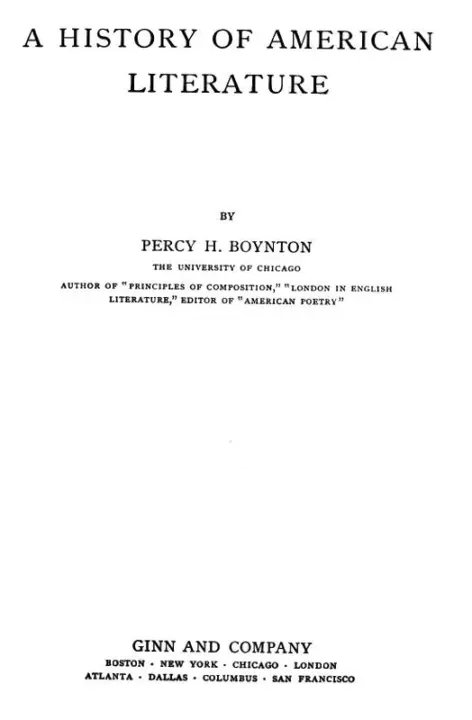
"A History of American Literature" by Percy Holmes Boynton is a comprehensive historical account written in the early 20th century. The book aims to explore the evolution of American literature by emphasizing significant writers and literary movements while providing insight into the development of American thought and culture throughout different historical periods. It is particularly focused on analyzing key works and authors, offering a lens through which readers can understand the complexities of American literary history. At the start of the book, the author establishes that American literature originates from diverse influences, particularly those carried over from England by early settlers. Boynton discusses the uniqueness of American literary beginnings, contrasting it with the literary traditions of established nations. The opening section highlights the formative influences of both the Puritans and Royalists in the context of 17th-century America, outlining how their differing motivations—religious freedom versus economic opportunity—shaped the emerging literary landscape. The text reflects on the character of early American literature as being a mix of religious piety, utilitarian prose, and the seeds of future literary developments, setting the stage for more in-depth examinations of individual authors and their contributions throughout the book.
Introduction adapted from the source catalogue; source summaries may be automatically generated.
Free to read · English · 167,546 words · No account needed
MAKE TIME FOR A GOOD BOOK
On by default. Untick to stop anonymous reading totals. Each page counts after 10 seconds in view. How this works.
Anonymous counting is on unless you have switched it off.
=Bibliographies=
Good bibliographies in Lounsbury's Life (see below), and Cambridge History of American Literature, Vol. I, pp. 532-534.
=Biography and Criticism=
There is no official biography, Cooper having opposed such a publication. The best single volume is by T. R. Lounsbury (A.M.L. Series).
BROWNELL, W. C. Cooper. Scribner's Magazine, April, 1906. Also in American Prose Masters. 1909.
BRYANT, W. C. A Discourse on the Life and Genius of James
Fenimore Cooper. 1852.
CLEMENS, S. L. (Mark Twain). Fenimore Cooper's Literary Offenses. North American Review, July, 1895. Also in How to tell a Story and Other Essays. 1897.
ERSKINE, JOHN. Leading American Novelists. 1910.
HILLARD, G. S. Fenimore Cooper. Atlantic Monthly, January,
1862.
HOWE, M. A. DEW. James Fenimore Cooper. The Bookman, March, 1897. Also in American Bookmen. 1898.
HOWELLS, W. D. Heroines of Fiction. 1901.
MATTHEWS, B. Fenimore Cooper. Atlantic Monthly, September, 1907. Also in Gateways to Literature. 1912.
PHILLIPS, MARY E. James Fenimore Cooper. 1913.
SIMMS, W. C. The Writings of J. Fenimore Cooper. Views and
Reviews. 1845. Ser. 1.
STEDMAN, E. C. Poe, Cooper, and the Hall of Fame. North American Review, August, 1907.
TUCKERMAN, H. T. James Fenimore Cooper. North American Review,
October, 1859.
VAN DOREN, CARL. Cambridge History of American Literature. Vol.
I, Bk. II, in chap. vi.
VINCENT, L. H. American Literary Masters. 1906.
WILSON, J. G. Cooper Memorials and Memories. The Independent,
January 31, 1901.
Read Brownell's defense of Cooper's Indian characters in his "Masters of American Prose" and check his statements by your own observations in a selected novel.
Read the comments of Brownell in "American Prose Masters," and of Lounsbury in the A. M. L. Series, on Cooper's women, and then arrive at your own conclusions from the reading of a selected novel.
If you have read two or three of Cooper's novels, see if he has introduced his usual polished gentleman and his bore or pedant in each, and see how nearly these characters correspond in themselves and in their story value.
Make a study of the actual plot and its development in any selected
novel of Cooper's.
Read Mark Twain's essay on "Fenimore Cooper's Literary Offenses" and decide on how far it is fair and how far it was dictated by Mark Twain's hostility to romantic fiction.
Read Cooper's prefaces to a half-dozen or more novels for the light they will throw on his belligerency of temper.
Read "Home as Found" for comparison of the topics treated with those in the "Salmagundi" and "Croaker" papers, for observation on the variety of American weaknesses presented, for a decision as to how fundamental or how superficial these weaknesses were, and for a conclusion as to the amount of evident ill temper in the book.
Your reading position is saved on this browser. Take it to another device with a library code. Reading pages adapt to text, rather than matching a printed edition.
BEHIND THE BOOK
This eBook is for the use of anyone anywhere in the United States and most other parts of the world at no cost and with almost no restrictions whatsoever. You may copy it, give it away or re-use it under the terms of the Project Gutenberg License included with this eBook or online at www.gutenberg.org. If you are not located in the United States, you will have to check the laws of the country where you are located before using this eBook. Read the source licence.
The original source file, including credits and licence, is retained by this library. Request an original-format copy at no charge. Please include the book title and Project Gutenberg identifier #45353.
KEEP YOUR CURIOSITY GOING
Cécile Tormay

Moritz Busch
John L. Ransom
Frances Wright
Cécile Tormay

Mabel Potter Daggett