
The Writing of News A Handbook with Chapters on Newspaper Correspondence and Copy Reading
Charles G. (Charles Griffith) Ross
THE CLASSIC COLLECTION · 1892
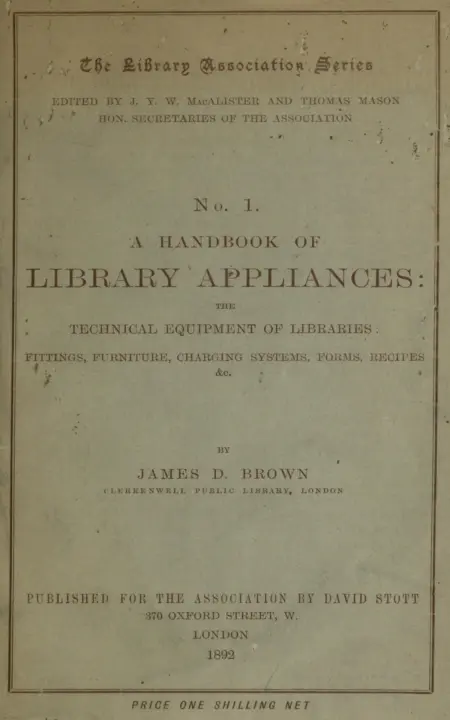
"A Handbook of Library Appliances" by James Duff Brown is a practical guide focused on the technical equipment needed for libraries, written in the late 19th century. This work aims to assist librarians in efficiently setting up various aspects of library management, including fittings, furniture, and record-keeping systems. It compiles comprehensive details about tools, furniture, and operational frameworks essential for the smooth running of libraries. The opening of this handbook outlines the founding and objectives of the Library Association of the United Kingdom, highlighting its role in fostering collaboration and improvements in library operations. It introduces the idea of a framework for helping those involved in library management, elaborating on key initiatives like the introduction of library appliances and the importance of upgrading library systems. It also mentions significant inventions and innovations, such as the Library Indicator and Cotgreave's designs, which aim to enhance the functionality and user experience within public libraries. Overall, the beginning sets the tone for a detailed exploration of library apparatus designed to ease the librarian's tasks and improve library services for the public.
Introduction adapted from the source catalogue; source summaries may be automatically generated.
Free to read · English · 19,668 words · No account needed
MAKE TIME FOR A GOOD BOOK
On by default. Untick to stop anonymous reading totals. Each page counts after 10 seconds in view. How this works.
Anonymous counting is on unless you have switched it off.
The “Cotgreave” indicator, invented by Mr. Alfred Cotgreave, now librarian of West Ham, London, differs from the Elliot in principle and appearance, and is more economical in the space required. It consists of an iron frame, divided into columns of 100 by means of wooden uprights and tin slides; but has numbered blank books in every space, instead of an alternation of numbered uprights and spaces. Into each space is fitted a movable metal case, cloth-covered, containing a miniature ledger ruled to carry a record of borrowers’ numbers and dates of issue. These cases are turned up at each end, thus [Illustration], and the book-number appears at one end on a red ground and at the other on a blue ground.
[Illustration: FIG. 10.[8]—COTGREAVE’S INDICATOR]
The blue end is shown to the public to indicate books in, and the red end to indicate books out. The ordinary method of working it is as follows: The borrower, having found the number of the book wanted indicated in (blue), asks for it by number at the counter, and hands over his ticket. The assistant, having procured the book, next withdraws the indicator-book and enters in the first blank space the reader’s ticket-number and the date, reverses the little ledger to show the number out, and leaves in it the borrower’s card; stamps or writes the date on the issue-label of the book, and gives it to the reader. On return the indicator number is simply turned round, and the borrower receives back his card. “Overdues” can be shown by means of coloured clips, or by having the borrowers’ cards shaped or coloured, and issues are recorded on day-sheets, or by means of application forms. There are, however, endless ways of working both the Elliot and Cotgreave indicators, though there is only space to describe the most elementary forms. Like every other department of library work, the working of an indicator-charging system will bear careful thought, and leave room for original developments. The “Duplex” indicator, invented by Mr. A. W. Robertson, librarian of Aberdeen, has several novel features which call for attention. A full-sized Duplex indicator occupies 5 ft. 4 in. of counter space for every 2000 numbers, while a smaller pattern for a similar number occupies 3 ft. 8 in. of counter space, both being 4 ft. high, and is a frame fitted with slides in the manner of the Cotgreave and Elliot indicators. It is also a catalogue, and the numbers and titles of books are given on the blocks which fit into numbered spaces. Each block has a removable and reversible sheet for carrying a record consisting of borrower’s number, number in ticket-register, and date of issue. The borrowers’ cards are made of wood, and also bear a removable slip for noting the numbers of books read. When a book is asked for the assistant proceeds first to the indicator and removes the block, which bears on its surface the location marks and accession number of the book, and on one end the number and title of the book; the other being coloured red to indicate out, but also bearing the number. He then carries the reader’s number on to the block, and having got and issued the book, leaves the block and card on a tray. This is all that is done at the moment of issue, and it is simple enough, all the registration being postponed till another time. The assistant who does this takes a tray of blocks and cards and sits down in front of the ticket-register, which is a frame divided into compartments, consecutively numbered up to five hundred or more, and bearing the date of issue. He then selects a card and block, carries the book-number on to the borrower’s card, and the number of the first vacant ticket-register compartment, with the date, on to the book block, and leaves the borrower’s card in the register. Probably the statistical returns will also be made up at this time. The blocks are then placed reversed in the indicator, and so are shown out to the public. When a book is returned, the assistant proceeds to the indicator to turn the block, and while doing so notes the date and register number, and then removes and returns the borrower’s card. By this process the ticket-register is gradually weeded, till on the expiry of the period during which books can be kept without fine, all tickets remaining are removed to the overdue register, which bears the same date, and are placed in its compartments according to the order of the ticket-register. A slip bearing those numbers is pinned down the side of the overdue register so that defaulters can easily be found.
Your reading position is saved on this browser. Take it to another device with a library code. Reading pages adapt to text, rather than matching a printed edition.
BEHIND THE BOOK
This eBook is for the use of anyone anywhere in the United States and most other parts of the world at no cost and with almost no restrictions whatsoever. You may copy it, give it away or re-use it under the terms of the Project Gutenberg License included with this eBook or online at www.gutenberg.org. If you are not located in the United States, you will have to check the laws of the country where you are located before using this eBook. Read the source licence.
The original source file, including credits and licence, is retained by this library. Request an original-format copy at no charge. Please include the book title and Project Gutenberg identifier #68130.
KEEP YOUR CURIOSITY GOING
Charles G. (Charles Griffith) Ross
Hannah Webster Foster

Emily Lawless
Edwin Hamlin Carr

Charles De Lano Hine
Andrew Ure