
The Writing of News A Handbook with Chapters on Newspaper Correspondence and Copy Reading
Charles G. (Charles Griffith) Ross
THE CLASSIC COLLECTION · 1893
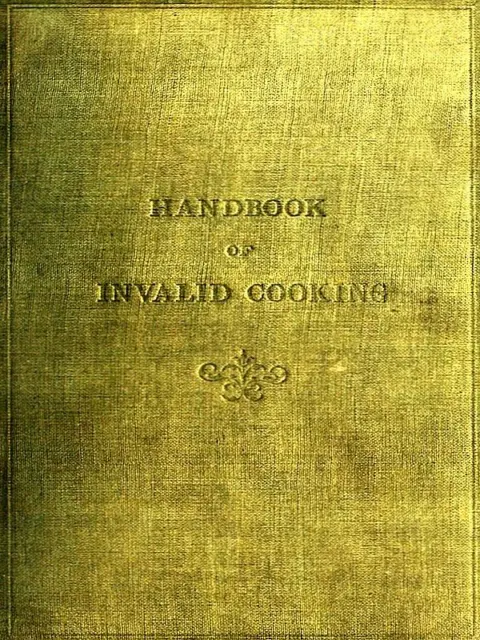
"A Handbook of Invalid Cooking" by Mary A. Boland is a scientific publication written in the late 19th century. The work serves as a guide for nurses in training and those caring for the sick, focusing on the principles of nutrition, the properties of different food types, and providing recipes for suitable dishes for patients. It is designed to educate its readers on the importance of proper nourishment and food preparation in promoting health and recovery. The opening of the handbook outlines its purpose and structure, emphasizing the need for knowledge in the areas of hygiene, chemistry, and proper food preparation for nurses. Boland introduces the significance of cleanliness, the role of food in the healing process, and the basic principles of nutrition that nurses should understand to effectively care for their patients. The text also highlights the importance of various food elements, such as proteins, fats, and carbohydrates, and sets the stage for more detailed dietary guidelines and practical recipes in subsequent sections. Overall, it provides a foundational view of the relationship between food, health, and the meticulous care required in the nursing profession.
Introduction adapted from the source catalogue; source summaries may be automatically generated.
Free to read · English · 82,286 words · No account needed
MAKE TIME FOR A GOOD BOOK
On by default. Untick to stop anonymous reading totals. Each page counts after 10 seconds in view. How this works.
Anonymous counting is on unless you have switched it off.
[22] The body loses each day, in the performance of its ordinary and usual functions, about nine pounds of matter (Martin); therefore, that amount of income of food, water, and air will be needed in every twenty-four hours.
[23] Prof. Atwater, in "The Century Magazine," 1887-88.
[24] Hemoglobin, the red coloring matter of the blood, contains
albumen.
[25] Protein may be converted into fat; but although this will happen, it will not do to depend upon it for the supply in the nutrition of the body; for either it cannot be formed in sufficient quantity, or the excess of nitrogen acts as a poison. The body suffers unless a due amount of fat as such be taken. (Martin.)
[26] By regulating the amount of fat taken each day with food, so that a little less than is needed is consumed, one may reduce the amount of fat of the body and become thin, or reduce an excess of fat without injury to health. The process must be gradual, and continued for a number of months. Bismarck, by the advice of his physician, reduced himself in this way without loss of energy or any ill feeling.
[27] Flint's "Physiology."
[28] Parkes.
[29] Martin.
[30] Martin.
[31] Composition of oatmeal:
Nitrogenous matter 12.6%
Carbohydrates, starch, etc. 63.8%
Fatty matter 5.6%
Mineral matter 3.0%
Water 15.0%
-------
Total 100.00%
From Prof. Mott's Chart of the Composition, Digestibility, and
Nutritive Value of Food.
[32] For a further account of micro-organisms in milk, see the
chapter on Milk.
[33] George Kennan, in his accounts of his perilous journeyings through Siberia, bears ample testimony to the comforting effects of hot tea. Often when he and his companion were chilled through, and almost dead with cold and fatigue, after many hours' travel over the frozen snows, they were revived by draughts of hot tea provided at the stations.
[34] The ash of tea contains potash, soda, magnesia, phosphoric acid, chlorin, carbonic acid, iron, silica, and traces of manganese.
{ Water 74.00%
Egg Whole { Nitrogenous matter 14.00%
{ Fat 10.50%
{ Inorganic matter 1.50%
[36] Another analysis is that of Payen, the distinguished French
chemist.
Water 74.4%
Starch, sugar, pectose 21.2%
Nitrogenous matter 1.7%
Fat .1%
Cellulose and epidermis 1.5%
Inorganic matter 1.1%
-------
Total 100.00%
Pohl found the proportion of starch, judging by specific gravity in different varieties, to be as follows: 16.38%, 17.11%, 18.43%, 18.95%, 20.45%, 21.32%, 24.14%.
DR. SMITH'S "Food."
[37] Mattieu Williams.
[38] From actual experiment.
[39] From Mrs. Lincoln's "Boston Cook Book."
[40] Pink sugar may be made by putting a few drops of carmine into a cup of powdered sugar, and sifting it several times until the carmine is entirely distributed through it.
[41] Mrs. Richards.
[42] A portion of the starch and sugar is consumed to feed the growing yeast. It has been estimated that about 1/7 of a barrel of flour is lost in raising bread--that is, that amount is consumed by the yeast used.
Your reading position is saved on this browser. Take it to another device with a library code. Reading pages adapt to text, rather than matching a printed edition.
BEHIND THE BOOK
This eBook is for the use of anyone anywhere in the United States and most other parts of the world at no cost and with almost no restrictions whatsoever. You may copy it, give it away or re-use it under the terms of the Project Gutenberg License included with this eBook or online at www.gutenberg.org. If you are not located in the United States, you will have to check the laws of the country where you are located before using this eBook. Read the source licence.
The original source file, including credits and licence, is retained by this library. Request an original-format copy at no charge. Please include the book title and Project Gutenberg identifier #54568.
KEEP YOUR CURIOSITY GOING
Charles G. (Charles Griffith) Ross
Hannah Webster Foster

Emily Lawless
Edwin Hamlin Carr

Charles De Lano Hine
Andrew Ure