THE CLASSIC COLLECTION✦Inhibition, symptom and anxietyCLASSIC FREE BOOKS
Inhibition, symptom and anxiety
Sigmund Freud
THE CLASSIC COLLECTION · 1920
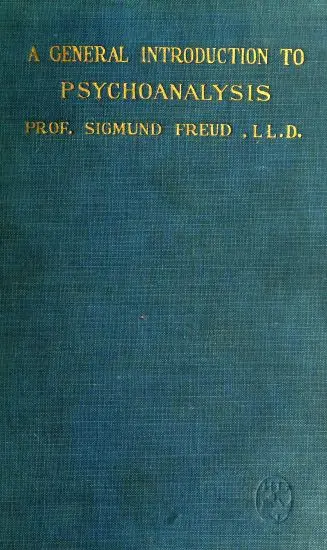
"A General Introduction to Psychoanalysis" by Sigmund Freud is a set of lectures given in 1915-1917. In twenty-eight accessible talks, Freud presents his revolutionary ideas about the unconscious mind, dreams, and neuroses to a lay audience. Beginning with everyday slips of the tongue, progressing through dream analysis, and culminating in theories of mental illness, he grounds his radical psychological theories in common experience. The lectures became his most popular and widely translated work, offering both newcomers and advanced readers insight into the foundations of psychoanalytic thought.
Introduction adapted from the source catalogue; source summaries may be automatically generated.
Free to read · English · 157,131 words · No account needed
MAKE TIME FOR A GOOD BOOK
On by default. Untick to stop anonymous reading totals. Each page counts after 10 seconds in view. How this works.
Anonymous counting is on unless you have switched it off.
One cannot maintain that the world was very grateful to psychoanalytic research for its discovery of the Oedipus-complex. On the contrary, it called forth the strongest resistance on the part of adults; and persons who had neglected to take part in denying this proscribed or tabooed feeling-relationship later made good the omission by taking all value from the complex through false interpretations. According to my unchanged conviction there is nothing to deny and nothing to make more palatable. One should accept the fact, recognized by the Greek myth itself, as inevitable destiny. On the other hand, it is interesting that this Oedipus-complex, cast out of life, was yielded up to poetry and given the freest play. O. Rank has shown in a careful study how this very Oedipus-complex has supplied dramatic literature with a large number of motives in unending variations, derivations and disguises, also in distorted forms such as we recognize to be the work of a censor. We may also ascribe this Oedipus-complex to those dreamers who were so fortunate as to escape in later life these conflicts with their parents, and intimately associated therewith we find what we call the castration complex, the reaction to sexual intimidation or restriction, ascribed to the father, of early infantile sexuality.
By applying our former researches to the study of the psychic life of the child, we may expect to find that the origin of other forbidden dream-wishes, of excessive sexual impulses, may be explained in the same manner. Thus we are moved to study the development of sex-life in the child also, and we discover the following from a number of sources: In the first place, it is a mistake to deny that the child has a sexual life, and to take it for granted that sexuality commences with the ripening of the genitals at the time of puberty. On the contrary--the child has from the very beginning a sexual life rich in content and differing in numerous respects from that which is later considered normal. What we call "perverse" in the life of the adult, differs from the normal in the following respects: first, in disregard for the dividing line of species (the gulf between man and animal); second, being insensible to the conventional feeling of disgust; third, the incest-limitation (being prohibited from seeking sexual satisfaction with near blood-relations); fourth, homosexuality, and fifth, transferring the role of the genitals to other organs and other parts of the body. None of these limitations exist in the beginning, but are gradually built up in the course of development and education. The little child is free from them. He knows no unbridgable chasm between man and animal; the arrogance with which man distinguishes himself from the animal is a later acquisition. In the beginning he is not disgusted at the sight of excrement, but slowly learns to be so disgusted under the pressure of education; he lays no special stress on the difference between the sexes, rather accredits to both the same genital formation; he directs his earliest sexual desires and his curiosity toward those persons closest to him, and who are dear to him for various reasons--his parents, brothers and sisters, nurses; and finally, you may observe in him that which later breaks through again, raised now to a love attraction, viz., that he does not expect pleasure from his sexual organs alone, but that many other parts of the body portray the same sensitiveness, are the media of analogous sensations, and are able to play the role of the genitals. The child may, then, be called "polymorphus perverse," and if he makes but slight use of all these impulses, it is, on the one hand, because of their lesser intensity as compared to later life, and on the other hand, because the bringing up of the child immediately and energetically suppresses all his sexual expressions. This suppression continues in theory, so to say, since the grown-ups are careful to control part of the childish sex-expressions, and to disguise another part by misrepresenting its sexual nature until they can deny the whole business. These are often the same persons who discourse violently against all the sexual faults of the child and then at the writing table defend the sexual purity of the same children. Where children are left to themselves or are under the influence of corruption, they often are capable of really conspicuous performances of perverse sexual activity. To be sure, the grown-ups are right in looking upon these things as "childish performances," as "play," for the child is not to be judged as mature and answerable either before the bar of custom or before the law, but these things do exist, they have their significance as indications of innate characteristics as well as causes and furtherances of later developments, they give us an insight into childhood sex-life and thereby into the sex life of man. When we rediscover in the background of our distorted dreams all these perverse wish-impulses, it means only that the dream has in this field traveled back to the infantile condition.
Your reading position is saved on this browser. Take it to another device with a library code. Reading pages adapt to text, rather than matching a printed edition.
Sigmund Freud
Sigmund Freud
Sigmund Freud
Sigmund Freud
BEHIND THE BOOK
This eBook is for the use of anyone anywhere in the United States and most other parts of the world at no cost and with almost no restrictions whatsoever. You may copy it, give it away or re-use it under the terms of the Project Gutenberg License included with this eBook or online at www.gutenberg.org. If you are not located in the United States, you will have to check the laws of the country where you are located before using this eBook. Read the source licence.
The original source file, including credits and licence, is retained by this library. Request an original-format copy at no charge. Please include the book title and Project Gutenberg identifier #38219.
KEEP YOUR CURIOSITY GOING

Charles G. (Charles Griffith) Ross
Hannah Webster Foster

Emily Lawless
Edwin Hamlin Carr

Charles De Lano Hine
Andrew Ure