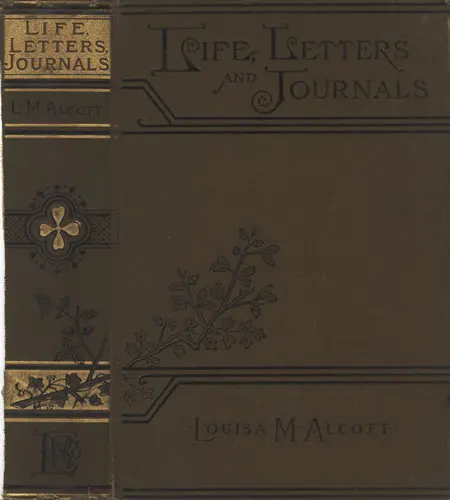
Louisa May Alcott : Her Life, Letters, and Journals
Louisa May Alcott
THE CLASSIC COLLECTION · 1887
"A Garland for Girls" by Louisa May Alcott is a collection of short stories written in the late 19th century. The book centers around the lives of young girls navigating societal expectations, personal aspirations, and the complexities of charity and friendship as they strive to better themselves and the world around them. The opening of "A Garland for Girls" presents a group of six Boston girls who form a club for mental improvement, dubbed the Mayflower Club. As they reconvene after summer, they engage in discussions filled with lively gossip and heartfelt resolutions to help less fortunate individuals in their community. Each girl grapples with her feelings about charity, expressing both enthusiasm and reluctance, while coming up with personal challenges to make a positive impact. The chapter reveals the girls' diverse personalities and sets the stage for their individual journeys toward empowerment and social responsibility, ultimately highlighting the bond of friendship and the transformative power of helping others.
Introduction adapted from the source catalogue; source summaries may be automatically generated.
Free to read · English · 71,871 words · No account needed
MAKE TIME FOR A GOOD BOOK
On by default. Untick to stop anonymous reading totals. Each page counts after 10 seconds in view. How this works.
Anonymous counting is on unless you have switched it off.
“A few children's aprons hung in the little window, with some knit lace, balls, and old-fashioned garters, two or three dolls, and a very poor display of small wares. In a show-case, however, on the table that was the counter, I found some really pretty things, made of plush, silk, and ribbon, with a good deal of taste. So I said I'd buy a needle-book, and a gay ball, and a pair of distracting baby's shoes, made to look like little open-work socks with pink ankle-ties, so cunning and dainty, I was glad to get them for Cousin Clara's baby. The woman seemed pleased, though she had a grim way of talking, and never smiled once. I observed that she handled my hat as if used to such work, and evidently liked to do it. I thanked her for repairing damages so quickly and well, and she said, with my hat on her hand, as if she hated to part with it, 'I'm used to millineryin' and never should have give it up, if I didn't have my folks to see to. I took this shop, hopin' to make things go, as such a place was needed round here, but mother broke down, and is a sight of care; so I couldn't leave her, and doctors is expensive, and times hard, and I had to drop my trade, and fall back on pins and needles, and so on.'”
Ella was a capital mimic, and imitated the nasal tones of the Vermont woman to the life, with a doleful pucker of her own blooming face, which gave such a truthful picture of poor Miss Almira Miller that those who had seen her recognized it at once, and laughed gayly.
“Just as I was murmuring a few words of regret at her bad luck,” continued Ella, “a sharp voice called out from a back room, 'Almiry! Almiry! come here.' It sounded very like a cross parrot, but it was the old lady, and while I put on my hat I heard her asking who was in the shop, and what we were 'gabbin' about.' Her daughter told her, and the old soul demanded to 'see the gal;' so I went in, being ready for fun as usual. It was a little, dark, dismal place, but as neat as a pin, and in the bed sat a regular Grandma Smallweed smoking a pipe, with a big cap, a snuff-box, and a red cotton handkerchief. She was a tiny, dried-up thing, brown as a berry, with eyes like black beads, a nose and chin that nearly met, and hands like birds' claws. But such a fierce, lively, curious, blunt old lady you never saw, and I didn't know what would be the end of me when she began to question, then to scold, and finally to demand that 'folks should come and trade to Almiry's shop after promisin' they would, and she havin' took a lease of the place on account of them lies.' I wanted to laugh, but dared not do it, so just let her croak, for the daughter had to go to her customers. The old lady's tirade informed me that they came from Vermont, had 'been wal on 't till father died and the farm was sold.' Then it seems the women came to Boston and got on pretty well till 'a stroke of numb-palsy,' whatever that is, made the mother helpless and kept Almiry at home to care for her. I can't tell you how funny and yet how sad it was to see the poor old soul, so full of energy and yet so helpless, and the daughter so discouraged with her pathetic little shop and no customers to speak of. I did not know what to say till 'Grammer Miller,' as the children call her, happened to say, when she took up her knitting after the lecture, 'If folks who go spendin' money reckless on redic'lus toys for Christmas only knew what nice things, useful and fancy, me and Almiry could make ef we had the goods, they'd jest come round this corner and buy 'em, and keep me out of a Old Woman's Home and that good, hard-workin' gal of mine out of a 'sylum; for go there she will ef she don't get a boost somehow, with rent and firin' and vittles all on her shoulders, and me only able to wag them knittin'-needles.'
Your reading position is saved on this browser. Take it to another device with a library code. Reading pages adapt to text, rather than matching a printed edition.
Louisa May Alcott
Louisa May Alcott
Louisa May Alcott
Louisa May Alcott
BEHIND THE BOOK
This eBook is for the use of anyone anywhere in the United States and most other parts of the world at no cost and with almost no restrictions whatsoever. You may copy it, give it away or re-use it under the terms of the Project Gutenberg License included with this eBook or online at www.gutenberg.org. If you are not located in the United States, you will have to check the laws of the country where you are located before using this eBook. Read the source licence.
The original source file, including credits and licence, is retained by this library. Request an original-format copy at no charge. Please include the book title and Project Gutenberg identifier #5830.
KEEP YOUR CURIOSITY GOING
Coulson Kernahan

Maurice Baring
Frances Wright
Cécile Tormay

Frederic Jesup Stimson

W. H. P. (William Henry Pope) Jarvis