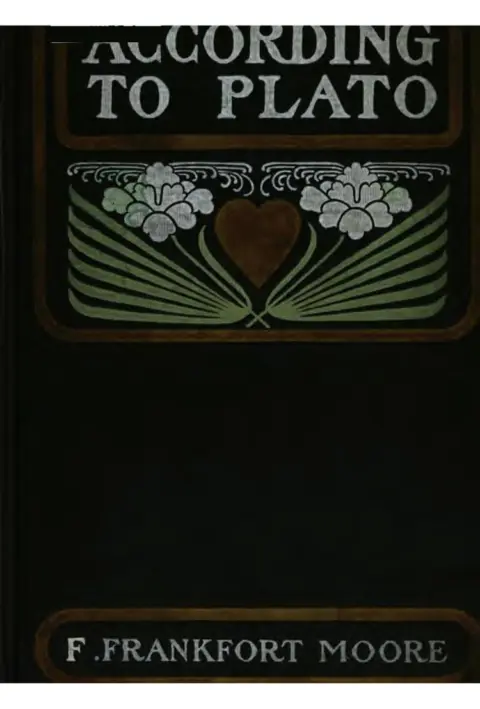
Discovering “Evelina”: An Old-fashioned Romance A Companion Book to “The Jessamy Bride”
Frank Frankfort Moore
THE CLASSIC COLLECTION · 1919
"A Garden of Peace: A Medley in Quietude" by Frank Frankfort Moore is a fictional work written in the early 20th century. The narrative revolves around characters like Dorothy and the unnamed narrator, who engage in witty banter while discussing gardens. The book explores themes of tranquility and contemplation through the lens of gardening, reflecting on the history and social fabric surrounding the gardens of a small English town. The opening of the book introduces us to a vibrant conversation between the narrator and Dorothy, who expresses skepticism about the title, alluding to a contemporary engagement with the idea of peace. As they explore various gardens—both real and metaphorical—they reflect on the dichotomy of war and peace, drawing connections between historical events and the quiet beauty of gardens. The conversation veers into anecdotes about notable gardens worldwide and culminates in the promise of future adventures together, setting the stage for a deeper exploration of life, memory, and the essence of gardening as a sanctuary from the turmoil of the outside world.
Introduction adapted from the source catalogue; source summaries may be automatically generated.
Free to read · English · 74,485 words · No account needed
MAKE TIME FOR A GOOD BOOK
On by default. Untick to stop anonymous reading totals. Each page counts after 10 seconds in view. How this works.
Anonymous counting is on unless you have switched it off.
“Because a Pacific Garden must surely be a Garden of Peace; and that's where we are going now with the title-page of a book that is to catch the pennies of the public, and resemble as nearly as I can make it--consistent with my natural propensity to quarrel with things that do not matter in the least--one of the shadiest of the slopes of the Island Valley of Avilion--
Where falls not hall, or rain, or any snow,
Nor ever wind blows loudly, for it lies
Deep-meadow'd, happy, fair with orchard-lawns
And bowery hollows, crown'd with summer sea.”
Luckily I recollected the quotation, for I had not been letter-perfect I should have had a poor chance of a bright future with Dorothy.
As it was, however, she only felt if the big tomato was as ripe as it
seemed, and said,--
“'Orchard-lawns.' H'm, I wonder if Tennyson, with all his 'careful-robin' observation of the little things of Nature was aware that you should never let grass grow in an apple orchard.”
“I wonder, indeed,” I said, with what I considered a graceful acquiescence. “But at the same time I think I should tell you that there are no little things in Nature.”
“I suppose there are not,” said she. “Anyhow, you will have the biggest tomato in Nature in your salad with the cold lamb. Is that the bell?”
“It is the ghost-tinkle of the bell of the bell-wedder who was the father of the lamb,” said I poetically.
“So long as you do not mention the mother of the lamb when you come to the underdone stratum, I shall be satisfied,” said she.
PS.--(1.30)--And I didn't.
PFS.--(1.35)--But I might have.
This town of ours is none other than Yardley Parva. Every one is supposed to know that the name means “The Little Sheltered Garden,” and that it was given this name by a mixed commission of Normans and Romans. The Normans, who spoke a sort of French, gave it the first syllable, which is the root of what became jardin, and which still survives in the “backyard” of American literature; meaning not the backyard of an English home, where broken china and glass and other incidental rubbish are thrown to work their way into the bowels of the earth, but a place of flowers and beans and pumpkins. The surname, Parva, represents the influence of the Romans, who spoke a sort of Latin. Philologists are not wholehearted about the “ley,” but the general impression is that it had a narrow escape from being “leigh,” an open meadow; ley, however, is simply “lee,” or a sheltered quarter, the opposite to “windward.” Whatever foundation there may be for this philology--whether it is derived from post hoc evidence or not--every one who knows the place intimately will admit that if it is not literally exact, it should be made so by the Town Council; for it is a town of sheltered little gardens. It has its High Street: and this name, a really industrious philologist will tell you, is derived, not from its occupying any elevated position, but from the fact that the people living on either side were accustomed to converse across the street, and any one wishing to chat with an opposite neighbour, tried to attract his attention with the usual hail of “hie there!”; and as there was much crossquestioning and answering, there was a constant chorus of “hie, hie!” so that it was really the gibe of strangers that gave it its name, only some fool of a purist seven or eight hundred years ago acquired the absurd notion that the word was “High” instead of “Hie!” So it was that Minnesingers' Lane drifted into Mincing Lane, I have been told. It had really nothing to do with the Min Sing district of China, where the tea sold in that street of tea-brokers came from. Philology is a wonderful study; and no one who has made any progress in its by-paths should ever be taken aback or forced to look silly.
Your reading position is saved on this browser. Take it to another device with a library code. Reading pages adapt to text, rather than matching a printed edition.
Frank Frankfort Moore
Frank Frankfort Moore
Frank Frankfort Moore
Frank Frankfort Moore
BEHIND THE BOOK
This eBook is for the use of anyone anywhere in the United States and most other parts of the world at no cost and with almost no restrictions whatsoever. You may copy it, give it away or re-use it under the terms of the Project Gutenberg License included with this eBook or online at www.gutenberg.org. If you are not located in the United States, you will have to check the laws of the country where you are located before using this eBook. Read the source licence.
The original source file, including credits and licence, is retained by this library. Request an original-format copy at no charge. Please include the book title and Project Gutenberg identifier #51940.
KEEP YOUR CURIOSITY GOING
Coulson Kernahan

Maurice Baring
Frances Wright
Cécile Tormay

Frederic Jesup Stimson

W. H. P. (William Henry Pope) Jarvis