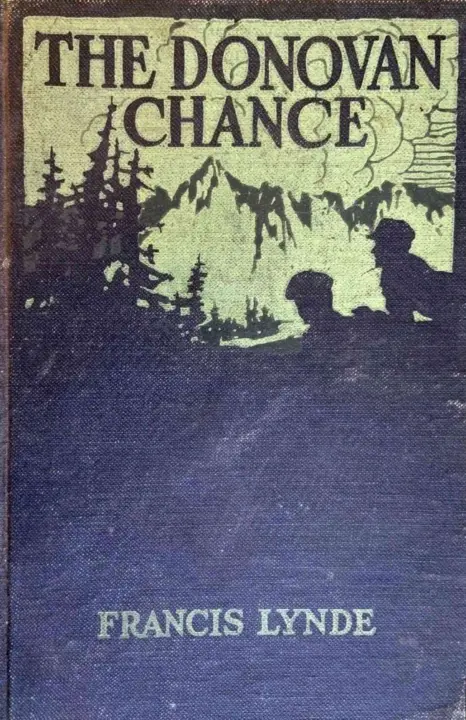
The Donovan chance
Francis Lynde
THE CLASSIC COLLECTION · 1905
"A Fool for Love" by Francis Lynde is a novel written in the early 20th century. The story follows John Winton, a railroad engineer, and his colleague Morton P. Adams as they embark on a hazardous journey through the mountains while navigating complex corporate conflicts interwoven with personal romantic intrigue. At its core, the narrative explores themes of ambition, love, and the struggle between competing interests in the infrastructure development of the American West. The opening of the book introduces readers to a wintery scene on a train station where the protagonist, John Winton, and his companion, Adams, await their delayed train to Denver. Their conversation reveals Winton’s frustration about being forced into fieldwork he would rather avoid, especially as his thoughts drift towards Virginia Carteret, a captivating woman he has just seen aboard a private car. The atmosphere changes when Winton learns they are on a collision course with corporate rivalries that threaten to derail their plans—not just for the railroad, but also for his budding interest in Virginia. As the plot unfolds, tension builds around Winton's professional challenges, romance, and the socioeconomic landscapes of the time. The beginning sets a vivid stage for both the romantic and adventurous elements of the tale that are yet to come.
Introduction adapted from the source catalogue; source summaries may be automatically generated.
Free to read · English · 29,922 words · No account needed
MAKE TIME FOR A GOOD BOOK
On by default. Untick to stop anonymous reading totals. Each page counts after 10 seconds in view. How this works.
Anonymous counting is on unless you have switched it off.
“Degenerate scion of a noble race!” jested Adams. “What ancient Carteret of them all would have compromised with the necessities by becoming a captain of industry?”
“It wasn't their metier, or the metier of their times,” said Miss Virginia with conviction. “They were sword-soldiers merely because that was the only way a strong man could conquer in those days. Now it is different, and a strong man fights quite as nobly in another field--and deserves quite as much honor.”
“Think so? I don't agree with you--as to the fighting, I mean. I like to take things easy. A good club, a choice of decent theaters, the society of a few charming young women like--”
She broke him with a mocking laugh.
“You were born a good many centuries too late, Mr. Adams; you would have fitted so beautifully, into decadent Rome.”
“No--thanks. Twentieth-century America, with the commercial frenzy taken out of it, is good enough for me. I was telling Winton a little while ago--”
“Your friend of the Kansas City station platform?” she interrupted. “Mightn't you introduce us a little less informally?”
“Beg pardon, I'm sure--yours and Jack's: Mr. John Winton, of New York and the world at large, familiarly known to his intimates--and they are precious few--as 'Jack W.' As I was about to say--”
But she seemed to find a malicious satisfaction in breaking in upon
him.
“'Mr. John Winton': it's a pretty name as names go, but it isn't as strong as he is. He is an 'industry colonel,' isn't he? He looks it.”
The Bostonian avenged himself at Winton's expense for the unwelcome
interruption.
“So much for your woman's intuition,” he laughed. “Speaking of idlers, there is your man to the dotting of the 'i'; a dilettante raised to the nth power.”
Miss Carteret's short upper lip curled in undisguised scorn.
“I like men who do things,” she asserted with pointed emphasis; whereupon the talk drifted eastward to Boston, and Winton was ignored until Virginia, having exhausted the reminiscent vein, said, “You are going on through to Denver?”
“To Denver and beyond,” was the reply. “Winton has a notion of hibernating in the mountains--fancy it; in the dead of winter!--and he has persuaded me to go along. He sketches a little, you know.”
“Oh, so he is an artist?” said Virginia, with interest newly aroused.
“No,” said Adams gloomily, “he isn't an artist--isn't much of anything, I'm sorry to say. Worse than all, he doesn't know his grandfather's middle name. Told me so himself.”
“That is inexcusable--in a dilettante,” said Miss Virginia mockingly. “Don't you think so?”
Your reading position is saved on this browser. Take it to another device with a library code. Reading pages adapt to text, rather than matching a printed edition.
Francis Lynde
Francis Lynde
Francis Lynde
Francis Lynde
BEHIND THE BOOK
This eBook is for the use of anyone anywhere in the United States and most other parts of the world at no cost and with almost no restrictions whatsoever. You may copy it, give it away or re-use it under the terms of the Project Gutenberg License included with this eBook or online at www.gutenberg.org. If you are not located in the United States, you will have to check the laws of the country where you are located before using this eBook. Read the source licence.
The original source file, including credits and licence, is retained by this library. Request an original-format copy at no charge. Please include the book title and Project Gutenberg identifier #8073.
KEEP YOUR CURIOSITY GOING
Coulson Kernahan

Maurice Baring
Frances Wright
Cécile Tormay

Frederic Jesup Stimson

W. H. P. (William Henry Pope) Jarvis