
On an Irish Jaunting-Car Through Donegal and Connemara
Samuel G. (Samuel Gamble) Bayne
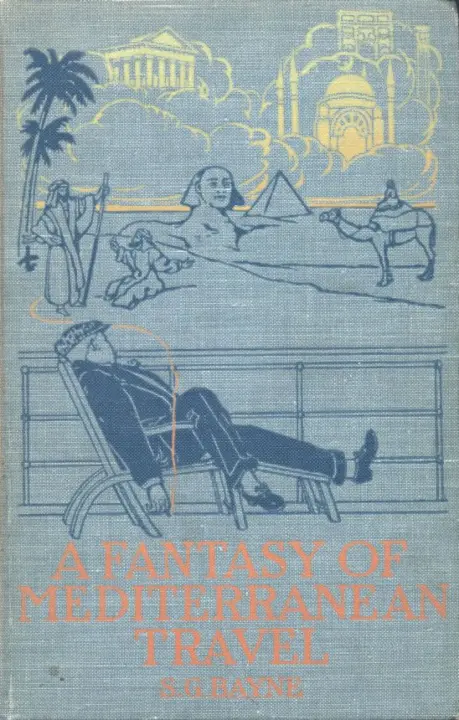
THE CLASSIC COLLECTION · 1909
"A Fantasy of Mediterranean Travel" by Samuel G. Bayne is a travel narrative written in the early 20th century. This work recounts a voyage aboard the ship "King of Cork" as it embarks on a leisurely cruise through the Mediterranean, visiting various enchanting locations. The author vividly captures the experiences of quirky passengers and describes fascinating landscapes, cultures, and historical sites, showcasing the charm and eccentricities of Mediterranean travel. The opening portion introduces the setting and atmosphere aboard the steamer, where a diverse assembly of characters is introduced, each with their own peculiarities. Bayne sets the tone with a blend of humor and keen observation, detailing the ship's departure from New York, the nature of the passengers—which include an assortment of oddballs and types reminiscent of a Dickensian novel—and an amusing anecdote about the ship's adventures. With its lighthearted and witty narrative style, the text promises an engaging journey filled with personal experiences and lively interactions among travelers, making it a delightful read for those interested in travel stories infused with humor and charm.
Introduction adapted from the source catalogue; source summaries may be automatically generated.
Free to read · English · 34,885 words · No account needed
MAKE TIME FOR A GOOD BOOK
On by default. Untick to stop anonymous reading totals. Each page counts after 10 seconds in view. How this works.
Anonymous counting is on unless you have switched it off.
Farther along we come to Bittir, so strongly fortified that it took the Romans three years to capture it, costing them the lives lost in the horrible massacre described in the Talmud--one of the largest in all history.
And now the train stops at Jerusalem. This railroad is a tiny affair, and the officials marked up the class of some of its carriages by painting out one numeral from "II," leaving it a "I" class carriage, thus turning a second into a first just to keep up the spirit of deception that is the potent atmosphere of the Holy Land. But we were in Jerusalem and didn't care a rap, even though the varnish on the seats was wet and we were stuck to them like limpets to a rock in the sea.
It was quite a strain on the Holy City to take care of such a crowd, but all was well managed and we were comfortably stowed away somewhere (many in convents), and only the most confirmed "kickers" could offer any fair objection to the arrangements.
Very few writers and hardly any lecturers and speakers who have visited Jerusalem have told the truth about it, or if some of them have, they told only the pleasant part of it. In fact, it has usually been given a treble coat of whitewash, entirely misleading to those who are to follow them. When the writer holds Jerusalem to be the greatest of historical cities with all the reverence due to it, and yet finds it in the hands of the Turkish government--which does not know the meaning of truth nor of honesty; which by its example prostitutes every decent feeling in the minds of the people to its own base ends, and permits the barefaced robbery and oppression, not only of the visitor but of its own citizens--then I say the modern writer has a delicate task to perform in describing it, for in relating the facts he might seem to be railing and scoffing at religion and biblical history, whereas nothing is farther from his mind or his intention. Everything is so interwoven that it is hard to separate the serious and truthful from the ridiculous and fraudulent. This deceit is not alone of to-day; it goes back to the times when landmarks and historic evidences were obliterated by wars, earthquakes and revolutions, and when all traces of locations during these upheavals of centuries were lost and covered with debris sometimes one hundred and fifty feet deep, the city of Jerusalem itself not having a single inhabitant for over fifty years in one period of its history. Then the "holy men" of those old days saw at once their opportunity to make religion both popular and paying, as well as the necessity for doing so, and they therefore invented a system of "pious frauds" by selecting bogus sites on particular spots for this, that, and the other incident which occurred in the great religious dramas in the Holy Land. These selections gave the ignorant, to whom they wholly appealed, some material, practical object on which to lay hold--something to worship which they could see and feel; and this was where the profit lay. Thus we find that there are crowded in the rooms of the Church of the Holy Sepulchre over thirty "sacred sites." There is the exact spot where the clay was found to make Adam; Adam's grave; the tears of the Virgin petrified in the form of a cross. Then there is the Stone of Unction; near by the Chapel of the Parted Raiment, where Christ's clothes were gambled for; again, the spot where He was crowned with thorns; the place where they scourged Him; that spot beyond is where they nailed Him to the cross--and the hole for the cross has been carefully cut out, no doubt by the best local stone-cutter not so many years ago. Then there is the long story of the finding of the true cross--but why further speak of these absurd fictions, intended to fool and work upon the poor Greek, Armenian, Syrian, Latin, Copt, Abyssinian and Russian pilgrims--in fact, all who are ignorant and credulous and will give bakshish to these fat and sleek bandits, who never did an honest day's work in their lives and who couldn't be driven with a shotgun to do any kind of labor! At birth they are dedicated to organized robbery and oppression and they have no thought of disturbing this dedication--not if they know it! For fees, they show the "Cradle," a heavy, marble bath tub that would take many men to rock it with a crowbar. They exhibit the "Manger," also in marble (!), that never had a straw in it, and if you seem credulous they will tell you anything they think you will swallow. I pretended to believe them, and in consequence got a load of lies that would have made Ananias clap his hands with joy. And so on ad infinitum! By one "holy" pretence and another they rob these poor victims of their money till it is all gone, when they are allowed to go home as best they may. All religions, including the Roman Catholic and the Protestant, should combine to form a universal commission, which should be supplied with funds raised by public subscription the world over for the purpose of regulating Jerusalem. The objectionable buildings and "fake" objects should be razed to the ground, and it should be the duty of this commission to set forth and establish the authentic, historical sites and locations as nearly as reasoning and induction can locate them, and it should also be its province to see that proper treatment, protection and accommodation are given the poor pilgrims who go there annually; the rich and educated can take care of themselves.
Your reading position is saved on this browser. Take it to another device with a library code. Reading pages adapt to text, rather than matching a printed edition.
Samuel G. (Samuel Gamble) Bayne
BEHIND THE BOOK
This eBook is for the use of anyone anywhere in the United States and most other parts of the world at no cost and with almost no restrictions whatsoever. You may copy it, give it away or re-use it under the terms of the Project Gutenberg License included with this eBook or online at www.gutenberg.org. If you are not located in the United States, you will have to check the laws of the country where you are located before using this eBook. Read the source licence.
The original source file, including credits and licence, is retained by this library. Request an original-format copy at no charge. Please include the book title and Project Gutenberg identifier #22115.
KEEP YOUR CURIOSITY GOING
Wilfrid Scawen Blunt
Wilfrid Scawen Blunt

E. W. (Edgar Watson) Howe
Francis Greenleaf Allinson & Anne C. E. (Anne Crosby Emery) Allinson
Cyrenus Cole

John Martineau