THE CLASSIC COLLECTION✦The Shield of LoveCLASSIC FREE BOOKS
The Shield of Love
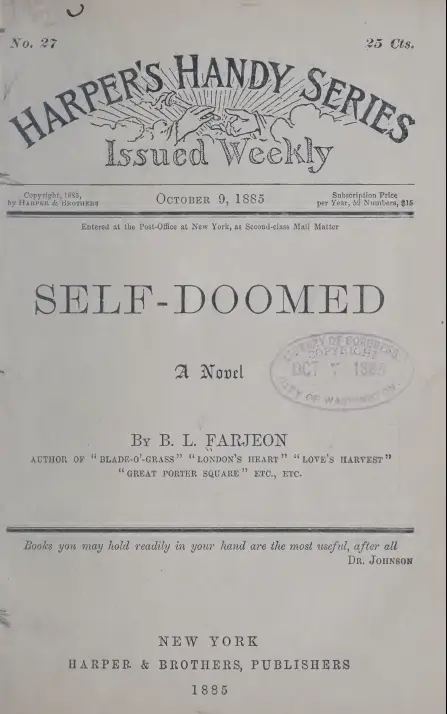
B. L. (Benjamin Leopold) Farjeon
THE CLASSIC COLLECTION · 1894
"A Fair Jewess" by B. L. Farjeon is a novel written in the late 19th century. The story centers around Dr. Spenlove, a compassionate and self-sacrificing physician who grapples with poverty while tending to his patients; particularly, he becomes entwined in the life of Mrs. Turner, a woman facing dire circumstances after becoming a mother under desperate conditions. The narrative explores themes of love, moral dilemmas, and societal judgments regarding women and motherhood. The opening portion of the book introduces Dr. Spenlove on a snowy evening as he reflects on his imminent departure from Portsmouth due to his financial struggles. As he walks home, he worries about a particular patient, Mrs. Turner, who has fallen into destitution and is on the verge of losing her child. Despite his own hardships, Spenlove demonstrates profound compassion by delaying his return home to assist her. His concern leads him to search for her amid the inclement weather, and he ultimately discovers both her and her baby in a perilous state in the snow. This sets off a chain of events involving a wealthy man named Mr. Gordon, who wishes to help Mrs. Turner, complicating the moral choices that Spenlove and the woman must face regarding her future and that of her child. The themes of sacrifice, social injustice, and the struggles of motherhood are introduced compellingly, laying a foundation for the emotional and ethical tensions that will unfold in the story.
Introduction adapted from the source catalogue; source summaries may be automatically generated.
Free to read · English · 103,592 words · No account needed
MAKE TIME FOR A GOOD BOOK
On by default. Untick to stop anonymous reading totals. Each page counts after 10 seconds in view. How this works.
Anonymous counting is on unless you have switched it off.
Other speeches followed, and when the proceedings were at an end Dr. Spenlove asked Mr. Moss to introduce him to Mr. Cohen.
"Cohen," said Mr. Moss, "Dr. Spenlove wishes to know you."
Aaron started.
He never forgot a name or a face, and he recollected the mention of
Dr. Spenlove's name when Mr. Moss came to him in Gosport with the
child.
"Without exactly knowing it, perhaps," said Dr. Spenlove, "you have been most kind in movements in which I have taken an interest. I am glad of the opportunity of making your acquaintance."
Nothing more; no reference to the private matter.
Aaron breathed more freely.
He responded to Dr. Spenlove's advances, and the gentlemen parted
friends.
Rose Moss was in the room during the proceedings, and her fair young face beamed with pride; it was her lover's father who was thus honored, and she felt that she had, through Aaron Cohen's son, a share in that honor.
When the gratifying but fatiguing labors of the day were at an end, and Aaron, Rachel, and Rose were alone, Rachel said:
"I am sorry, dear Rose, that Joseph was not here to hear what was said
about his father."
"It would not have made him love and honor him more," said Rose.
Rachel pressed her hand and kissed her; she had grown to love this sweet and simple girl, who seemed to have but one thought in life, her lover. Then the sightless woman asked them to describe the picture to her, and she listened in an ecstasy of happiness to their words.
"Is it not wonderful?" she said to Aaron. "A famous picture, they
said, and I the principal figure. What can the painter have seen in
me?"
"What all men see, my life," replied Aaron, "but what no one knows as
I know."
"It has been a happy day," sighed Rachel; she sat between them, each holding a hand. "You did not hear from our dear Ruth this morning?"
"No, dear mother." For thus was Rose already permitted to address
Rachel.
"She will be home in two days, and our dear lad as well. I wish he were back from Australia, even before he has started, and so do you, my dear. But time soon passes. Just now it seems but yesterday that we were in France."
The day waned. Rachel and Rose were together; Aaron was in his study, writing letters. A servant entered.
"A gentleman to see you, sir."
Aaron looked at the card, which bore the name of Mr. Richard
Dillworthy.
"I am busy," said Aaron. "Does he wish to see me particularly? Ask him
if he can call again."
Your reading position is saved on this browser. Take it to another device with a library code. Reading pages adapt to text, rather than matching a printed edition.
B. L. (Benjamin Leopold) Farjeon
B. L. (Benjamin Leopold) Farjeon
B. L. (Benjamin Leopold) Farjeon
B. L. (Benjamin Leopold) Farjeon
BEHIND THE BOOK
This eBook is for the use of anyone anywhere in the United States and most other parts of the world at no cost and with almost no restrictions whatsoever. You may copy it, give it away or re-use it under the terms of the Project Gutenberg License included with this eBook or online at www.gutenberg.org. If you are not located in the United States, you will have to check the laws of the country where you are located before using this eBook. Read the source licence.
The original source file, including credits and licence, is retained by this library. Request an original-format copy at no charge. Please include the book title and Project Gutenberg identifier #53296.
KEEP YOUR CURIOSITY GOING
Coulson Kernahan

Maurice Baring
Frances Wright
Cécile Tormay

Frederic Jesup Stimson

W. H. P. (William Henry Pope) Jarvis