
My study windows
James Russell Lowell
THE CLASSIC COLLECTION · 1848
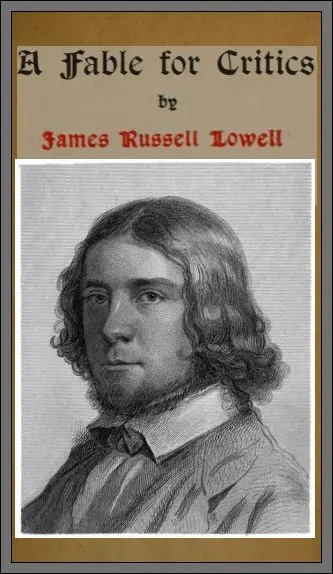
"A Fable for Critics" by James Russell Lowell is a book-length satirical poem published in 1848. The work features Apollo, god of poetry, and a critic discussing the state of American literature while sitting under a laurel tree. Lowell satirizes prominent literary figures of his era, including Ralph Waldo Emerson, Edgar Allan Poe, and Margaret Fuller, mixing sharp criticism with occasional praise. Published anonymously at first, the poem earned Lowell notoriety once his authorship was revealed, drawing both acclaim and controversy for its bold assessments.
Introduction adapted from the source catalogue; source summaries may be automatically generated.
Free to read · English · 20,382 words · No account needed
MAKE TIME FOR A GOOD BOOK
On by default. Untick to stop anonymous reading totals. Each page counts after 10 seconds in view. How this works.
Anonymous counting is on unless you have switched it off.
“O, weep with me, Daphne,” he sighed, “for you know it’s A terrible thing to be pestered with poets! But, alas, she is dumb, and the proverb holds good, She never will cry till she’s out of the wood! What wouldn’t I give if I never had known of her? ’Twere a kind of relief had I something to groan over: If I had but some letters of hers, now, to toss over, I might turn for the nonce a Byronic philosopher, And bewitch all the flats by bemoaning the loss of her. One needs something tangible, though, to begin on,-- A loom, as it were, for the fancy to spin on; What boots all your grist? it can never be ground Till a breeze makes the arms of the windmill go round, (Or, if ’tis a water-mill, alter the metaphor, And say it won’t stir, save the wheel be well wet afore, Or lug in some stuff about water “so dreamily,”-- It is not a metaphor, though, ’tis a simile); A lily, perhaps, would set my mill a-going, For just at this season, I think, they are blowing. Here, somebody, fetch one; not very far hence They’re in bloom by the score, ’tis but climbing a fence, There’s a poet hard by, who does nothing but fill his Whole garden, from one end to t’other, with lilies; A very good plan, were it not for satiety, One longs for a weed here and there, for variety; Though a weed is no more than a flower in disguise, Which is seen through at once, if love give a man eyes.”
Now there happened to be among Phœbus’s followers, A gentleman, one of the omnivorous swallowers Who bolt every book that comes out of the press, Without the least question of larger or less, Whose stomachs are strong at the expense of their head,-- For reading new books is like eating new bread, One can bear it at first, but by gradual steps he Is brought to death’s door of a mental dyspepsy. On a previous stage of existence, our Hero Had ridden outside, with the glass below zero; He had been, ’tis a fact you may safely rely on, Of a very old stock a most eminent scion,-- A stock all fresh quacks their fierce boluses ply on, Who stretch the new boots Earth’s unwilling to try on, Whom humbugs of all shapes and sorts keep their eye on, Whose hair’s in the mortar of every new Zion, Who, when whistles are dear, go directly and buy one, Who think slavery a crime that we must not say fie on, Who hunt, if they e’er hunt at all, with the lion (Though they hunt lions also, whenever they spy one), Who contrive to make every good fortune a wry one, And at last choose the hard bed of honor to die on, Whose pedigree, traced to earth’s earliest years, Is longer than anything else but their ears;-- In short, he was sent into life with the wrong key, He unlocked the door, and stept forth a poor donkey. Though kicked and abused by his bipedal betters Yet he filled no mean place in the kingdom of letters; Far happier than many a literary hack, He bore only paper-mill rags on his back (For it makes a vast difference which side the mill One expends on the paper his labor and skill); So, when his soul waited a new transmigration, And Destiny balanced ’twixt this and that station, Not having much time to expend upon bothers, Remembering he’d had some connection with authors; And considering his four legs had grown paralytic,-- She set him on two, and he came forth a critic.
Your reading position is saved on this browser. Take it to another device with a library code. Reading pages adapt to text, rather than matching a printed edition.
James Russell Lowell
James Russell Lowell
James Russell Lowell

James Russell Lowell
BEHIND THE BOOK
This eBook is for the use of anyone anywhere in the United States and most other parts of the world at no cost and with almost no restrictions whatsoever. You may copy it, give it away or re-use it under the terms of the Project Gutenberg License included with this eBook or online at www.gutenberg.org. If you are not located in the United States, you will have to check the laws of the country where you are located before using this eBook. Read the source licence.
The original source file, including credits and licence, is retained by this library. Request an original-format copy at no charge. Please include the book title and Project Gutenberg identifier #66213.
KEEP YOUR CURIOSITY GOING

Eric Mackay
Edmund Gosse
Sophia Margaretta Hensley
Gilbert Parker
George MacDonald

Elizabeth Bibesco