
My study windows
James Russell Lowell
THE CLASSIC COLLECTION · 1848
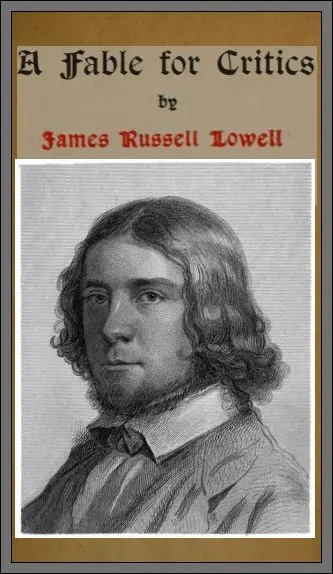
"A Fable for Critics" by James Russell Lowell is a book-length satirical poem published in 1848. The work features Apollo, god of poetry, and a critic discussing the state of American literature while sitting under a laurel tree. Lowell satirizes prominent literary figures of his era, including Ralph Waldo Emerson, Edgar Allan Poe, and Margaret Fuller, mixing sharp criticism with occasional praise. Published anonymously at first, the poem earned Lowell notoriety once his authorship was revealed, drawing both acclaim and controversy for its bold assessments.
Introduction adapted from the source catalogue; source summaries may be automatically generated.
Free to read · English · 20,382 words · No account needed
MAKE TIME FOR A GOOD BOOK
On by default. Untick to stop anonymous reading totals. Each page counts after 10 seconds in view. How this works.
Anonymous counting is on unless you have switched it off.
Here Miranda came up, and said, “Phœbus!you know That the Infinite Soul has its infinite woe, As I ought to know, having lived cheek by jowl, Since the day I was born, with the Infinite Soul; I myself introduced, I myself, I alone, To my Land’s better life authors solely my own, Who the sad heart of earth on their shoulders have taken, Whose works sound a depth by Life’s quiet unshaken, Such as Shakespeare, for instance, the Bible, and Bacon, Not to mention my own works; Time’s nadir is fleet, And, as for myself, I’m quite out of conceit”--
“Quite out of conceit! I’m enchanted to hear it,” Cried Apollo aside. “Who’d have thought she was near it? To be sure, one is apt to exhaust those commodities One uses too fast, yet in this case as odd it is As if Neptune should say to his turbots and whitings, ‘I’m as much out of salt as Miranda’s own writings’ (Which, as she in her own happy manner has said, Sound a depth, for ’tis one of the functions of lead). She often has asked me if I could not find A place somewhere near me that suited her mind; I know but a single one vacant, which she, With her rare talent that way, would fit to a T, And it would not imply any pause or cessation In the work she esteems her peculiar vocation,-- She may enter on duty to-day, if she chooses, And remain Tiring-woman for life to the Muses.”
Miranda meanwhile has succeeded in driving Up into a corner, in spite of their striving, A small flock of terrified victims, and there, With an I-turn-the-crank-of-the-Universe air And a tone which, at least to my fancy, appears Not so much to be entering as boxing your ears, Is unfolding a tale (of herself, I surmise, For ’tis dotted as thick as a peacock’s with I’s). Apropos of Miranda, I’ll rest on my oars And drift through a trifling digression on bores, For, though not wearing ear-rings in more majorum, Our ears are kept bored just as if we still wore ’em. There was one feudal custom worth keeping, at least, Roasted bores made a part of each well-ordered feast, And of all quiet pleasures the very ne plus Was in hunting wild bores as the tame ones hunt us. Archæologians, I know, who have personal fears Of this wise application of hounds and of spears, Have tried to make out, with a zeal more than wonted, ’Twas a kind of wild swine that our ancestors hunted; But I’ll never believe that the age which has strewn Europe o’er with cathedrals, and otherwise shown That it knew what was what, could by chance not have known (Spending, too, its chief time with its buff on, no doubt), Which beast ’twould improve the world most to thin out. I divide bores myself, in the manner of rifles, Into two great divisions, regardless of trifles;-- There’s your smooth-bore and screw-bore, who do not much vary In the weight of cold lead they respectively carry. The smooth-bore is one in whose essence the mind Not a corner nor cranny to cling by can find; You feel as in nightmares sometimes, when you slip Down a steep slated roof, where there’s nothing to grip; You slide and you slide, the blank horror increases,-- You had rather by far be at once smashed to pieces; You fancy a whirlpool below white and frothing, And finally drop off and light upon--nothing. The screw-bore has twists in him, faint predilections For going just wrong in the tritest directions; When he’s wrong he is flat, when he’s right he can’t show it, He’ll tell you what Snooks said about the new poet,[3] Or how Fogrum was outraged by Tennyson’s Princess; He has spent all his spare time and intellect since his Birth in perusing, on each art and science, Just the books in which no one puts any reliance, And though nemo we’re told, horis omnibus sapit, The rule will not fit him, however you shape it, For he has a perennial foison of sappiness; He has just enough force to spoil half your day’s happiness, And to make him a sort of mosquito to be with, But just not enough to dispute or agree with.
Your reading position is saved on this browser. Take it to another device with a library code. Reading pages adapt to text, rather than matching a printed edition.
James Russell Lowell
James Russell Lowell
James Russell Lowell

James Russell Lowell
BEHIND THE BOOK
This eBook is for the use of anyone anywhere in the United States and most other parts of the world at no cost and with almost no restrictions whatsoever. You may copy it, give it away or re-use it under the terms of the Project Gutenberg License included with this eBook or online at www.gutenberg.org. If you are not located in the United States, you will have to check the laws of the country where you are located before using this eBook. Read the source licence.
The original source file, including credits and licence, is retained by this library. Request an original-format copy at no charge. Please include the book title and Project Gutenberg identifier #66213.
KEEP YOUR CURIOSITY GOING

Eric Mackay
Edmund Gosse
Sophia Margaretta Hensley
Gilbert Parker
George MacDonald

Elizabeth Bibesco