
My study windows
James Russell Lowell
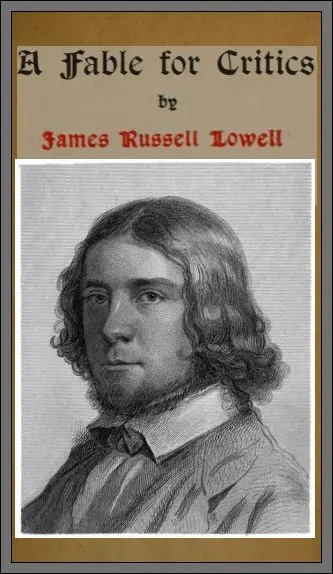
THE CLASSIC COLLECTION · 1848
"A Fable for Critics" by James Russell Lowell is a book-length satirical poem published in 1848. The work features Apollo, god of poetry, and a critic discussing the state of American literature while sitting under a laurel tree. Lowell satirizes prominent literary figures of his era, including Ralph Waldo Emerson, Edgar Allan Poe, and Margaret Fuller, mixing sharp criticism with occasional praise. Published anonymously at first, the poem earned Lowell notoriety once his authorship was revealed, drawing both acclaim and controversy for its bold assessments.
Introduction adapted from the source catalogue; source summaries may be automatically generated.
Free to read · English · 20,382 words · No account needed
MAKE TIME FOR A GOOD BOOK
On by default. Untick to stop anonymous reading totals. Each page counts after 10 seconds in view. How this works.
Anonymous counting is on unless you have switched it off.
“He’s so innate a cockney, that had he been born Where plain bare skin’s the only full-dress that is worn, He’d have given his own such an air that you’d say ’T had been made by a tailor to lounge in Broadway. His nature’s a glass of champagne with the foam on ’t, As tender as Fletcher, as witty as Beaumont; So his best things are done in the flush of the moment; If he wait, all is spoiled; he may stir it andshake it, But, the fixed air once gone, he can never remake it. He might be a marvel of easy delightfulness, If he would not sometimes leave the r out of sprightfulness; And he ought to let Scripture alone--’tis self-slaughter, For nobody likes inspiration-and-water. He’d have been just the fellow to sup at the Mermaid, Cracking jokes at rare Ben, with an eye to the barmaid, His wit running up as Canary ran down,-- The topmost bright bubble on the wave of The Town.
“Here comes Parker, the Orson of parsons, a man Whom the Church undertook to put under her ban (The Church of Socinus, I mean),--his opinions Being So- (ultra) -cinian, they shocked the Socinians; They believed--faith, I’m puzzled--I think I may call Their belief a believing in nothing at all, Or something of that sort; I know they all went For a general union of total dissent: He went a step farther; without cough or hem, He frankly avowed he believed not in them; And, before he could be jumbled up or prevented, From their orthodox kind of dissent he dissented. There was heresy here, you perceive, for the right Of privately judging means simply that light Has been granted to me for deciding on you; And in happier times, before Atheism grew, The deed contained clauses for cooking you too: Now at Xerxes and Knut we all laugh, yet our foot With the same wave is wet that mocked Xerxes and Knut, And we all entertain a secure private notion, That our Thus far! will have a great weight with the ocean. ’Twas so with our liberal Christians: they bore With sincerest conviction their chairs to the shore; They brandished their worn theological birches, Bade natural progress keep out of the Churches, And expected the lines they had drawn to prevail With the fast-rising tide to keep out of their pale; They had formerly dammed the Pontifical See, And the same thing, they thought, would do nicely for P.; But he turned up his nose at their mumming and shamming, And cared (shall I say?) not a d---- for their damming; So they first read him out of their church, and next minute Turned round and declared he had never been in it. But the ban was too small or the man was too big, For he recks not their bells, books, and candlesa fig (He scarce looks like a man who would stay treated shabbily, Sophroniscus’ son’s head o’er the features of Rabelais); He bangs and bethwacks them,--their backs he salutes With the whole tree of knowledge torn up by the roots; His sermons with satire are plenteously verjuiced, And he talks in one breath of Confutzee, Cass, Zerduscht, Jack Robinson, Peter the Hermit, Strap, Dathan, Cush, Pitt (not the bottomless, that he’s nofaith in), Pan, Pillicock, Shakespeare, Paul, Toots, Monsieur Tonson, Aldebaran, Alcander, Ben Khorat, Ben Jonson, Thoth, Richter, Joe Smith, Father Paul, Judah Mouis, Musæus, Muretus, hem,--μ Scorpionis, Maccabee, Maccaboy, Mac--Mac--ah! Machiavelli, Condorcet, Count d’Orsay, Conder, Say, Ganganelli, Orion, O’Connell, the Chevalier D’O, (See the Memoirs of Sully,) το παν, the great toe Of the statue of Jupiter, now made to pass For that of Jew Peter by good Romish brass. (You may add for yourselves, for I find it a bore, All the names you have ever, or not, heard before, And when you’ve done that--why, invent a few more.) His hearers can’t tell you on Sunday beforehand, If in that day’s discourse they’ll be Bibled or Koraned, For he’s seized the idea (by his martyrdom fired) That all men (not orthodox) may be inspired; Yet though wisdom profane with his creed he may weave in, He makes it quite clear what he doesn’t believe in, While some, who decry him, think all Kingdom Come Is a sort of a, kind of a, species of Hum, Of which, as it were, so to speak, not a crumb Would be left, if we didn’t keep carefully mum, And, to make a clean breast, that ’tis perfectly plain That all kinds of wisdom are somewhat profane; Now P.’s creed than this may be lighter or darker, But in one thing, ’tis clear, he has faith, namely--Parker, And this is what makes him the crowd-drawing preacher, There’s a background of god to each hardworking feature, Every word that he speaks has been fierily furnaced In the blast of a life that has struggled in earnest: There he stands, looking more like a ploughman than priest, If not dreadfully awkward, not graceful at least, His gestures all downright and same, if you will, As of brown-fisted Hobnail in hoeing a drill; But his periods fall on you, stroke after stroke, Like the blows of a lumberer felling an oak, You forget the man wholly, you’re thankful to meet With a preacher who smacks of the field and the street, And to hear, you’re not over-particular whence, Almost Taylor’s profusion, quite Latimer’s sense.
Your reading position is saved on this browser. Take it to another device with a library code. Reading pages adapt to text, rather than matching a printed edition.
James Russell Lowell
James Russell Lowell
James Russell Lowell

James Russell Lowell
BEHIND THE BOOK
This eBook is for the use of anyone anywhere in the United States and most other parts of the world at no cost and with almost no restrictions whatsoever. You may copy it, give it away or re-use it under the terms of the Project Gutenberg License included with this eBook or online at www.gutenberg.org. If you are not located in the United States, you will have to check the laws of the country where you are located before using this eBook. Read the source licence.
The original source file, including credits and licence, is retained by this library. Request an original-format copy at no charge. Please include the book title and Project Gutenberg identifier #66213.
KEEP YOUR CURIOSITY GOING

Eric Mackay
Edmund Gosse
Sophia Margaretta Hensley
Gilbert Parker
George MacDonald

Elizabeth Bibesco