The Stark Munro Letters Being series of twelve letters written by J. Stark Munro, M.B., to his friend and former fellow-student, Herbert Swanborough, of Lowell, Massachusetts, during the years 1881-1884
Arthur Conan Doyle

THE CLASSIC COLLECTION · 1899
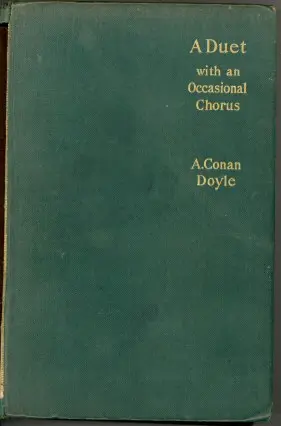
"A Duet, with an Occasional Chorus" by Arthur Conan Doyle is a novel written in the late 19th century. The story revolves around the lives of Frank Crosse and Maude Selby as they navigate the complexities of love, marriage, and personal aspirations leading up to their wedding. Through their correspondence, the book captures their deep affection and the mix of excitement and anxiety that accompanies their impending union. The opening of the novel introduces Frank and Maude through a series of letters that highlight their preparations for marriage, including discussions about the wedding date, the choice of attire, and their hopes for the future. As they share their thoughts and feelings about each other, the reader gains insight into their characters: Frank's self-doubt about providing for Maude and Maude's unwavering love and confidence in their partnership. This correspondence sets the stage for the unfolding dynamics of their relationship, infused with moments of humor, tension, and vulnerability. As the narrative progresses, the importance of their emotional connection amidst societal expectations and personal challenges becomes increasingly evident.
Introduction adapted from the source catalogue; source summaries may be automatically generated.
Free to read · English · 68,439 words · No account needed
MAKE TIME FOR A GOOD BOOK
On by default. Untick to stop anonymous reading totals. Each page counts after 10 seconds in view. How this works.
Anonymous counting is on unless you have switched it off.
‘You may take it from me, Frank, that if any married woman ever tells her husband that until she saw him she never felt any emotion at the sight of another man, it is simple nonsense. There may be women of that sort about, but I never met them. I don’t think I should like them, for they must be dry, cold, unsympathetic, unemotional, unwomanly creatures.’
‘Maude, you have loved some one else!’
‘I won’t deny that I have been interested deeply interested in several
men.’
‘Several!’
‘It was before I had met you, dear. I owed you no duty.’
‘You have loved several men.’
‘The feeling was for the most part quite superficial. There are many different sorts and degrees of love.’
‘Good God, Maude! How many men inspired this feeling in you?’
‘The truth is, Frank, that a healthy young woman who has imagination and a warm heart is attracted by every young man. I know that you wish me to be frank and to return your confidence. But there is a certain kind of young man with whom I always felt my interest deepen.’
‘Oh, you did discriminate?’
‘Now you are getting bitter. I will say no more.’
‘You have said too much. You must go on now.’
‘Well, I was only going to say that dark men always had a peculiar fascination for me. I don’t know what it is, but the feeling is quite overpowering.’
‘Is that why you married a man with flaxen hair?’
‘Well, I couldn’t expect to find every quality in my husband, could I? It would not be reasonable. I assure you, dear, that taking your tout ensemble, I like you far the best of all. You may not be the handsomest, and you may not be the cleverest—one cannot expect one’s absolute ideal,—but I love you far, far the best of any. I do hope I haven’t hurt you by anything I have said.’
‘I am sorry I am not your ideal, Maude. It would be absurd to suppose myself anybody’s ideal, but I hoped always that the eyes of love transfigured an object and made it seem all right. My hair is past praying for, but if you can point out anything that I can mend—’
‘No, no, I want you just as you are. If I hadn’t liked you best, I shouldn’t have married you, Frank, should I?’
‘But those other experiences?’
‘Oh, we had better drop them. What good can it possibly do to discuss my old experiences? It will only annoy you.’
Your reading position is saved on this browser. Take it to another device with a library code. Reading pages adapt to text, rather than matching a printed edition.
Arthur Conan Doyle
Arthur Conan Doyle
Arthur Conan Doyle
Arthur Conan Doyle
BEHIND THE BOOK
This eBook is for the use of anyone anywhere in the United States and most other parts of the world at no cost and with almost no restrictions whatsoever. You may copy it, give it away or re-use it under the terms of the Project Gutenberg License included with this eBook or online at www.gutenberg.org. If you are not located in the United States, you will have to check the laws of the country where you are located before using this eBook. Read the source licence.
The original source file, including credits and licence, is retained by this library. Request an original-format copy at no charge. Please include the book title and Project Gutenberg identifier #5260.
KEEP YOUR CURIOSITY GOING
Coulson Kernahan

Maurice Baring
Frances Wright
Cécile Tormay

Frederic Jesup Stimson

W. H. P. (William Henry Pope) Jarvis


