The Stark Munro Letters Being series of twelve letters written by J. Stark Munro, M.B., to his friend and former fellow-student, Herbert Swanborough, of Lowell, Massachusetts, during the years 1881-1884
Arthur Conan Doyle

THE CLASSIC COLLECTION · 1899
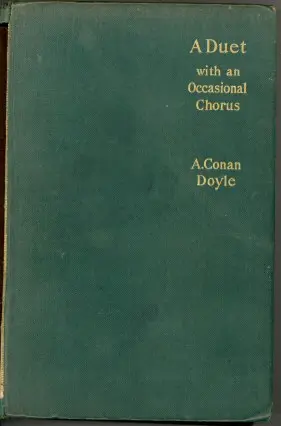
"A Duet, with an Occasional Chorus" by Arthur Conan Doyle is a novel written in the late 19th century. The story revolves around the lives of Frank Crosse and Maude Selby as they navigate the complexities of love, marriage, and personal aspirations leading up to their wedding. Through their correspondence, the book captures their deep affection and the mix of excitement and anxiety that accompanies their impending union. The opening of the novel introduces Frank and Maude through a series of letters that highlight their preparations for marriage, including discussions about the wedding date, the choice of attire, and their hopes for the future. As they share their thoughts and feelings about each other, the reader gains insight into their characters: Frank's self-doubt about providing for Maude and Maude's unwavering love and confidence in their partnership. This correspondence sets the stage for the unfolding dynamics of their relationship, infused with moments of humor, tension, and vulnerability. As the narrative progresses, the importance of their emotional connection amidst societal expectations and personal challenges becomes increasingly evident.
Introduction adapted from the source catalogue; source summaries may be automatically generated.
Free to read · English · 68,439 words · No account needed
MAKE TIME FOR A GOOD BOOK
On by default. Untick to stop anonymous reading totals. Each page counts after 10 seconds in view. How this works.
Anonymous counting is on unless you have switched it off.
‘It’s dreadful,’ said Maude, and began to cry.
Frank knelt down in front of her and kissed her hands. She had sweet little plump hands, very soft and velvety.
‘You make me feel such a brute,’ said he. ‘Anyhow, I love you now with all my heart and mind and soul.’
‘Forty-firstly and lastly,’ she sobbed, half laughing and half crying. Then she pulled his hair to reassure him.
‘I can’t be angry with you,’ said she. ‘Besides, it would be ungenerous to be angry when you tell me things of your own free will. You are not forced to tell me. It is very honourable of you. But I do wish you had taken an interest in me first.’
‘Well, it was not so fated. I suppose there are some men who are quite good when they are bachelors. But I don’t believe they are the best men. They are either archangels upon earth—young Gladstones and Newmans—or else they are cold, calculating, timid, un-virile creatures, who will never do any good. The first class must be splendid. I never met one except in memoirs. The others I don’t want to meet.’
Women are not interested in generalities.
‘Were they nicer than me?’ she asked.
‘Who?’
‘Those forty women.’
‘No, dear, of course not. Why are you laughing?’
‘Well, it came into my head how funny it would be, if the forty were all gathered into one room, and you were turned loose in the middle of them.’
‘Funny!’ Frank ejaculated. Women have such extraordinary ideas of humour. Maude laughed until she was quite tired.
‘It doesn’t strike you as comic?’ she cried at last.
‘No, it doesn’t,’ he answered coldly.
‘Of course it wouldn’t,’ said she, and went off into another ripple of pretty contralto laughter. There is a soft, deep, rich laugh, which some women have, that is the sweetest sound in Nature.
‘When you have quite finished,’ said he huffily. Her jealousy was much more complimentary than her ridicule.
‘All right now. Don’t be cross. If I didn’t laugh I should cry. I’m so sorry if I have annoyed you.’ He had gone back to his chair, so she paid him a flying visit. ‘Satisfied?’
‘Not quite.’
‘Now?’
‘All right. I forgive you.’
‘That’s funny too. Fancy you forgiving me after all these confessions. But you never loved one of them all as you love me.’
‘Never.’
‘Swear it.’
‘I do swear it.’
‘Morally, and what do you call it, and the other?’
‘Not one of them.’
‘And never will again?’
‘Never.’
‘Good boy for ever and ever?’
‘For ever and ever.’
Your reading position is saved on this browser. Take it to another device with a library code. Reading pages adapt to text, rather than matching a printed edition.
Arthur Conan Doyle
Arthur Conan Doyle
Arthur Conan Doyle
Arthur Conan Doyle
BEHIND THE BOOK
This eBook is for the use of anyone anywhere in the United States and most other parts of the world at no cost and with almost no restrictions whatsoever. You may copy it, give it away or re-use it under the terms of the Project Gutenberg License included with this eBook or online at www.gutenberg.org. If you are not located in the United States, you will have to check the laws of the country where you are located before using this eBook. Read the source licence.
The original source file, including credits and licence, is retained by this library. Request an original-format copy at no charge. Please include the book title and Project Gutenberg identifier #5260.
KEEP YOUR CURIOSITY GOING
Coulson Kernahan

Maurice Baring
Frances Wright
Cécile Tormay

Frederic Jesup Stimson

W. H. P. (William Henry Pope) Jarvis


