The Stark Munro Letters Being series of twelve letters written by J. Stark Munro, M.B., to his friend and former fellow-student, Herbert Swanborough, of Lowell, Massachusetts, during the years 1881-1884
Arthur Conan Doyle

THE CLASSIC COLLECTION · 1899
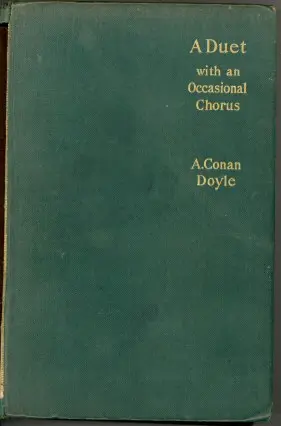
"A Duet, with an Occasional Chorus" by Arthur Conan Doyle is a novel written in the late 19th century. The story revolves around the lives of Frank Crosse and Maude Selby as they navigate the complexities of love, marriage, and personal aspirations leading up to their wedding. Through their correspondence, the book captures their deep affection and the mix of excitement and anxiety that accompanies their impending union. The opening of the novel introduces Frank and Maude through a series of letters that highlight their preparations for marriage, including discussions about the wedding date, the choice of attire, and their hopes for the future. As they share their thoughts and feelings about each other, the reader gains insight into their characters: Frank's self-doubt about providing for Maude and Maude's unwavering love and confidence in their partnership. This correspondence sets the stage for the unfolding dynamics of their relationship, infused with moments of humor, tension, and vulnerability. As the narrative progresses, the importance of their emotional connection amidst societal expectations and personal challenges becomes increasingly evident.
Introduction adapted from the source catalogue; source summaries may be automatically generated.
Free to read · English · 68,439 words · No account needed
MAKE TIME FOR A GOOD BOOK
On by default. Untick to stop anonymous reading totals. Each page counts after 10 seconds in view. How this works.
Anonymous counting is on unless you have switched it off.
It was not much, but it had a surprising effect upon the waiter. He
turned and hurried away.
‘There now, you’ve shocked him?’ cried Frank.
‘Where has he gone, Frank?’
‘To complain to the management about your language.’
‘No, Frank. Please tell me! Oh, I wish I hadn’t been so rude. Here he
is again.’
‘All right. Sit tight,’ said Frank.
A sort of procession was streaming up the hall. There was their fat waiter in front with a large covered cheese-dish. Behind him was another with two smaller ones, and a third with some yellow powder upon a plate was bringing up the rear.
‘This is Gorgonzola, main,’ said the waiter, with a severe manner. ‘And there’s Camembert and Gruyère behind, and powdered Parmesan as well. I’m sorry that the Stilton don’t give satisfaction.’
Maude helped herself to Gorgonzola and looked very guilty and uncomfortable. Frank began to laugh.
‘I meant you to be rude to me, not to the cheese,’ said he, when the procession had withdrawn.
‘I did my best, Frank. I contradicted you.’
‘Oh, it was a shocking display of temper.’
‘And I hurt the poor waiter’s feelings.’
‘Yes, you’ll have to apologise to his Stilton before he will forgive
you.’
‘And I don’t believe he is a bit more convinced that we are veterans than
he was before.’
‘All right, dear; leave him to me. Those reminiscences of mine must have settled him. If they didn’t, then I feel it is hopeless.’
It was as well for his peace of mind that Frank could not hear the conversation between the fat waiter and their chambermaid, for whom he nourished a plethoric attachment. They had half an hour off in the afternoon, and were comparing notes.
‘Nice-lookin’ couple, ain’t they, John?’ said the maid, with the air of an expert. ‘I don’t know as we’ve ‘ad a better since the spring weddin’s.’
‘I don’t know as I’d go as far as that,’ said the fat waiter critically. ‘’E’d pass all right. ’E’s an upstandin’ young man with a good sperrit in ’im.’
‘What’s wrong with ’er, then?’
‘It’s a matter of opinion,’ said the waiter. ‘I likes ’em a bit more full-flavoured myself. And as to ’er taste, why there, if you ’ad seen ’er turn up ’er nose at the Stilton at lunch.’
‘Turn up ’er nose, did she? Well, she seemed to me a very soft-spoken, obligin’ young lady.’
‘So she may be, but they’re a queer couple, I tell you. It’s as well they are married at last.’
‘Why?’
Your reading position is saved on this browser. Take it to another device with a library code. Reading pages adapt to text, rather than matching a printed edition.
Arthur Conan Doyle
Arthur Conan Doyle
Arthur Conan Doyle
Arthur Conan Doyle
BEHIND THE BOOK
This eBook is for the use of anyone anywhere in the United States and most other parts of the world at no cost and with almost no restrictions whatsoever. You may copy it, give it away or re-use it under the terms of the Project Gutenberg License included with this eBook or online at www.gutenberg.org. If you are not located in the United States, you will have to check the laws of the country where you are located before using this eBook. Read the source licence.
The original source file, including credits and licence, is retained by this library. Request an original-format copy at no charge. Please include the book title and Project Gutenberg identifier #5260.
KEEP YOUR CURIOSITY GOING
Coulson Kernahan

Maurice Baring
Frances Wright
Cécile Tormay

Frederic Jesup Stimson

W. H. P. (William Henry Pope) Jarvis


