
The William Henry Letters
Abby Morton Diaz
THE CLASSIC COLLECTION · 1875
"A Domestic Problem: Work and Culture in the Household" by Abby Morton Diaz is a non-fiction work written during the late 19th century. This examination of the challenges faced by women in balancing household duties with personal development explores the cultural context of domestic life and the societal expectations placed upon women. Diaz poses a critical inquiry: how can a woman engage with culture and personal enrichment while fulfilling the demands of family and home? The opening of the book articulates the prevailing dilemma for women of the time, caught between relentless household responsibilities and the desire for intellectual growth. Diaz employs a conversational tone, inviting women to address the complexity of their situation. She discusses the myriad of household tasks that consume a woman's time and energy, emphasizing the point that despite the overwhelming nature of these duties, they require significant cognitive engagement. She suggests the necessity of dialogue among women to explore these issues and considers the implications of their expectations in shaping both their lives and their children's futures. Through this chapter, Diaz lays the groundwork for a sustained discourse on the need for cultural enlightenment for women, highlighting the importance of preparation and education in their traditional roles as caregivers.
Introduction adapted from the source catalogue; source summaries may be automatically generated.
Free to read · English · 22,576 words · No account needed
MAKE TIME FOR A GOOD BOOK
On by default. Untick to stop anonymous reading totals. Each page counts after 10 seconds in view. How this works.
Anonymous counting is on unless you have switched it off.
Another way of immediate escape is by making the present race of husbands aware that their wives are being killed, or crazed, with hard work and care, especially husbands in the small towns and villages, and more especially farmers. In regard to these last, it is no exaggeration to say that their wives in many cases work like slaves. Indeed, this falls short of the truth, for slaves have not the added burden of responsibility. As things are now, the woman who marries a farmer often goes, as one may say, into a workhouse, sentenced to hard labor for life.
When these husbands permit their wives to "overwork," it is not from indifference, but from sheer ignorance. They don't know, they don't begin to conceive, of the labor there is in "woman's work." It is true that neither are merchant-princes aware of what it costs their wives to superintend the complicated arrangements of their establishments; to see that all the wheels, and the wheels within wheels, revolve smoothly, and that comfort and style go hand in hand; but let us consider now the farmers' wives, toiling on, and on, and on, in country towns, East, West, and all the way between. Their husbands, in not a few cases, are able to hire at least the drudgery done, and would if they only knew. A young woman from a New Hampshire village, herself an invalid from hard work, speaking to me of her mother, said, "She suffers every thing with her back. When she stoops down to the oven to attend to the pies, she has to hold on to her back, hard, to get up again." I said, "Why, I shouldn't think your father would let her make them."--"Oh," said she, "father don't understand. He's hard." One day I was sitting in the house of a young woman,--a fragile, delicate creature, scarcely able to lift the baby she was holding,--when her husband came in. He was a working man, tall and robust looking. He walked toward the pantry. "You mustn't cut a pie," the little wife called out laughing. Then turning to me, she said, with a sort of appealing, piteous glance, "He don't understand how hard it is for me to make pies." I know a young woman, not a strong woman, who, with a family of very little children, does her own work, and makes from one to two dozen pies at a common baking, "'cause hubby loves 'em." I know another, similarly situated, who gives her husband pies at breakfast as well as at other meals, because "he was brought up to them at home." Now, all these "hubbies" are loving "hubbies," but--they do not know. A friend of mine, an elderly woman lately deceased, came to her death (so her neighbors said) by hard work. "Killed with work," was the exact expression they used. She was a dear good woman; a person of natural refinement, of strict integrity, of a forgiving spirit, intelligent, sweet-tempered, gentle-mannered; everybody loved her. Her husband is a well-to-do farmer. He inherited money and lands, and has them still. His wife, who was every thing to him, whom he could not bear out of his sight, and for whom, if he had known, he would have sacrificed money and lands, is gone. But--he did not know. "Mother" never complained. "Mother" did the cooking, did the washing, scrubbed the floors. They had "company forever," the neighbors said. "Mother" received, with smiling hospitality, all who came. Help was hard to procure; still help might and would have been procured had the husband known the case to be, as it certainly was, a case of life or death. But--he did not know: so "mother" died of work and care.
Your reading position is saved on this browser. Take it to another device with a library code. Reading pages adapt to text, rather than matching a printed edition.
Abby Morton Diaz
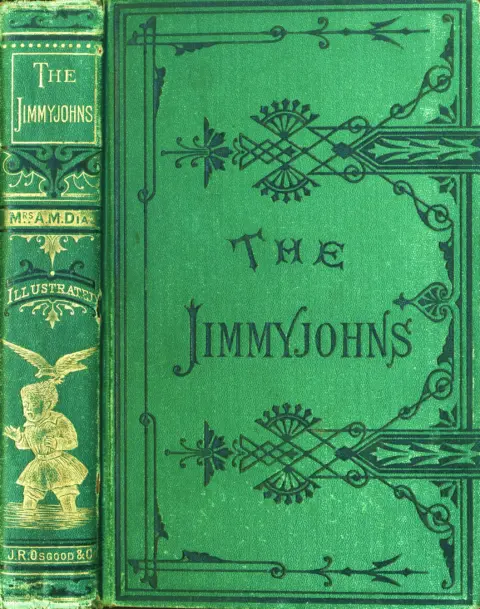
Abby Morton Diaz
Abby Morton Diaz
Abby Morton Diaz
BEHIND THE BOOK
This eBook is for the use of anyone anywhere in the United States and most other parts of the world at no cost and with almost no restrictions whatsoever. You may copy it, give it away or re-use it under the terms of the Project Gutenberg License included with this eBook or online at www.gutenberg.org. If you are not located in the United States, you will have to check the laws of the country where you are located before using this eBook. Read the source licence.
The original source file, including credits and licence, is retained by this library. Request an original-format copy at no charge. Please include the book title and Project Gutenberg identifier #6704.
KEEP YOUR CURIOSITY GOING

Charles G. (Charles Griffith) Ross
Hannah Webster Foster

Emily Lawless
Edwin Hamlin Carr

Charles De Lano Hine
Andrew Ure