THE CLASSIC COLLECTION✦An outlaw’s diary: the CommuneCLASSIC FREE BOOKS
An outlaw’s diary: the Commune
Cécile Tormay
THE CLASSIC COLLECTION · 1764
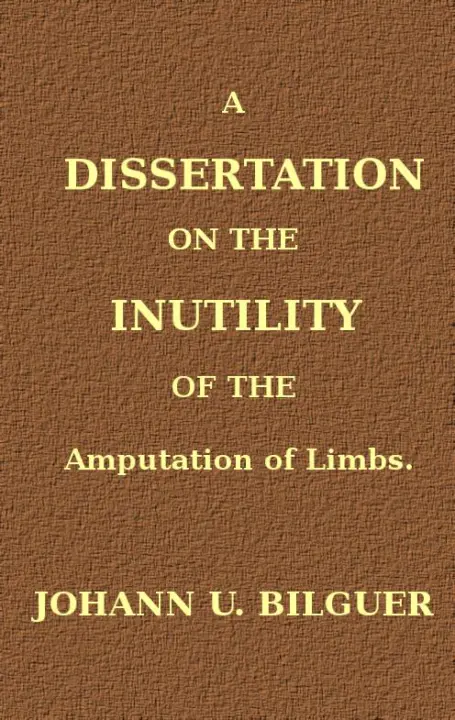
"A Dissertation on the Inutility of the Amputation of Limbs" by Johann Ulrich Bilguer is a scientific publication written in the mid-18th century. The text provides a thorough examination of the necessity and implications of limb amputation in surgical practices, particularly in military medicine during wartime. The author argues against the commonality of amputating injured limbs, positioning that many cases previously thought requiring amputation can actually be treated successfully without resorting to this extreme measure. The opening of this dissertation sets the stage by establishing Bilguer's intent to refute the long-standing practice of amputation as a solution for gunshot wounds and other traumas. He reflects on his battlefield experiences, noting that numerous patients whom the medical professionals deemed in need of amputation ultimately healed without it. Bilguer aims to enlighten his peers by sharing evidence and personal accounts to promote less detrimental surgical strategies, emphasizing compassion and the patient’s quality of life over traditional but barbaric methods. The translation of this work aims to propagate his "beneficent design," advocating for the humane treatment of wounded soldiers.
Introduction adapted from the source catalogue; source summaries may be automatically generated.
Free to read · English · 23,364 words · No account needed
MAKE TIME FOR A GOOD BOOK
On by default. Untick to stop anonymous reading totals. Each page counts after 10 seconds in view. How this works.
Anonymous counting is on unless you have switched it off.
4. Take of crude alum, and white vitriol, each two ounces and two drams; lytharge of silver and myrrh, each an ounce; Aleppo galls, two ounces; juniper and bay berries, each an ounce; savin and rue, each two pugils; oak leaves, a handfull and a half; verdegris, half an ounce; camphor, two drams; calamin, six drams[11]. After having mixed and reduced all these ingredients to powder, let two ounces of the composition be boiled with four pints of water, or with two of water and two of vinegar.
The following embrocations applied to parts already mortified, will stop the further progress of the mortification; where it is just beginning they will prevent it, and will also help nature to separate the dead parts from the sound.
1. Spirit of wine, three ounces; myrrh and aloes powdered, of each half an ounce; Ægyptian ointment, three drams[12].
2. Vinous decoction of scordium, twelve ounces; vinegar of rue and of roses, of each four ounces; spirit of treacle, three ounces; and one ounce of sal ammoniac.
3. Lime water, four pints; treacle spirit, or that of feverfew, two pints; white wine vinegar, one pint; elixir proprietatis, six ounces; Ægyptian ointment, two ounces.
4. Decoction of elder flowers, six ounces; wine, eight ounces; vinegar, camphorated spirit of wine, treacle spirit, or that of feverfew, each two ounces; spirit of salt, two drams.
Lastly, in order to soften the parts, separate the sloughs, and promote suppuration, the following application may be used.
Water germander, two handfulls; mallows and marshmallows, each a handfull; flower of linseed, three ounces; Venice soap and sal ammoniac, of each two ounces; linseed oil, an ounce. Let these ingredients be boiled together, in vinegar and water, to the consistence of a poultice.
It may be in general observed with regard to fomentations, that such as are emollient are serviceable, when hard dry crusts prevent a discharge; those which abound with acid, when there is a considerable degree of putrefaction; and, lastly, those which are spirituous, saline or strengthening, are most proper when swellings are flabby, and the body abounds with aqueous humours.
[9] These two last applications are not in Heister: The species pro cataplasmatic, consists of yarrow, wormwood, water germander, southernwood, chamomile, sage, hysop, rue, elder, St. John's wort, and red roses.
It is quite unnecessary to make use of all these ingredients at one
time. TISSOT.
Your reading position is saved on this browser. Take it to another device with a library code. Reading pages adapt to text, rather than matching a printed edition.
BEHIND THE BOOK
This eBook is for the use of anyone anywhere in the United States and most other parts of the world at no cost and with almost no restrictions whatsoever. You may copy it, give it away or re-use it under the terms of the Project Gutenberg License included with this eBook or online at www.gutenberg.org. If you are not located in the United States, you will have to check the laws of the country where you are located before using this eBook. Read the source licence.
The original source file, including credits and licence, is retained by this library. Request an original-format copy at no charge. Please include the book title and Project Gutenberg identifier #44089.
KEEP YOUR CURIOSITY GOING
Cécile Tormay

Moritz Busch
John L. Ransom
Frances Wright
Cécile Tormay

Mabel Potter Daggett