THE CLASSIC COLLECTION✦An outlaw’s diary: the CommuneCLASSIC FREE BOOKS
An outlaw’s diary: the Commune
Cécile Tormay
THE CLASSIC COLLECTION · 1862
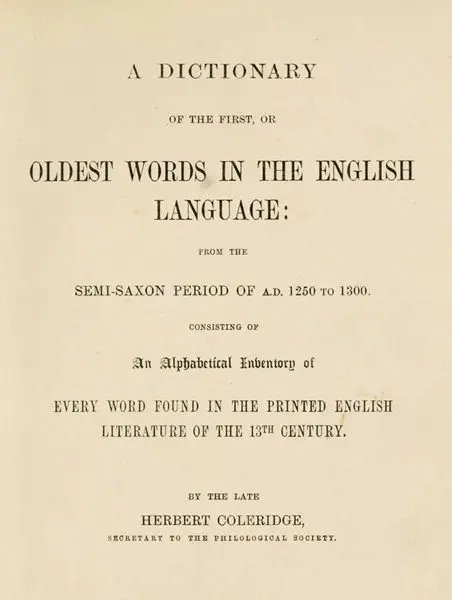
"A Dictionary of the First or Oldest Words in the English Language" by Herbert Coleridge is a scholarly dictionary written in the mid-19th century. This work serves as a comprehensive inventory of every word found in the printed English literature of the 13th century, aiming to establish a historical perspective on the evolution of the English language. The book is likely to attract linguists, philologists, and those interested in the historical development of English vocabulary. The opening of the dictionary begins with a preface where Coleridge outlines the purpose and significance of the work. He emphasizes that the dictionary aims to provide a foundational resource for the Philological Society's larger project of compiling an English dictionary. In this section, he notes how the words are organized, detailing the approach taken to illustrate both older forms and modern equivalents, along with the systematic referencing of etymological roots. The introduction also acknowledges contributions from various scholars, highlighting a collaborative effort toward documenting the lexicon of early English literature and its historical context.
Introduction adapted from the source catalogue; source summaries may be automatically generated.
Free to read · English · 55,821 words · No account needed
MAKE TIME FOR A GOOD BOOK
On by default. Untick to stop anonymous reading totals. Each page counts after 10 seconds in view. How this works.
Anonymous counting is on unless you have switched it off.
Heavy, adj. Wright’s L. P. p. 102
---- v. a. == make heavy. Ps. xxxi. 4
Hechil, sb. == a hackle, for carding flax. Rel. Ant. ii. p. 176. Dut.
hekel
Hedge, sb. RG. 211. AS. hege
Hedy ? Wright’s L. P. p. 22. Probably a mistake for ‘hendy.’ Cf. Ib. p. 27
Heed, sb. Wright’s L. P. p. 112
---- v. a. HD. 2389
Heel, sb. HD. 898
Heelspor, sb. == footstep. Ps. xlviii. 6; lv. 7
Heifer, sb. Pol. S. 239
Height, sb. Wright’s L. P. p. 110
Heir, sb. RG. 377, 469
Heisugge, sb. == hedge-sparrow. O. and N. 505. AS. hege-sugge. Bosworth on the authority of More gives ‘Sugga,’ a bird which feeds on figs. Lye explains ‘hege-sugge’ as ‘cicada,’ ‘vicetula’
Helde, sb. == loyalty. RG. 285. AS. held, heol (see Beowulf, 2459).
Germ. hold
---- == virtue? Wright’s L. P. p. 37
Helde, v. n. == incline, lean to. Wright’s L. P. p. 24. Ps. lxi. 4; AS.
healdan, hyldan
Hele, v. n. == drink health to a person? Alys. 1048
Hele, v. a. == cover [hile]. HD. 2082; part, ‘y-heled.’ RG. 305, 457; ‘hole.’ Alys. 4203. AS. hélan
Heling [hiling], sb. == cover. Ps. lx. 5
---- == lurking-place [heolyng]. Alys. 6188
Hell, sb. RG. 322
Helm, sb. == helmet. RG. 186, 401
Help, sb. RG. 556
---- v. a. RG. 3; part. ‘y-hoppe.’ RG. 405
Helper, sb. Ps. li. 9
Helpless, adj. RG. 134, 237
Helplich, adj. == helpful. Fall and P. 4
Heme, sb. == man. Pol. S. 156; O. and N. 1113. Fr. homme
Heme, adj. == pleasant, agreeable? Wright’s L. P. p. 32. Perhaps for ‘queme,’ ‘q-heme,’ the first letter being dropped to preserve the alliteration
Hemming, sb. == fringe. Ps. xliv. 14
Hemp, sb. HD. 782. AS. hænep
Hen, sb. RG. 404
Henceforth, adv. [heþenforth]. Ps. cxii. 2
Hence, adv. [henne]. RG. 476; [hunne], Fragm. Sci. 98; [honne], O. and N. 879. Probably an old gen. of ‘hen’ (cf. Germ. ‘hin’), used absolutely
Hende, adj. == kind, courteous. RG. 404. See on this word Gloss. Rem. to
Laȝ. iii. 445
Hende, sb. == duck. HD. 1241. ON. önd. AS. ened
Hendely, adv. == well, cleverly. 167 B.
Hene, adj. == abject. Pol. S. 150. AS. hean
Hente, v. a. == take. RG. 460; part. ‘yhent.’ RG. 185. AS. hentan
Henyng, in Wright’s L. P. p. 36, a misprint for ‘hevyng.’ See Hoving
Heowes, == high men? Wright’s L. P. p. 114. AS. heáh
Herb, sb. 41 β
Herbarewen, v. a. == harbour, lodge. Pol. S. 240; part. ‘herborwed.’ HD. 742. ON. herbergja, Fr. herbergier
Herbegi, sb. == a lodging. Signa ante Jud. 168
Herber, sb. == arbour, garden. Alys. 331. Lat. herbarium
Herboru, sb. == lodging. HD. 742
Herd, sb. Ps. lxiii. 3
---- v. a. == keep, preserve. Ps. xlix. 19; lvii. 3. AS. hyrdan
Here, adv. RG. 369; ‘here and there.’ 42 B.
Here, sb. == army. Alys. 2101, 5266. AS. here
Here, vb. == to bless, praise. See Herie
Herebefore, adv. 1239 B.
Hereby, adv. 938 B.
Hereof, adv. RG. 364
Hereto, adv. 137 B.
Hergonge, sb. == invasion. O. and N. 1189. AS. heregang
Herie, v. a. == praise. Ps. xcix. 4; [here]. Body and Soul, 200. AS.
hérian
Your reading position is saved on this browser. Take it to another device with a library code. Reading pages adapt to text, rather than matching a printed edition.
BEHIND THE BOOK
This eBook is for the use of anyone anywhere in the United States and most other parts of the world at no cost and with almost no restrictions whatsoever. You may copy it, give it away or re-use it under the terms of the Project Gutenberg License included with this eBook or online at www.gutenberg.org. If you are not located in the United States, you will have to check the laws of the country where you are located before using this eBook. Read the source licence.
The original source file, including credits and licence, is retained by this library. Request an original-format copy at no charge. Please include the book title and Project Gutenberg identifier #41975.
KEEP YOUR CURIOSITY GOING
Cécile Tormay

Moritz Busch
John L. Ransom
Frances Wright
Cécile Tormay

Mabel Potter Daggett