THE CLASSIC COLLECTION✦An outlaw’s diary: the CommuneCLASSIC FREE BOOKS
An outlaw’s diary: the Commune
Cécile Tormay
THE CLASSIC COLLECTION · 1862
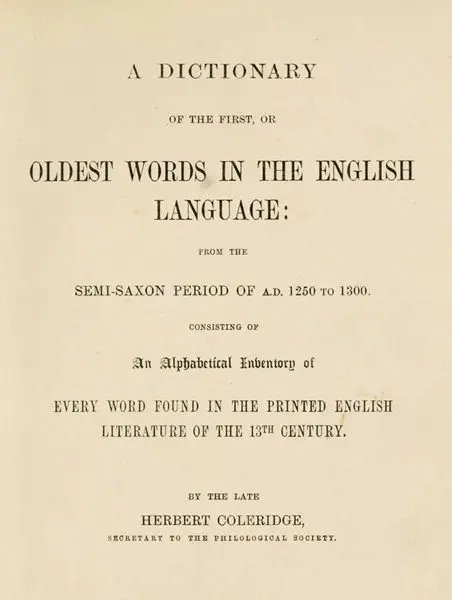
"A Dictionary of the First or Oldest Words in the English Language" by Herbert Coleridge is a scholarly dictionary written in the mid-19th century. This work serves as a comprehensive inventory of every word found in the printed English literature of the 13th century, aiming to establish a historical perspective on the evolution of the English language. The book is likely to attract linguists, philologists, and those interested in the historical development of English vocabulary. The opening of the dictionary begins with a preface where Coleridge outlines the purpose and significance of the work. He emphasizes that the dictionary aims to provide a foundational resource for the Philological Society's larger project of compiling an English dictionary. In this section, he notes how the words are organized, detailing the approach taken to illustrate both older forms and modern equivalents, along with the systematic referencing of etymological roots. The introduction also acknowledges contributions from various scholars, highlighting a collaborative effort toward documenting the lexicon of early English literature and its historical context.
Introduction adapted from the source catalogue; source summaries may be automatically generated.
Free to read · English · 55,821 words · No account needed
MAKE TIME FOR A GOOD BOOK
On by default. Untick to stop anonymous reading totals. Each page counts after 10 seconds in view. How this works.
Anonymous counting is on unless you have switched it off.
Yse, sb. == iron. Alys. 5149. AS. ísen. Germ. eisen
Ysome, adv. == together. RG. 3, 83. AS. gesome
Ysteot, part. == fastened. Alys. 2768
Yswerred, adj. == having necks. Alys. 6264. AS. sweora
Yswowe, part. == in a swoon. Alys. 2262. See Swoon
Ythe, adv. == easily. K. Horn, 61. AS. eáðe
Ythen, part. == flourishing, prosperous. See The, vb.
Ytolde, part. == pitched (of a tent). Alys. 5901. See Teld
Yvortrou, adj. == mistrustful. RG. 342
Ywrye. See Wreon
Ȝarewe, adj. == ready. O. and N. 378. AS. gearo
Ȝark, v. a. == make ready. RG. 391, 399. Alys. 1411. AS. gearcian
Ȝarte. See Yare
Ȝavre, == ever, or perhaps ‘of yore.’ O. and N. 1178
Ȝef. See If
Ȝeines. Rel. S. i. 16. Probably instead of ‘tharto ȝeines’ we should read ‘thar toȝeines’ == there against, i.e. against death. AS. to-geánes
Ȝeme, sb. == care. RG. 135. AS. gýman
---- v. a. == care for, take care of. HD. 131
Ȝeming, sb. == care. Ps. cxl. 3
Ȝende, sb. == end. RG. 169
Ȝene ? O. and N. 843
Ȝeode, vb. == went. See Go
Ȝep, adj. == active. Wright’s L. P. p. 39; bold. O. and N. 465. AS. gæp
Ȝephede, sb. == boldness. O. and N. 683
Ȝerne, adv. == earnestly. RG. 487. AS. georne
Ȝete, v. a. == cast. Body and Soul, 189. See yhete
Ȝeuȝede, sb. == youth, q. v.
Ȝeve, == give, q. v.
Ȝeynchar, sb. == repentance. Wright’s L. P. p. 46. See App. to Mapes’s Poems, p. 343. AS. cerran with ‘gen’
Ȝeȝe, v. n. == jog along, go. Wright’s L. P. p. 111
---- v. a. == jog. Pol. S. 158
Ȝif. See If
Ȝiverness, sb. == avarice. Rel. S. vii. 11. AS. gífer
Ȝoe, == she. See under He
Ȝoe, == joy, q. v.
Ȝokkyn, sb. == joking? Wright’s L. P. p. 50
Ȝomere, adj. == sorrowful. O. and N. 415. AS. geomor
Ȝonie, == yawn, q. v.
Ȝoȝelinge, sb. == chattering, gabbling. O. and N. 40. Probably the same as the later ‘gaggle,’ which is used of a confused noise of people talking, in the Poem on the Deposition of Richard II. p. 18, and of geese, in Churchyard’s Pleasant Conceit penned in Verse (1593), cited in the pref. to Nash’s Pierce Penniless. (Shaksp. Soc.’s ed.), p. xviii.
Ȝraihand. See Thraying
Ȝuling. See Yelling
Ȝulle. See Yell
Ȝulpe. See Yelp
Ȝulping. See Yelping
Baru, add AS. bearh
Bert, v. n. == crepitum ventris edere. Rel. Ant. ii. p. 211
Bidde, v. n. == need, ought. HD. 1733. Another form of ‘bud.’ Dan. bör. Compare Chaucer’s ‘bode.’ Rom. Rose, 790
Birde, sb. For HD. 2760, read Wright’s L. P. pp. 25, 30
Birde, vb. pret. == it behoved. HD. 2760. ON. byrjar. Dan. bör
Brol ? Rel. Ant. ii. 192
By, v. a. == to defame. Manuel des Pecches, 1355. ON. bía, maculare
Ferblet. Possibly ‘suffused with blood,’ ‘sanguine.’ Cf. ‘forbled,’ in the Anturs of Arthur at Tarne Wathelan, st. 51
Your reading position is saved on this browser. Take it to another device with a library code. Reading pages adapt to text, rather than matching a printed edition.
BEHIND THE BOOK
This eBook is for the use of anyone anywhere in the United States and most other parts of the world at no cost and with almost no restrictions whatsoever. You may copy it, give it away or re-use it under the terms of the Project Gutenberg License included with this eBook or online at www.gutenberg.org. If you are not located in the United States, you will have to check the laws of the country where you are located before using this eBook. Read the source licence.
The original source file, including credits and licence, is retained by this library. Request an original-format copy at no charge. Please include the book title and Project Gutenberg identifier #41975.
KEEP YOUR CURIOSITY GOING
Cécile Tormay

Moritz Busch
John L. Ransom
Frances Wright
Cécile Tormay

Mabel Potter Daggett