THE CLASSIC COLLECTION✦An outlaw’s diary: the CommuneCLASSIC FREE BOOKS
An outlaw’s diary: the Commune
Cécile Tormay
THE CLASSIC COLLECTION · 1862
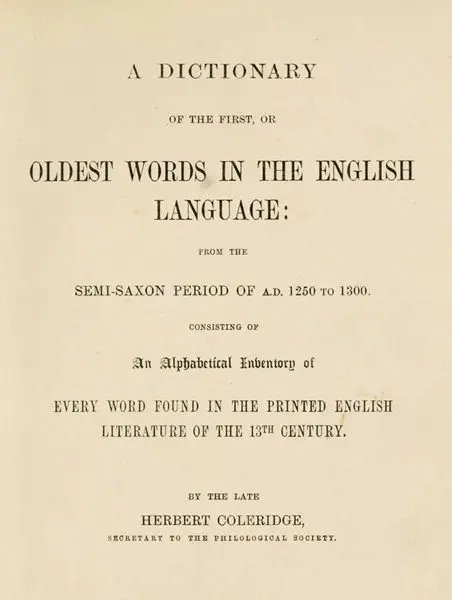
"A Dictionary of the First or Oldest Words in the English Language" by Herbert Coleridge is a scholarly dictionary written in the mid-19th century. This work serves as a comprehensive inventory of every word found in the printed English literature of the 13th century, aiming to establish a historical perspective on the evolution of the English language. The book is likely to attract linguists, philologists, and those interested in the historical development of English vocabulary. The opening of the dictionary begins with a preface where Coleridge outlines the purpose and significance of the work. He emphasizes that the dictionary aims to provide a foundational resource for the Philological Society's larger project of compiling an English dictionary. In this section, he notes how the words are organized, detailing the approach taken to illustrate both older forms and modern equivalents, along with the systematic referencing of etymological roots. The introduction also acknowledges contributions from various scholars, highlighting a collaborative effort toward documenting the lexicon of early English literature and its historical context.
Introduction adapted from the source catalogue; source summaries may be automatically generated.
Free to read · English · 55,821 words · No account needed
MAKE TIME FOR A GOOD BOOK
On by default. Untick to stop anonymous reading totals. Each page counts after 10 seconds in view. How this works.
Anonymous counting is on unless you have switched it off.
Sweetly, adj. == sweet. Wright’s L. P. p. 52
---- adv. Rel. Ant. ii. p. 193
Sweetness, sb. Wright’s L. P. p. 68. St Swithin, 156
Swell, v. n. Body and Soul, 23; pret. ‘sval.’ O. and N. 7
Sweng, sb. == trick. O. and N. 795. Lit. ‘a blow.’ AS. sweng. Cf. our expression, ‘a stroke of policy’
Swepe, v. a. == strike, exercise. Ps. lxxvi. 7. AS. swip. ON. svipa
Sweping, sb. == a blow. Ps. xxxiv. 15; xxxvii. 18
Swere, v. a. == oppress. Fragm. in Warton, H. E. P. vol. i. p. 22. OHG.
swárjan.
Swice, v. n. == cease. O. and N. 336; [iswike]. O. and N. 927
---- == faint, fail. Wright’s L. P. p. 48. AS. swícan
Swich, adv. == as if. O. and N. 566
Swift, adj. Ps. xli. 5
Swiftly, adv. Ps. cxlii. 7
Swike, v. a. == deceive. RG. 115. AS. swícan, swícol
---- sb. == deceiver, traitor RG. 105
Swikedhede, sb. RG. 357
Swikedom. RG. 512, 569. AS. swícdom
Swikeldom, sb. O. and N. 163
Swikelhede, sb. O. and N. 162
Swile, v. a. == wash. HD. 919. AS. swilian
Swim, v. n. 410 and 164 β. AS. swimman
Swine, sb. RG. 376
Swing, v. a. == strike, beat. Wright’s L. P. p. 84. AS. swingan
Swink, v. n. == labour. RG. 41; [iswinc]. Moral Ode, st. 94
---- sb. == labour, toil. RG. 40, 234. AS. swincan
Swire, sb. == neck. Wright’s L. P. p. 35. AS. sweora
Swise. See Swithe
Swithe, adj. == vehement. 340 β. AS. swíð
---- adv. == quickly. HD. 140, 682
---- == very. HD. 111; [swise], O. and N. 1565. AS. swíðe
Swithe, v. a. == burn; pret. ‘swath.’ Ps. cv. 18; part. ‘swithand.’ Ps. lxxxii. 15. ON. svíða
Swiving, sb. == fornication. Pol. S. 69 Swed. besofva
Swo, adv. == so. Wright’s L. P. p. 49
---- == as if. O. and N. 76
Swoon, sb. RG. 13. AS. a-swunan
---- v. n. [swoghen]. Alys. 5857; part. ‘yswowe.’ RG. 290. Alys. 2262; ‘yswawe.’ Alys. 2379
Swooning, sb. K. Horn, 454
Swop, sb. == blow. Marg. 30. ON. svipa
Sword, sb. RG. 395
Swore, == sworn? Pol. S. 157
Swored, sb. == neck. Alys. 974
Sworre, sb. == war. RG. 413
Swost. Rel. S. v. 152. The rhyme requires ‘swoȝ,’ for which ‘swost’ is probably an error; ‘swoȝ’ may mean ‘throw.’ See Hall. s. v. Swot
Swynde, v. n. == waste away. Pol. S. 150. AS. swindan
Sygaldry, sb. == nonsense, trick. Alys. 7015. Fr. singe, singerie? In the Manuel des Pecches, v. 503, ‘sygaldry’ occurs as a verb, in the sense of ‘sing charms, or spells’
Syke, == sigh, q. v.
Synagogue, sb. Ps. lxxxi. 1
Sytoling, sb. == playing on the citole or guitar. Alys. 1043
Sywe, Sywinge. See Sue
Sywete. See Suite
Tabard, sb. == a short cloak worn by military personages. Alys. 5476. Fr. tabar. Ital. tabaro. See Wright’s Vocabb. p. 133
Tabernacle, sb. RG. 20
Tabor, sb. == a musical instrument. RG. 396
Taboring, sb. Alys. 925
Tache, v. a. == spot or stain. Wright’s L. P. p. 70. Fr. tache
Tail, sb. (cauda). RG. 416. AS. tǽgel
---- == retinue of followers. RG. 305
Your reading position is saved on this browser. Take it to another device with a library code. Reading pages adapt to text, rather than matching a printed edition.
BEHIND THE BOOK
This eBook is for the use of anyone anywhere in the United States and most other parts of the world at no cost and with almost no restrictions whatsoever. You may copy it, give it away or re-use it under the terms of the Project Gutenberg License included with this eBook or online at www.gutenberg.org. If you are not located in the United States, you will have to check the laws of the country where you are located before using this eBook. Read the source licence.
The original source file, including credits and licence, is retained by this library. Request an original-format copy at no charge. Please include the book title and Project Gutenberg identifier #41975.
KEEP YOUR CURIOSITY GOING
Cécile Tormay

Moritz Busch
John L. Ransom
Frances Wright
Cécile Tormay

Mabel Potter Daggett