THE CLASSIC COLLECTION✦An outlaw’s diary: the CommuneCLASSIC FREE BOOKS
An outlaw’s diary: the Commune
Cécile Tormay
THE CLASSIC COLLECTION · 1862
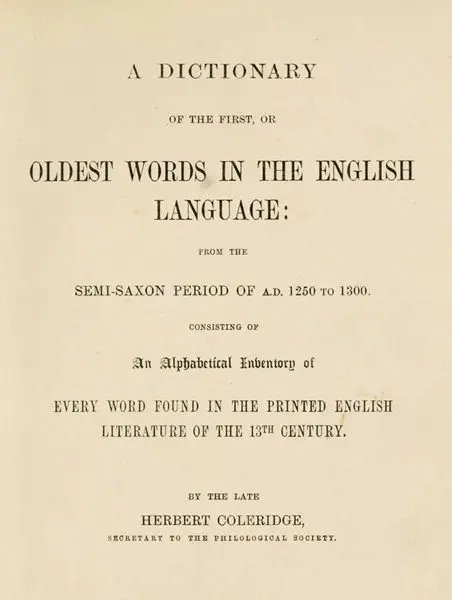
"A Dictionary of the First or Oldest Words in the English Language" by Herbert Coleridge is a scholarly dictionary written in the mid-19th century. This work serves as a comprehensive inventory of every word found in the printed English literature of the 13th century, aiming to establish a historical perspective on the evolution of the English language. The book is likely to attract linguists, philologists, and those interested in the historical development of English vocabulary. The opening of the dictionary begins with a preface where Coleridge outlines the purpose and significance of the work. He emphasizes that the dictionary aims to provide a foundational resource for the Philological Society's larger project of compiling an English dictionary. In this section, he notes how the words are organized, detailing the approach taken to illustrate both older forms and modern equivalents, along with the systematic referencing of etymological roots. The introduction also acknowledges contributions from various scholars, highlighting a collaborative effort toward documenting the lexicon of early English literature and its historical context.
Introduction adapted from the source catalogue; source summaries may be automatically generated.
Free to read · English · 55,821 words · No account needed
MAKE TIME FOR A GOOD BOOK
On by default. Untick to stop anonymous reading totals. Each page counts after 10 seconds in view. How this works.
Anonymous counting is on unless you have switched it off.
Amiral. See Admiral.
Amiss, adj. == wrong. RG. 451
Amiture, sb. == friendship. Alys. 3975
Amone, v. a. == remember. Sign. 147. AS. gemunan
Among, prep. == inter. 6 B.
---- adv. == at intervals, O. and N. 6
Amorrow, [amorwe] adv. == on the morrow. 49 B.
Amount, v. n. RG. 497 == ‘vor it ne ssolde amounti noȝt,’ == because it would amount to or avail nought. So the prep. is omitted in Alys. 6020
‘That amounted fyve hundred thousand
Knyghtis to armes, so Y fynde’
Amour, sb. == lover. Alys. 951
---- == love. Alys. 4573
Amty, == empty, RG. 17
Amye, sb. == friend. Alys. 1834. Fr. ami.
An, indef. art. == before a cons. RG. 537, ‘an stounde.’ So also RG. 261
---- == and. q. v.
---- == on, ‘an urthe’ 174 B. ‘an honde’ == on hand. 71 B. This last phrase seems to have dropped the meaning of ‘soon,’ ‘now,’ which it bears in Semi-Saxon. See Gloss. Rem. to Laȝamon, vol. iii. p. 474. ‘an hei’ == on high. RG. 537. ‘an hoker’ == with scorn. 710 B. ‘an aunter’ == on adventure, i. e. in peril. RG. 311, an oniwar == at unawares
---- == one, in acc. ‘anne.’ RG. 223.
An, v. a. == grant, allow, consent. O. and N. 1738. AS. unnan
Analing, == annihilating? Alys. 2166. Sic. Weber in Gloss. Hall s. v. suggests ‘avaling’ as the true reading == pulling down from their horses, which is probably correct
Anarrow, v. a. == confine, cramp up; hence, dishearten? Alys. 3346
Ancestor, sb. 428 B.
Anchor, sb. HD. 521
Ancre, sb. == nun. RG. 380
And, conj. RG. 368; [an]. O. and N. 31. RG. 264
Aneli, adj. == lonely. Ps. xxiv. 16
Anente, prep. == opposite to, over against. Fragm. Sci. 241
Anethered, part. == lowered, conquered. RG. 217
Angel, sb. RG. 254, 255, 441
Angrom, sb. == anguish. Ps. cxviii. 143. AS. ange
Anguish, sb. RG. 172, 442
Anguishous, adj. == full of anguish, RG. 157, 222
Anhang, v. a. == hang up, 3 s. pres. ‘an-hoð,’ O. and N. 1644. pret. ‘an-hung.’ RG. 509. AS. an-hòn
Anhit, v. a. == hit, strike. RG. 185
Anight, adv. == during the night. 681 B.
Anilepi, adj. == one, single. HD. 2107. AS. ‘æn-lipig’. Cf. ‘lepi ane.’ Ps. xiii. 1; lii. 2, 4
Anise, sb. Wright’s L. P. p. 26
Annoy, v. a. RG. 420, 487; part. annuid. RG. 550
---- sb. [anuy]. 1618 B.
Anness, sb. == solitude. Ps. ci. 7; [anes]. Ps. liv. 8
Anlace, [alinlaz] == a long knife worn at the girdle. HD. 2554
Anleth, sb. == countenance. Ps. xxvi. 9. AS. andwlita
Anon, adv. RG 373.
Anoniwar, adv. == at unawares. RG. 511
Anonrightes, adv. == immediately. Alys. 824
Another, adj. RG. 379, 444
Anoven, adv. == above. K. Horn, 638
Anoward, adv. upon. RG. 419
Anstond, v. a. == stand. RG. 267
Answer, vb. a. RG. 431
---- sb. RG. 500
Anthem, [anteyn] sb. St Dunstan, 185
Antre, sb. == adventure. RG. 35
---- v. a. == risk. Alys. 4265
Any, adj. == ‘any thing.’ 410 B.
---- == any one [eny]. RG. 376
Apair, v. a. == impair. St. Kath. 152
Apayed, == pleased. RG. 117, 1642 B. Fr. apaier, paier
Ape, sb. Alys. 4344
Apertly, adv. == openly. RG. 375
Apeyre, v. a. == impair. RG. 279
Apliȝt, adv. == immediately, at once. RG. 511
Your reading position is saved on this browser. Take it to another device with a library code. Reading pages adapt to text, rather than matching a printed edition.
BEHIND THE BOOK
This eBook is for the use of anyone anywhere in the United States and most other parts of the world at no cost and with almost no restrictions whatsoever. You may copy it, give it away or re-use it under the terms of the Project Gutenberg License included with this eBook or online at www.gutenberg.org. If you are not located in the United States, you will have to check the laws of the country where you are located before using this eBook. Read the source licence.
The original source file, including credits and licence, is retained by this library. Request an original-format copy at no charge. Please include the book title and Project Gutenberg identifier #41975.
KEEP YOUR CURIOSITY GOING
Cécile Tormay

Moritz Busch
John L. Ransom
Frances Wright
Cécile Tormay

Mabel Potter Daggett