THE CLASSIC COLLECTION✦The psychology of the criminalCLASSIC FREE BOOKS
The psychology of the criminal
Leo Markun
THE CLASSIC COLLECTION · 1927
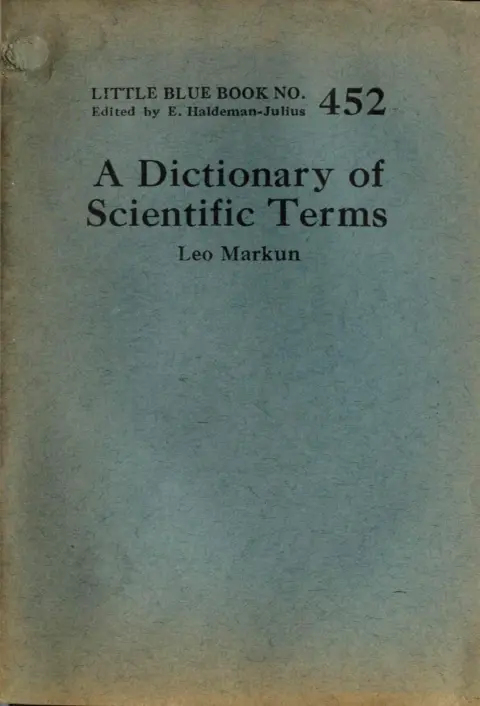
A dictionary of scientific terms by Leo Markun is a compact scientific reference compiled in the early 20th century. It is a dictionary designed for general readers and students, offering brief, accessible explanations of terminology across physics, chemistry, biology, and related disciplines; its likely topic is clarifying scientific vocabulary and method.
The preface sets a modest scope, stressing clarity for non-specialists, noting disagreements over meanings, and including boundary terms that test what counts as science (such as common sense, philosophy, theology, superstition). The main text is an alphabetical glossary from Abasia to Zymurgy, covering taxonomy, anatomy, geology and geological eras, elements and symbols, units and instruments, mathematical and physical concepts, and core ideas in evolution, genetics, psychology, and astronomy. Entries are concise and practical, often giving plural forms, variant spellings, prefixes and roots, and cross-disciplinary notes, with occasional viewpointed remarks on scientific method (hypothesis, theory, law), contested notions (instinct, ether, vitalism), and the value of metrics and standards. The result is a quick-reference guide aimed at orienting readers to essential meanings and usage across the scientific lexicon.
Introduction adapted from the source catalogue; source summaries may be automatically generated.
Free to read · English · 11,972 words · No account needed
MAKE TIME FOR A GOOD BOOK
On by default. Untick to stop anonymous reading totals. Each page counts after 10 seconds in view. How this works.
Anonymous counting is on unless you have switched it off.
Darwinism. Organic evolution in general. The theory that the origin of species is due to natural selection, as developed by Charles Robert Darwin. All biologists worthy of the name believe in evolution, but by no means all accept Darwinism in the narrow sense.
Declination. The angular distance of a heavenly body north or south of the celestial equator. The deviation of a magnetic needle from true north.
Decurrent. Extending downward, as the base of a leaf.
Dehydrate. Remove water, dry.
Dendrology. The scientific study of trees.
Devonian. Of the geological formation between the Silurian and the
Carboniferous.
Dew point. The temperature at which the air is saturated with
water-vapor.
Diadelphous. Formed into two bundles. (Of stamens.)
Diandrous. With two stamens.
Dielectric. Insulating, insulator of electricity.
Diesel engine. An internal combustion motor which compresses the air highly and which successfully burns oil which is unsuitable for the ordinary motor of an automobile.
Disease. Malady. Of some foods and drinks, an impairment in quality
caused by bacteria.
Dissipation of energy. The change of energy to such a form that it
cannot be used to do work.
Dissociate. Ionize, decompose, split up.
Doldrums. A region of calms and light winds near the equator.
Dolichocephalic. Long-headed, having a skull with the breadth less than four-fifths of the length.
Drug. A medicine, a medicinal agent, especially one of vegetable
origin.
Dynamics. The branch of physics dealing with forces.
Dyne. The amount of force that acts for a single second on a mass of one gram to give it a velocity of one centimeter per second.
Eccentric. Not concentric to a given circle. Arranged to change
rotary motion back and forth.
Echinoderm. One of a class of animals including the sea-urchins.
Eclipse. Of a heavenly body, obscured by passing between it and the observer or its source of light.
Ecliptic. The apparent orbit of the sun.
Ecology. The science dealing with the relations between organisms and
their environment.
Economics. The science of wealth, especially of its production,
distribution, and consumption.
Edentate. Toothless or without canine teeth.
Effect. See Cause.
Efferent. Carrying outward or away.
Efficiency. The ratio between the amount of work put into a machine and the amount derived from it.
Efflorescence. The loss of water of crystallization.
Electricity. A peculiar condition of the molecules of a body or of the ether surrounding the molecules, or else a sort of fluid or other matter in the form of small bodies called electrons. It is easier to tell what electricity does or how it is produced than to define it, especially since physicists have not been able to agree about its precise nature.
Electrode. Either pole of a cell.
Your reading position is saved on this browser. Take it to another device with a library code. Reading pages adapt to text, rather than matching a printed edition.
BEHIND THE BOOK
This eBook is for the use of anyone anywhere in the United States and most other parts of the world at no cost and with almost no restrictions whatsoever. You may copy it, give it away or re-use it under the terms of the Project Gutenberg License included with this eBook or online at www.gutenberg.org. If you are not located in the United States, you will have to check the laws of the country where you are located before using this eBook. Read the source licence.
The original source file, including credits and licence, is retained by this library. Request an original-format copy at no charge. Please include the book title and Project Gutenberg identifier #77721.
KEEP YOUR CURIOSITY GOING

John Muir

Asa Gray
Asa Gray

Florence Nightingale
Elizabeth Robins Pennell
Denison Olmsted